What this MBTI type test measures
The Myers-Briggs framework describes preferences across four dichotomies. Each pair reflects where you typically draw energy, gather information, make decisions, and organize your outer life.
-
Extraversion (E) / Introversion (I)
Whether you recharge through people and activity or through solitude and depth. Neither pole is better; both describe legitimate energy patterns.
-
Sensing (S) / Intuition (N)
Whether you trust concrete facts and present realities or patterns, possibilities, and future implications when taking in information.
-
Thinking (T) / Feeling (F)
Whether you prioritize logic and consistency or values and interpersonal impact when evaluating choices. Everyone uses both; this names your typical first filter.
-
Judging (J) / Perceiving (P)
Whether you prefer plans, closure, and structure or flexibility, spontaneity, and open options in how you organize daily life.
How it works
Three steps from first question to your four-letter type. Click Start Test to open the interactive quiz in a full-screen modal.
-
Answer 60 statements
Rate how much you agree with each plain-language preference item on a five-point scale from strongly disagree to strongly agree.
-
Items map to four dichotomies
Your responses roll up into preference scores for E/I, S/N, T/F, and J/P. The stronger side in each pair becomes one letter of your type.
-
View your type with clarity scores
Results show your four-letter type, preference clarity per dimension, and a plain-language profile with strengths and growth edges.
Take the MBTI type test
Rate 60 preference statements on a five-point agree-disagree scale. Your answers are scored across four dichotomies and mapped to one of sixteen type profiles such as INTJ, ENFP, or ISTJ.
Opens in a focused modal. No account required. Results stay on screen.
What your result means
Your four-letter type summarizes which pole you leaned toward in each dichotomy. Clarity percentages show how decisive those leanings were in this session.
| Clarity range | Typical reading |
|---|---|
| Below 25% | Slight preference; you may switch styles by context |
| 25 to 44% | Moderate preference; noticeable but not rigid |
| 45 to 69% | Clear preference; shows up regularly in daily choices |
| 70% and above | Very clear preference; strongly shapes your default approach |
A near-even split on one dichotomy does not mean the model failed. It may reflect genuine flexibility, situational adaptation, or items answered while tired or distracted.
The four MBTI dichotomies at a glance
Each letter in a type code comes from one preference pair. Together the four choices produce sixteen possible combinations.
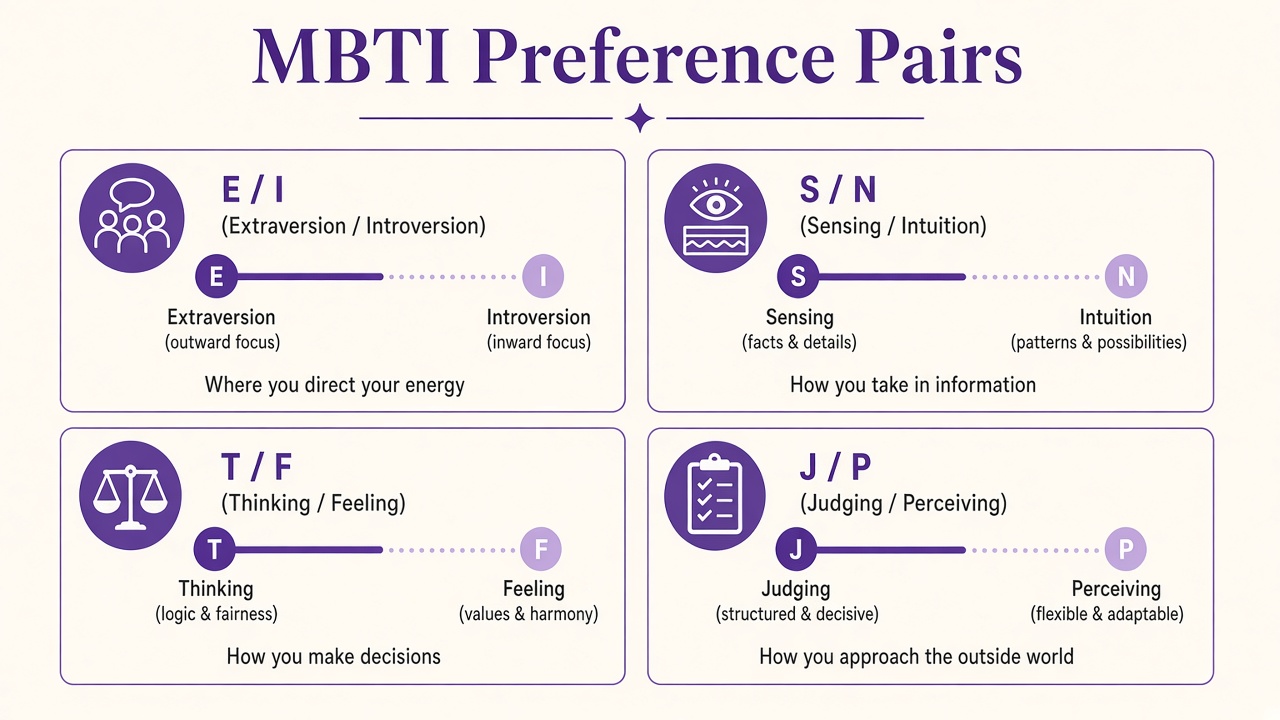
Type theory groups preferences into four independent dichotomies. Research debates how discrete these categories are, but the framework remains widely used for team communication and career reflection.
What this test can and cannot tell you
Can tell you
- Your self-reported preference on four well-known dichotomies
- A four-letter type label with clarity scores per dimension
- Plain-language strengths and growth edges for your type profile
- A starting point for reflection, conversation, or further reading
Cannot tell you
- Official Myers-Briggs Type Indicator certification or report
- Whether you should be hired, promoted, or admitted to a program
- A fixed identity that will never change across your lifetime
- Clinical diagnoses or mental health conditions
Understanding the MBTI type framework
The Myers-Briggs approach grew from Carl Jung's theory of psychological types and was later codified by Katharine Briggs and Isabel Briggs Myers. Their aim was practical: help people understand different ways of perceiving and deciding, especially in workplaces and classrooms. Today the four-letter code appears in career coaching, team workshops, and popular culture, often alongside trait models such as the Big Five personality test.
Unlike continuous trait scores, MBTI-style instruments sort preferences into dichotomies. Extraversion versus introversion describes energy direction. Sensing versus intuition captures information style. Thinking versus feeling names decision filters. Judging versus perceiving reflects outer structure. Combining one pole from each pair yields sixteen types, from ISTJ to ENFP. Researchers debate whether preferences are truly binary, but many readers find type language memorable for discussion.
MBTI versus Big Five: which should you take?
If you want percentile trait scores grounded in decades of factor-analytic research, start with the Big Five. If you want a categorical type label and team-friendly vocabulary, MBTI-style quizzes may feel more intuitive. Many people take both and compare: a high-extraversion Big Five score often aligns with an E in type results, but the frameworks are not interchangeable. Browse more options on our personality psychology hub or read our editorial policy for how we review test content.
Commercial MBTI assessments include professional interpretation and validated item sets. Free online versions, including ours, use shorter inventories and plain-language paraphrases. Treat any web result as a conversation starter. For hiring, clinical, or high-stakes decisions, use instruments designed and supervised for that purpose.
Workshop facilitators sometimes pair type codes with DISC workplace style test results because DISC emphasizes pace and communication habits in groups. For meme-culture hierarchy language, compare with our sigma personality test on independence. The frameworks are independent; comparing them can highlight where your preferences and your visible behavior align or diverge.
MBTI type test FAQ
Is this the official Myers-Briggs Type Indicator (MBTI)?
No. Our quiz uses plain-language items inspired by four-preference type theory. It is shorter, unproctored, and not the commercial MBTI instrument.
How long does the MBTI type test take?
Most people finish in about 10 minutes. There are 60 agree-disagree statements. You can pause and return in the same browser session.
What do the four letters in my MBTI type mean?
Each letter reflects a preference pole: E or I (energy), S or N (information), T or F (decisions), and J or P (structure). Together they form a four-letter type such as INFJ or ESTP.
Can my MBTI type change over time?
Core preferences can be stable, but scores may shift with mood, stress, and life stage. Treat results as a snapshot for reflection, not a permanent label.
How is MBTI different from the Big Five personality test?
MBTI sorts preferences into four dichotomies and a four-letter type. The Big Five measures continuous trait scores on five dimensions. Many people use both for different kinds of self-reflection.
Can employers use this MBTI test for hiring?
No. This is an educational self-report quiz. It is not normed, proctored, or validated for selection or screening decisions.
Who reviewed this content?
Dr. James Whitfield, PhD, reviewed the test framing and result explanations. See our editorial policy for review standards.
Reviewed by