What this DISC personality test measures
DISC maps four behavioral dimensions that describe how you tend to act under everyday pressure. The model emphasizes pace, priorities, and communication style rather than deep motivation patterns or clinical traits.
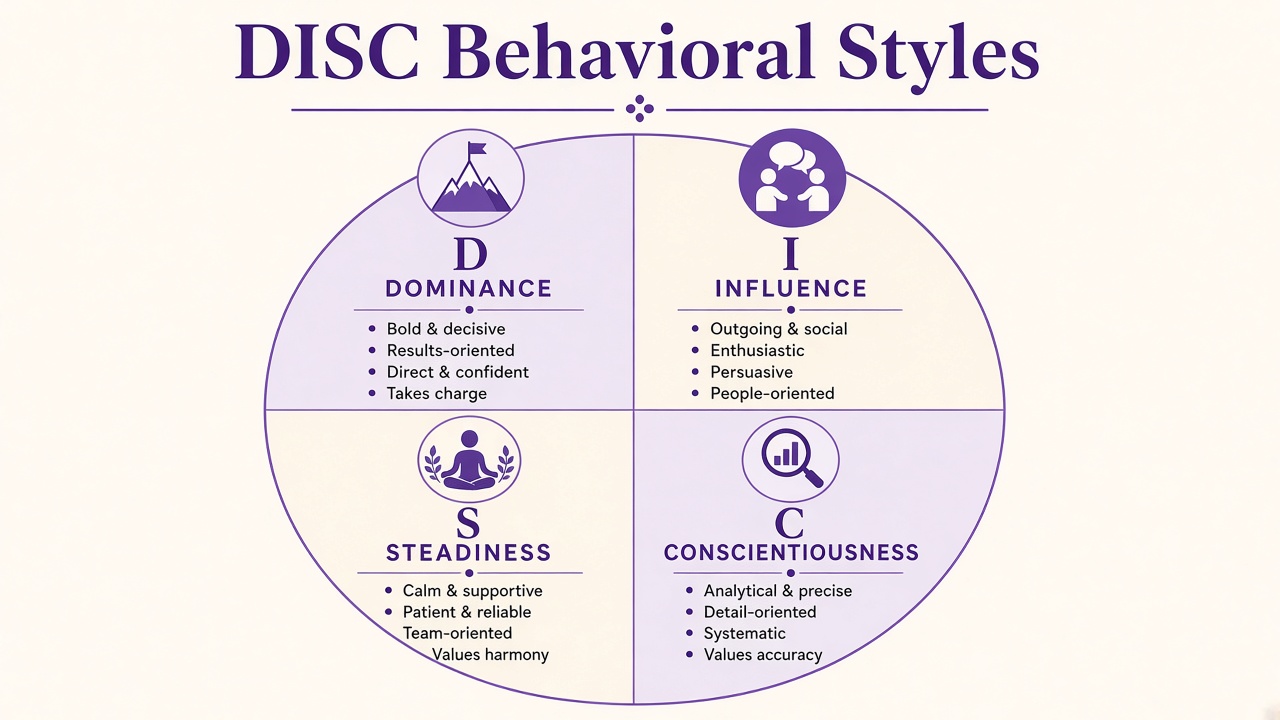
D · Dominance
Directness, decisiveness, and results focus.
I · Influence
Enthusiasm, persuasion, and social energy.
S · Steadiness
Patience, loyalty, and cooperative pace.
C · Conscientiousness
Accuracy, analysis, and quality standards.
How it works
Three steps from first question to your style profile. Click Start Test to open the interactive quiz in a full-screen modal.
Answer 48 statements
Rate how much you agree with each behavioral item on a five-point scale. You click Next after each answer; nothing auto-advances.
Items map to four dimensions
Your answers accumulate scores across Dominance, Influence, Steadiness, and Conscientiousness. The two highest dimensions form your blend.
View primary, secondary, and chart
Results show your primary style, secondary influence, dimension chart, strengths, growth edges, and pressure notes.
Take the DISC personality test
Rate 48 behavioral statements on a five-point agree-disagree scale. Your answers reveal a likely primary DISC style plus a secondary influence that shapes how you show up in teams and conversations.
Opens in a focused modal. No account required. Results stay on screen.
What your result means
Your primary style is the dimension with the highest item score. Your secondary style is the next highest, such as DI for Dominance with Influence influence or SC for Steadiness with Conscientiousness influence.
| Score pattern | Typical reading |
|---|---|
| One dimension clearly highest | Strong primary style; secondary adds nuance to communication |
| Two dimensions close together | Blended style; read both profiles for a fuller picture |
| Flat scores across dimensions | Many neutral answers or mixed contexts; retake when focused |
The four DISC dimensions
DISC is often shown as a circle or quadrant chart. Each letter captures a cluster of related behaviors that tend to appear together in workplace and social settings.
What this test can and cannot tell you
Can tell you
- Your self-reported behavioral emphasis across four DISC dimensions
- A primary and secondary style blend with plain-language profiles
- Strengths, growth edges, and pressure patterns for reflection
- A starting point for team communication or personal development reading
Cannot tell you
- Official Everything DiSC or Wiley certification results
- Whether you should be hired, promoted, or placed on a team
- Clinical diagnoses or mental health conditions
- A fixed label that never shifts with role or context
Understanding the DISC framework
William Moulton Marston, a psychologist best known for his work on lie detection and the creation of Wonder Woman, described four emotional response patterns in his 1928 book Emotions of Normal People. Industrial psychologists later translated those ideas into the DISC letters used in training rooms today: Dominance, Influence, Steadiness, and Conscientiousness. Publishers such as Wiley now market commercial DISC profiles, but the core idea remains behavioral: how you prioritize problems, people, pace, and procedures.
Unlike the Big Five trait inventory, which reports continuous scores on openness and related domains, DISC emphasizes situational behavior. A high Dominance score does not mean you dominate every conversation; it suggests you may default to direct action when goals are unclear. That makes DISC popular in leadership workshops even though researchers debate how stable the four buckets are across cultures.
Readers often compare DISC to type frameworks. The MBTI preference test sorts cognitive style into sixteen four-letter types. The Enneagram motivation quiz names nine core drives and wing patterns. For informal sigma versus hierarchy language from internet culture, see our sigma personality test on independence. DISC sits closest to everyday teamwork language: who moves fast, who builds rapport, who stabilizes change, and who checks the details. Browse more options on our personality psychology hub.
Free online DISC quizzes shorten the item count and use plain-language paraphrases. Treat any result as a hypothesis to explore, not a boxed identity. For hiring, clinical, or high-stakes decisions, use instruments designed and supervised for that purpose.
DISC personality test FAQ
What does DISC stand for?
DISC names four behavioral dimensions: Dominance, Influence, Steadiness, and Conscientiousness. The model describes how people tend to act in work and social settings, not fixed identity labels.
Who created the DISC model?
Psychologist William Moulton Marston outlined the emotional basis for DISC in his 1928 book Emotions of Normal People. Later researchers and publishers adapted his ideas into workplace assessment tools.
How long does this DISC personality test take?
Most people finish in about 8 minutes. There are 48 agree-disagree statements. You can pause and return in the same browser session.
What is a primary and secondary DISC style?
Your primary style is the dimension with the highest item score. Your secondary style is the next highest. Together they form a blend label such as DI or SC that adds nuance to your profile.
How is DISC different from MBTI or Big Five?
DISC focuses on observable behavioral pace and priorities in groups. MBTI maps four preference dichotomies into sixteen types. The Big Five measures continuous trait scores across five research domains.
Can I use this DISC test for hiring?
No. This quiz is for personal reflection and education only. Commercial DISC instruments used in hiring require validated administration and professional interpretation.
Who reviewed this content?
Dr. James Whitfield, PhD, reviewed the test framing and result explanations. See our editorial policy for review standards.
Reviewed by