What this mental age test measures
This mental age test estimates how young or mature your everyday attitudes feel. It looks at six lifestyle dimensions rather than intelligence, memory, or academic skill.
Lifestyle preferences
Spontaneity, social energy, and comfort with routine.
Sense of humor
Meme culture, dry wit, and how you use jokes in conversation.
Responsibility habits
Planning, deadlines, and follow-through on commitments.
Nostalgia
Attachment to past eras, keepsakes, and familiar media.
Risk and adventure
Caution versus thrill-seeking in travel, purchases, and debate.
Technology comfort
Adoption of new apps, social feeds, and troubleshooting confidence.
How it works
Three steps from first question to your mental age band. Click Start Test to open the interactive quiz in a full-screen modal.
Answer 45 statements
Rate how much you agree with each lifestyle item on a five-point scale. There is no timer and no auto-advance.
Items map to six dimensions
Younger-leaning and older-leaning answers shift a base score across humor, nostalgia, risk, and related habits.
View age, band, and dimension leans
Results show an estimated mental age with a range, a descriptive band, optional chronological age comparison, and per-dimension notes.
Take the mental age test
Rate 45 attitude statements on a five-point agree-disagree scale. Your answers produce an estimated mental age between 12 and 70 with a plain-language band and dimension chart.
Opens in a focused modal. No account required. Results stay on screen.
What your result means
Your mental age is a weighted sum of lifestyle lean scores, clamped between 12 and 70. The band label describes attitude patterns, not intelligence or moral worth.
| Age band | Typical reading |
|---|---|
| 12 to 22 · Playful Spirit | High novelty, humor, and spontaneity; lower caution scores |
| 23 to 32 · Youthful Mind | Mix of fun-seeking and early adult responsibility |
| 33 to 45 · Balanced Adult | Even blend across structure and flexibility |
| 46 to 58 · Seasoned Perspective | Strong planning, nostalgia, and risk caution |
| 59 to 70 · Timeless Wisdom | Deliberate choices, tradition, and low appetite for noise |
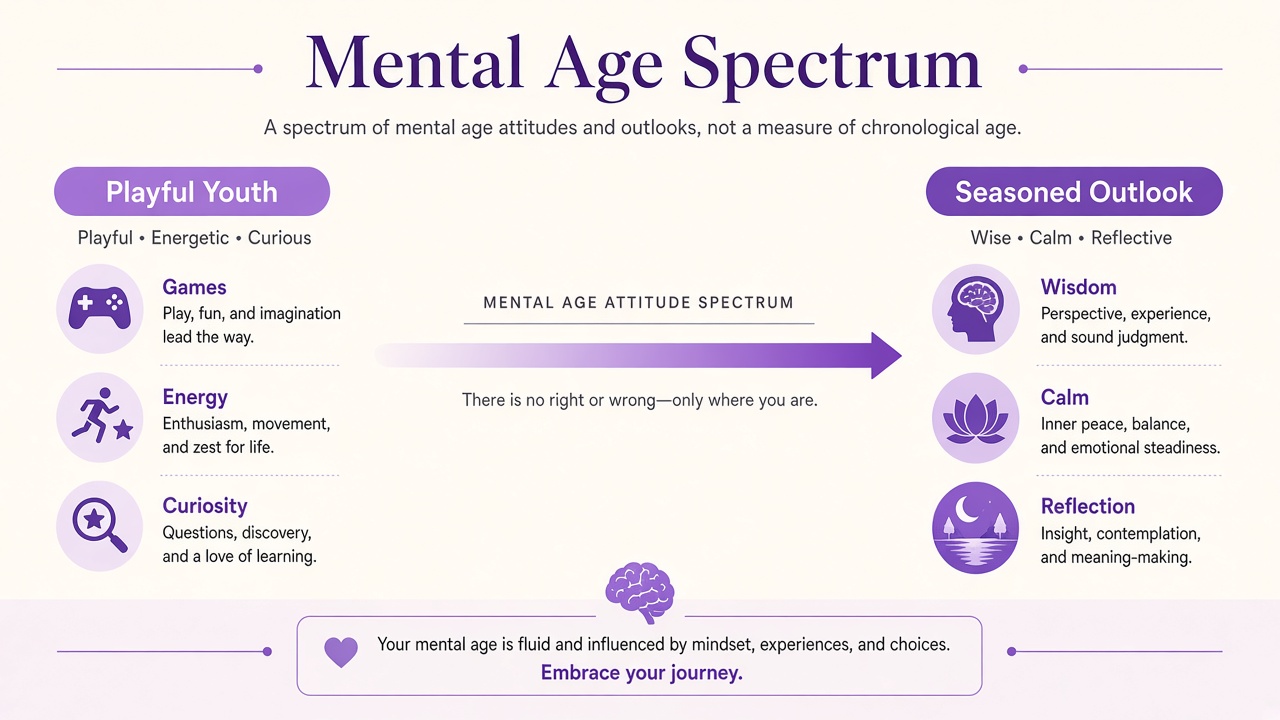
Mental age spectrum
The chart below shows how attitude items push your score along a playful age spectrum. High scores on responsibility and nostalgia pull older; humor and risk items pull younger.
What this test can and cannot tell you
Can tell you
- How young or mature your self-reported habits feel today
- Which lifestyle dimensions lean younger, older, or balanced
- A playful comparison note if you enter your chronological age
- A conversation starter about priorities, humor, and nostalgia
Cannot tell you
- IQ, cognitive ability, or brain development stage
- Whether you are immature or wise as a person
- Clinical developmental or neuropsychological findings
- A fixed label that should guide hiring or medical decisions
Mental age quizzes vs personality frameworks
Popular mental age quizzes spread through social media as light entertainment. They usually ask about music taste, bedtime, meme humor, and comfort with new technology. Psychologists distinguish that kind of attitude snapshot from formal cognitive aging research, which uses controlled tasks and normed instruments.
On The Quiz Hub we label the distinction clearly. The Big Five personality test measures continuous trait scores backed by decades of factor research. The Enneagram test maps nine motivation types with wing notes. The MBTI type test sorts four preference dichotomies into a four-letter profile. Mental age adds a single age-style number for people who want a quick, shareable result without learning a full framework.
Sample item: agreeing that you still laugh at cartoons pushes your score younger on humor. Agreeing that you research major purchases carefully pushes older on risk-taking. Neither item tests intelligence. For meme-culture independence framing, compare with our sigma personality test on quiet confidence. Browse more options on our personality psychology hub or read how we review quizzes in our editorial policy.
Mental age test FAQ
What is a mental age test?
A mental age test on The Quiz Hub estimates how young or old your attitudes feel based on lifestyle preferences, humor, responsibility habits, nostalgia, risk-taking, and technology comfort. It is playful self-reflection, not a measure of intelligence.
Is this mental age test an IQ test?
No. This quiz does not measure cognitive ability, memory, or problem-solving speed. Items focus on everyday attitudes and habits. For trait-based personality research, see our Big Five personality test instead.
How long does the mental age test take?
Most people finish in about 7 minutes. There are 45 agree-disagree statements. You can pause and return in the same browser session.
What does my mental age number mean?
Your score is mapped to a band from Playful Spirit (12-22) through Timeless Wisdom (59-70). The number describes attitude patterns in your answers, not biological brain age or developmental stage.
Can I compare mental age to my real age?
Yes, optionally. After results load you can enter your chronological age for a gap note, or skip that step entirely. The comparison is descriptive, not a judgment.
How is mental age different from MBTI or Enneagram?
MBTI maps four preference dichotomies into a type label. The Enneagram focuses on nine motivation patterns. Mental age sums lifestyle lean scores into a single age-style estimate with dimension notes.
Who reviewed this content?
Dr. James Whitfield, PhD, reviewed the test framing and result explanations. See our editorial policy for review standards.
Reviewed by