What this ambivert test measures
This ambivert test screens three patterns researchers associate with the flexible middle of the introvert-extrovert spectrum. Each domain uses original agree-disagree statements about how your social energy shifts by situation, not clinical symptom frequency.
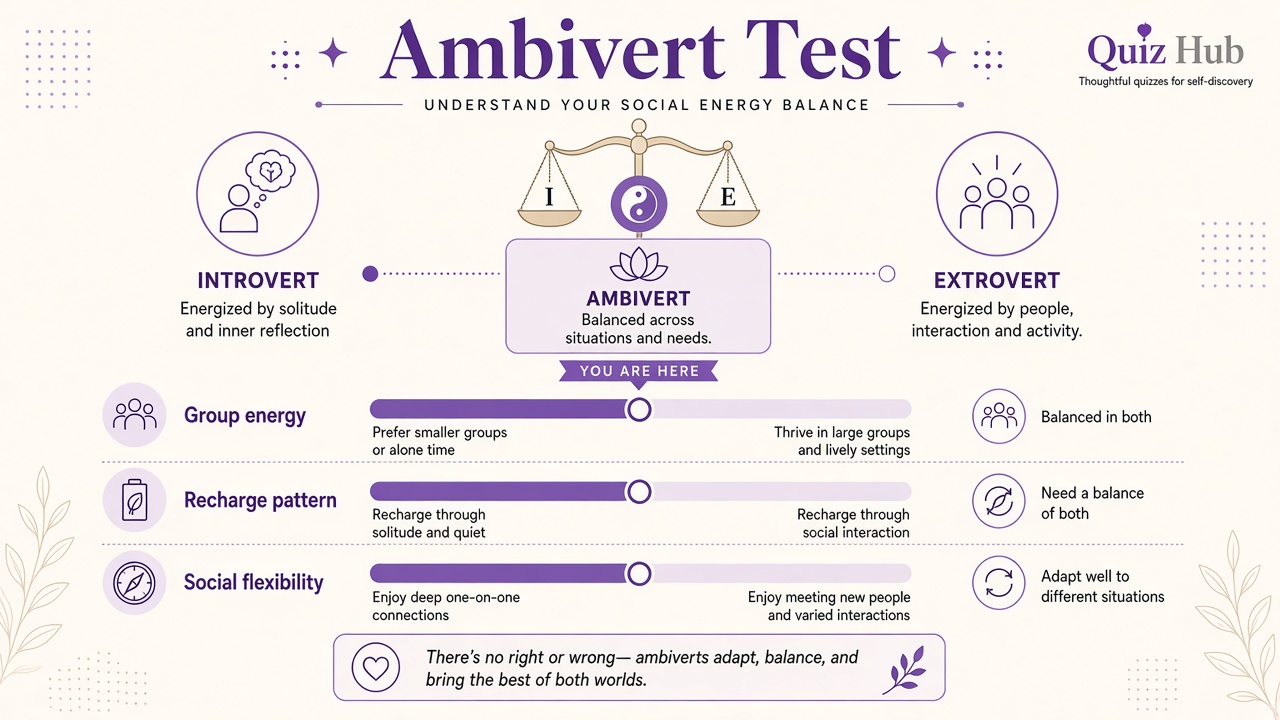
Group energy
Situational enjoyment of gatherings, parties, and group plans versus preference for smaller settings or early exits.
Recharge pattern
Whether solitude, company, or a mix restores you after social interaction and busy social weeks.
Social flexibility
How much your outgoing or quiet mode adapts to context rather than staying fixed across every setting.
Energy style, not inhibition
Results describe where you sit on the social energy spectrum. They do not measure shyness, social anxiety, or personality disorder traits.
How it works
Three steps from first statement to your ambivert strength score and lean percentages. Click Start Test to open the interactive quiz in a full-screen modal.
Answer 22 statements
Rate how much you agree with each item on a five-point scale from strongly disagree to strongly agree. There is no timer and no auto-advance between items.
Items map to poles and domains
Introvert-leaning, extrovert-leaning, and situational flexibility items combine into lean percentages and an ambivert strength score across three domains.
View strength score and lean chart
Results show ambivert strength (0 to 100), introvert and extrovert lean percentages, a band label, domain bars, and practical next steps for your social rhythm.
Take the ambivert test
Rate 22 statements about situational social energy, recharge needs, and flexible social style. Your answers produce an ambivert strength score, introvert and extrovert lean percentages, and a three-domain breakdown chart.
Opens in a focused modal. No account required. Results stay on screen.
What your result means
Your ambivert strength score blends balance between introvert and extrovert lean percentages with agreement on situational flexibility items. Introvert lean and extrovert lean always sum to 100%. Higher strength scores mean a more balanced, context-adaptive middle style on this snapshot.
| Ambivert band | Strength range | Typical reading |
|---|---|---|
| Strong Ambivert | 72 to 100 | Balanced lean percentages with high situational flexibility; social energy shifts by context |
| Moderate Ambivert | 48 to 71 | Flexible style with a visible introvert or extrovert lean when context does not decide for you |
| Leaning Style | 0 to 47 | Clearer introvert or extrovert energy default with less middle-ground flexibility on these items |
Social energy domains and the ambivert middle
The diagram below shows how group energy, recharge pattern, and social flexibility feed an ambivert strength score alongside introvert and extrovert lean percentages. A high group-energy bar with moderate flexibility, for example, can still produce a strong ambivert result if lean percentages stay balanced.
What this test can and cannot tell you
Can tell you
- How balanced your introvert and extrovert lean percentages look today
- An ambivert strength score and band label for energy-style reflection
- Which domain bar (group energy, recharge, flexibility) scores highest
- When to explore our introvert extrovert test, MBTI test, or shyness test for sibling constructs
Cannot tell you
- Your official Myers-Briggs type or any proprietary personality classification
- Whether you have social anxiety disorder or any clinical diagnosis
- Whether you are shy, confident, or likable in others' eyes
- A fixed label that will never change across life stages or cultures
Ambiversion and the introvert-extrovert spectrum
Psychologist Hans Eysenck studied extraversion as a trait dimension in the mid-twentieth century, linking it to arousal and social stimulation preferences. Later popular psychology stretched that line into introvert, ambivert, and extrovert language even though many research scales treat extraversion as continuous rather than three fixed boxes. Ambiverts describe people who enjoy groups sometimes, need recharge after intense social weeks, and shift style by context rather than always seeking or avoiding company.
The Quiz Hub built this ambivert test as a balanced-middle sibling to our introvert extrovert test. Where the spectrum quiz maps energy across the full range, this quiz weights situational flexibility and lean balance to produce an ambivert strength score plus introvert and extrovert lean percentages. That pairing helps readers who suspect they sit in the middle but still lean one direction when mood and context do not decide.
| The Quiz Hub test | What it adds |
|---|---|
| Introvert extrovert test | Full-spectrum social energy mapping across introvert and extrovert poles, not middle-focused strength scoring |
| MBTI test | Four dichotomies and sixteen type profiles with clarity percentages, not ambivert strength scoring |
| Shyness test | Social inhibition, group discomfort, and approach behavior, not energy gain or loss from company |
| This ambivert test | Ambivert strength score, introvert and extrovert lean percentages, and three social energy domain bars |
Sample item: agreeing that whether you enjoy a group event depends on the people and mood raises your social flexibility domain score and can increase ambivert strength when lean percentages stay near fifty-fifty. Agreeing that large group settings drain you faster than quiet time alone pulls introvert lean upward. If inhibition in groups matters more than energy drain, take our shyness test. Browse more screeners on our mental health and clinical hub or read how we review quizzes in our editorial policy.
Ambivert test FAQ
What does this ambivert test measure?
This ambivert test measures self-reported agreement with statements about situational social energy: enjoying groups sometimes, needing recharge after interaction, and shifting between outgoing and quiet modes. It produces an ambivert strength score plus introvert and extrovert lean percentages. It describes energy style patterns, not a clinical diagnosis.
What is an ambivert?
An ambivert is someone whose social energy sits in the flexible middle of the introvert-extrovert spectrum. Ambiverts may enjoy parties on some weekends and crave solitude on others. They adapt to context rather than always seeking crowds or always avoiding them. This test quantifies that middle style with a strength score and lean percentages.
How is ambiversion different from introversion or extroversion?
Introversion and extroversion describe where you typically gain or lose social energy. Ambiversion describes balance and situational flexibility between those poles. You can lean introvert or extrovert while still scoring as a moderate ambivert if your style shifts by context. Our introvert extrovert test covers the full spectrum; this quiz focuses on the balanced middle.
How is ambiversion different from shyness?
Ambiversion is about social energy and preference for company versus solitude. Shyness is about inhibition, self-consciousness, and hesitation when approaching others. An ambivert can be socially confident yet still need recharge time. A shy extrovert may want connection but hold back. Take our shyness test if inhibition matters more than energy drain.
What do the ambivert strength score and lean percentages mean?
The ambivert strength score (0 to 100) reflects how balanced and context-flexible your answers look. Higher scores mean introvert and extrovert lean percentages sit closer together with strong agreement on situational items. Introvert lean and extrovert lean percentages show which pole you tilt toward when context does not force a choice. They always sum to 100%.
Who reviewed this content?
Dr. Elena Vasquez, PhD, reviewed the test framing and result explanations. See our editorial policy for review standards.
Reviewed by