What this chronotype test measures
This chronotype test estimates morningness versus eveningness from everyday timing preferences. It groups 22 self-report items into four domains that mirror research on circadian rhythm without using the full clinical Morningness-Eveningness Questionnaire.
Wake and sleep rhythm
Preferred wake time, ease getting up, natural alarm-free mornings, and typical sleep onset.
Peak performance timing
When thinking, exercise, and creative work feel easiest relative to noon and sunset.
Daily habit timing
Meal timing, meeting preference, caffeine pattern, and tolerance for late social plans.
Self-perceived rhythm
How you and others describe your morning-evening identity and light sensitivity.
How it works
Three steps from first question to your chronotype band. Click Start Test to open the interactive quiz in a full-screen modal.
Answer 22 timing items
Rate each statement on a five-point scale from much more evening to much more morning. There is no timer and no auto-advance between items.
Items map to four domains
Your answers accumulate a morningness percentage across wake-sleep rhythm, peak performance, daily habits, and self-perception.
View chronotype and spectrum
Results show a Morning Lark, Intermediate, or Night Owl label, a spectrum marker, domain bars, and schedule tips.
Take the chronotype test
Rate 22 chronotype statements on a five-point morning-evening scale. Your answers produce a morningness percentage and one of three chronotype bands with a domain breakdown chart.
Opens in a focused modal. No account required. Results stay on screen.
What your result means
Your morningness percentage is the sum of scored items normalized to 0 through 100, where higher scores mean more morning preference. The chronotype label groups that score into plain-language bands. Domain bars show whether wake timing or peak focus drives your overall result.
| Chronotype band | Morningness range | Typical reading |
|---|---|---|
| Night Owl | 0 to 37% | Later peak alertness, slower ease with dawn alarms, stronger evening social or creative energy |
| Intermediate | 38 to 61% | Mixed timing that adapts to school or work but may feel misaligned at extremes |
| Morning Lark | 62 to 100% | Earlier wake preference, sharper morning focus, earlier wind-down toward sleep |
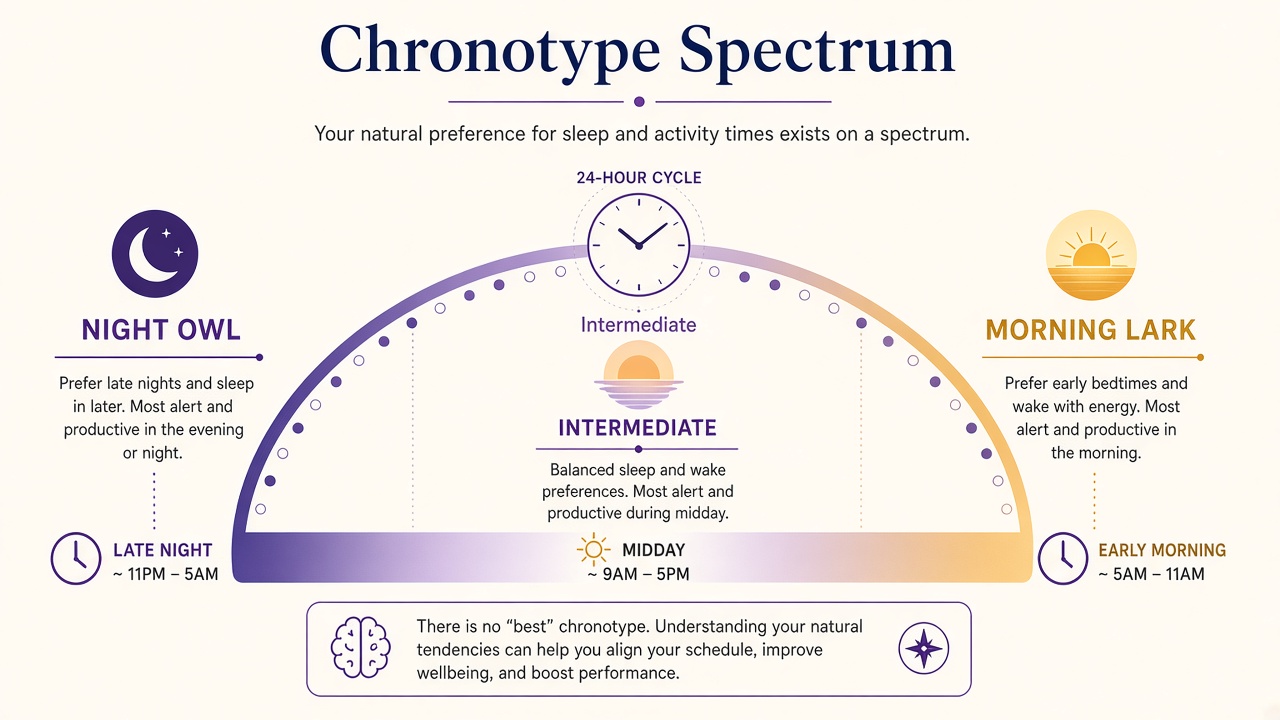
Morning Lark to Night Owl spectrum
The diagram below shows how morningness scores map across the three bands. A high wake-sleep score with low peak-performance score might still land you in Intermediate if your creative hours skew evening.
What this test can and cannot tell you
Can tell you
- Whether your self-reported timing leans morning, evening, or mixed
- A morningness percentage and three-band label for schedule planning
- Which of four domains score highest toward morning or evening preference
- A starting point for conversations about sleep hygiene or shift alignment
Cannot tell you
- Whether you have insomnia, sleep apnea, or delayed sleep phase disorder
- Official MEQ scores comparable to published research norms
- Whether you should be hired, cleared for safety-critical night work, or medicated
- A fixed identity that never shifts with light, age, or life season
Horne and Ostberg chronotype research
In 1976, Jim Horne and Olov Ostberg published the Morningness-Eveningness Questionnaire (MEQ) in the Journal of Interdisciplinary Cycle Research. Their 19-item scale helped researchers classify people along a morningness-eveningness continuum using preferred wake time, peak alertness, and self-rated rhythm. The MEQ became one of the most cited self-report tools in circadian rhythm research, though full validation requires the published instrument and norms, not a shortened web quiz.
The Quiz Hub built this chronotype test as an abbreviated, plain-language screener inspired by MEQ themes. It uses 22 original items and three result bands (Morning Lark, Intermediate, Night Owl) rather than the five MEQ categories. That trade-off favors readability for casual users while naming the Horne and Ostberg (1976) source honestly.
| The Quiz Hub test | What it adds |
|---|---|
| Big Five personality test | Trait percentiles (conscientiousness may correlate with routine but not chronotype directly) |
| MBTI type test | Cognitive preference types, not circadian timing |
| Mental age lifestyle quiz | Playful nostalgia and humor attitudes, not sleep phase |
| This chronotype test | Morningness score with wake, peak, habit, and self-perception domains |
Sample item: agreeing that your clearest thinking happens before noon raises your peak-performance morningness score. Agreeing that you still feel sharp after 10:00 p.m. lowers it through reverse scoring. Social jet lag from weekend sleep-ins can temporarily skew answers, so retake after a typical work week if results feel off. Browse more options on our personality psychology hub or read how we review quizzes in our editorial policy.
Chronotype test FAQ
What is a chronotype test?
A chronotype test estimates whether your alertness and sleep preference lean toward morning, evening, or a mix between the two. The Quiz Hub version uses 22 self-report items on wake time, peak focus, daily habits, and self-perception. Results sort into Morning Lark, Intermediate, or Night Owl bands.
How is this related to the Horne and Ostberg MEQ?
The Morningness-Eveningness Questionnaire (MEQ) was published by Horne and Ostberg in 1976 in the Journal of Interdisciplinary Cycle Research. Our online screener is abbreviated and uses original plain-language items inspired by MEQ themes. It is not the published 19-item MEQ and is not validated for research or clinical use.
What do Morning Lark, Intermediate, and Night Owl mean?
Morning Lark (62 to 100% morningness) suggests earlier wake preference and sharper morning focus. Intermediate (38 to 61%) sits between extremes and often adapts to schedules. Night Owl (0 to 37%) suggests later peak alertness and slower ease with very early alarms. Bands describe preference, not sleep quality or discipline.
Can my chronotype change over time?
Chronotype has a biological component but can shift with age, light exposure, work schedules, and parenting. Treat any result as a snapshot. Shift workers and teenagers often report different patterns than their long-term baseline.
Is this chronotype test a sleep disorder diagnosis?
No. Results are educational self-report only. They cannot diagnose delayed sleep phase disorder, insomnia, or other conditions. See a sleep medicine clinician if you have persistent sleep problems, excessive daytime sleepiness, or safety concerns while driving.
How long does the chronotype test take?
Most people finish in about 5 minutes. There are 22 items on a five-point morning-to-evening scale. You can pause and return in the same browser session.
Who reviewed this content?
Dr. James Whitfield, PhD, reviewed the test framing and result explanations. See our editorial policy for review standards.
Reviewed by