What this sigma personality test measures
The sigma personality test scores four internet-culture dimensions tied to the lone-wolf archetype: how independently you decide, how little you chase rank, how self-reliant you act, and how quietly confident you feel without crowd approval.
Independence
Self-directed choices, solo pace, and freedom from group pressure.
Hierarchy disinterest
Low focus on titles, pecking orders, and status contests.
Self-reliance
Problem-solving and ownership without defaulting to rescue.
Introverted confidence
Steady conviction without performing for an audience.
How it works
Three steps from first question to your sigma band. Click Start Test to open the interactive quiz in a full-screen modal.
Answer 40 statements
Rate how much you agree with each independence-style item on a five-point scale.
Items map to four dimensions
Your answers accumulate scores across independence, hierarchy disinterest, self-reliance, and introverted confidence.
View band and dimension chart
Results show Sigma-dominant, Balanced, or Hierarchy-oriented with a sigma index and dimension breakdown.
Take the sigma personality test
Rate 40 statements on a five-point agree-disagree scale. Your answers reveal a Sigma-dominant, Balanced, or Hierarchy-oriented pattern plus four dimension scores.
Opens in a focused modal. No account required. Results stay on screen.
What your result means
Your sigma index is the average of four dimension percentages. Bands group that index into pop-culture labels for reflection, not scientific typing.
| Band | Sigma index | Typical reading |
|---|---|---|
| Sigma-dominant | 58% or higher | Strong self-direction with low hierarchy focus |
| Balanced | 43% to 57% | Mix of independence and social calibration |
| Hierarchy-oriented | 42% or lower | More attuned to rank, norms, and status signals |
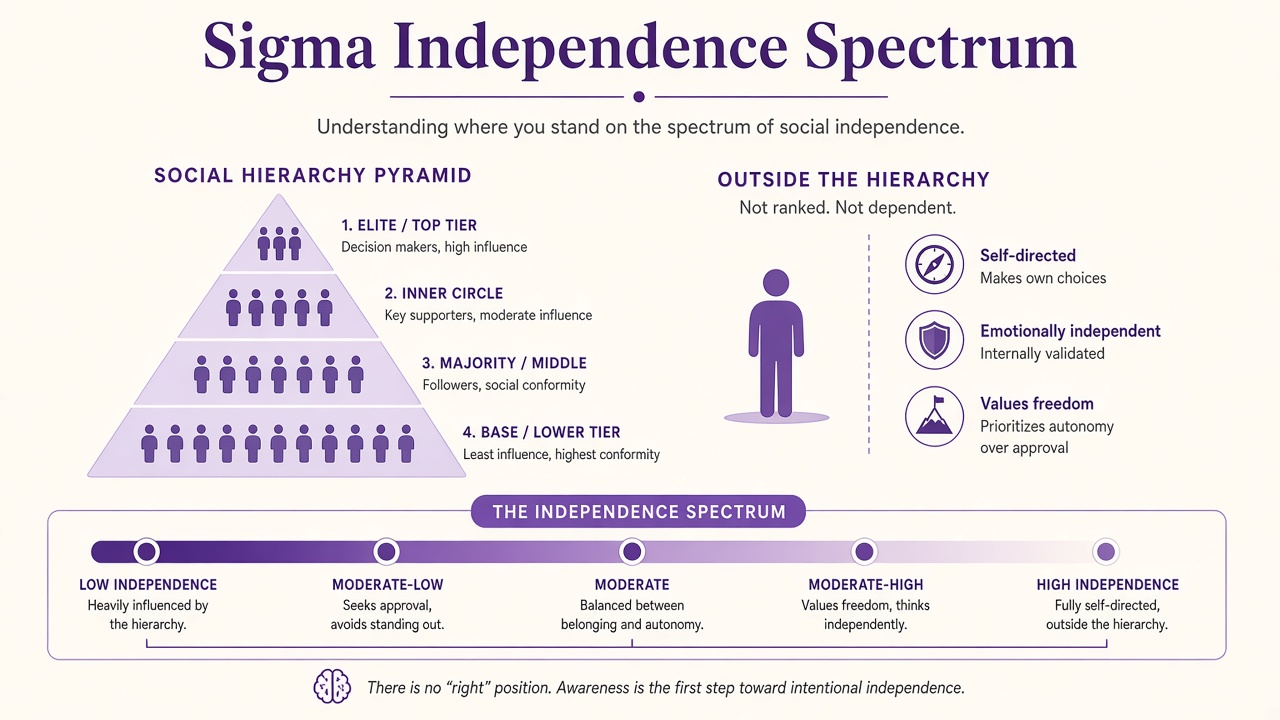
Sigma vs hierarchy spectrum
Internet-culture framing places sigma outside the visible pecking order while alpha and beta language maps to top and middle rungs. This diagram shows where your band sits on that informal spectrum.
What this test can and cannot tell you
Can tell you
- Your self-reported lean toward independence-style patterns
- Four dimension scores with a combined sigma index
- Plain-language strengths, growth edges, and social notes
- A starting point for meme-culture self-reflection
Cannot tell you
- Whether you are truly a sigma male or any gendered archetype
- Clinical diagnoses or personality disorder labels
- Scientific proof of a validated sigma type
- Whether you should be hired, dated, or ranked in a group
Understanding the sigma archetype online
The sigma label spread through forums, YouTube commentary, and self-help corners of social media as a counterpoint to alpha-beta hierarchy talk. Unlike the Big Five, which emerged from decades of factor-analytic research summarized by the American Psychological Association, sigma language is informal storytelling about people who lead their own lives without chasing visible rank.
Sample item: agreeing that you ignore prestige signals like titles or follower counts raises your hierarchy disinterest score. Agreeing that you need constant external validation to feel secure lowers your introverted confidence score. Neither item proves you belong to a tribe; they only describe patterns in your answers today.
Readers often compare sigma results to type frameworks. The MBTI preference test sorts cognitive style into sixteen four-letter types. The Enneagram motivation quiz names nine core drives and wing patterns. For research-backed trait percentiles, try the Big Five personality test. Sigma language is best treated as a conversation starter, not a box. Browse more tests on our personality psychology hub.
Sigma personality test FAQ
What is a sigma personality test?
A sigma personality test on The Quiz Hub scores self-reported independence, hierarchy disinterest, self-reliance, and quiet confidence. Results map to Sigma-dominant, Balanced, or Hierarchy-oriented bands using internet-culture language, not clinical psychology.
Is the sigma personality type scientifically validated?
No. The sigma label comes from online meme culture and self-help forums, not peer-reviewed personality research. This quiz is pop-psych reflection for entertainment and self-awareness, not a validated instrument like the Big Five.
How long does this sigma test take?
Most people finish in about 6 minutes. There are 40 agree-disagree statements. You can pause and return in the same browser session.
What is the difference between sigma, alpha, and beta labels?
In internet-culture framing, alpha suggests visible leadership and status pursuit, beta suggests followership within hierarchy, and sigma suggests independence outside the pecking order. These are informal archetypes, not research categories.
What does a Sigma-dominant result mean?
It means your answers lean toward self-direction, low interest in rank games, and quiet confidence without crowd validation. It describes a pattern in your responses, not a fixed identity or gender role.
How is this different from MBTI or Enneagram?
MBTI maps four preference dichotomies into sixteen types. The Enneagram focuses on nine motivation patterns with wings. This sigma quiz sums four independence-style dimensions into one pop-culture band label.
Who reviewed this content?
Dr. James Whitfield, PhD, reviewed the test framing and result explanations. See our editorial policy for review standards.
Reviewed by