What this maturity test measures
This maturity test looks at how you handle emotion, duty, urges, and other people in everyday life. It groups 42 self-report items into five domains that psychologists and coaches often discuss when they talk about emotional growth.
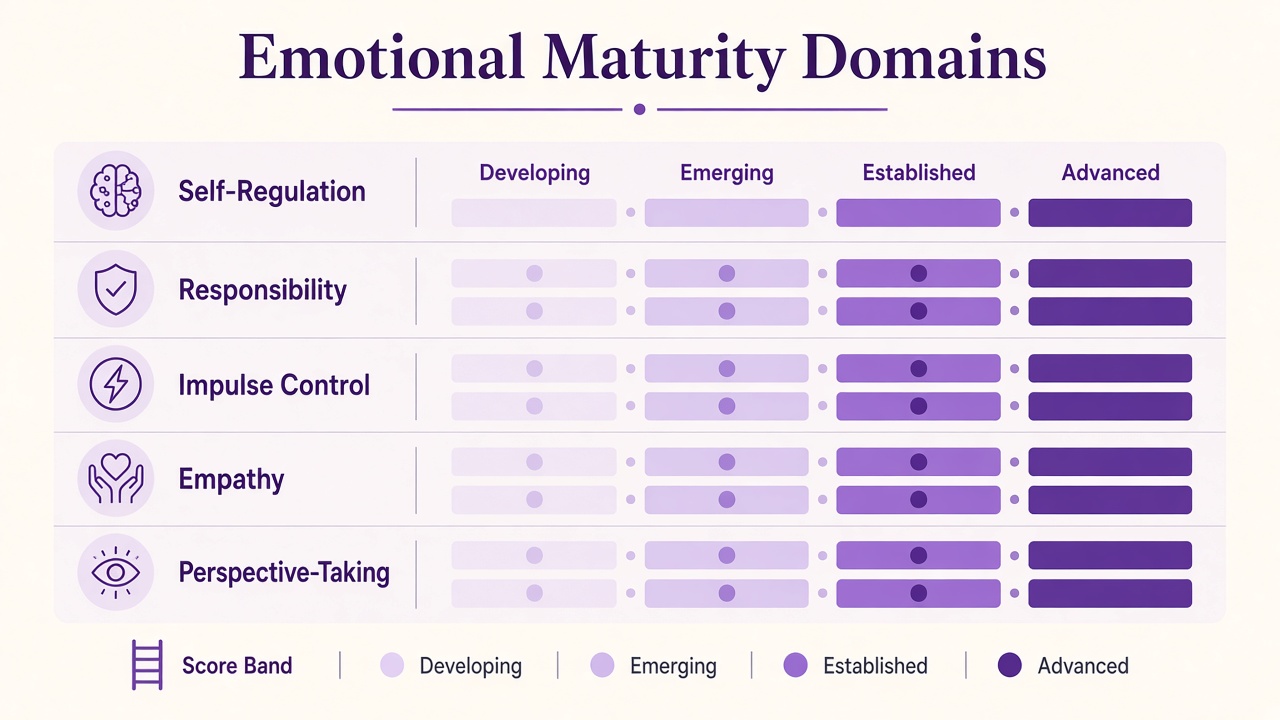
Emotional maturity
Staying composed under criticism, recovering from disappointment, and treating feedback as information.
Responsibility
Keeping promises, owning mistakes, and planning for obligations that affect others.
Impulse control
Pausing before reactive messages, delaying big decisions, and walking away when anger rises.
Empathy
Noticing distress, validating feelings before advising, and adjusting tone when words land badly.
Perspective-taking
Considering other viewpoints, separating people from problems, and updating opinions when facts change.
How it works
Three steps from first question to your maturity band. Click Start Test to open the interactive quiz in a full-screen modal.
Answer 42 statements
Rate how much you agree with each habit on a five-point scale. There is no timer and no auto-advance between items.
Items map to five domains
Your answers accumulate scores across emotional maturity, responsibility, impulse control, empathy, and perspective-taking.
View band and dimension chart
Results show an overall percentage, a band label from Developing through Advanced, per-domain scores, and growth focus notes.
Take the maturity test
Rate 42 maturity statements on a five-point agree-disagree scale. Your answers produce an overall percentage and one of four bands with a dimension breakdown chart.
Opens in a focused modal. No account required. Results stay on screen.
What your result means
Your overall percentage is the sum of scored items normalized to 0 through 100. The band label groups that score into plain-language maturity stages. Domain bars show where you are strongest and where practice may help most.
| Score band | Percentage range | Typical reading |
|---|---|---|
| Developing | 0 to 35% | Several regulation and accountability habits still forming; common under stress or life transitions |
| Emerging | 36 to 55% | Solid instincts with gaps under fatigue, rivalry, or time pressure |
| Established | 56 to 75% | Reliable composure, follow-through, and care for others in most situations |
| Advanced | 76 to 100% | Strong integration across domains; still room for blind spots and context you cannot see |
Five domains of emotional maturity
The diagram below shows how domain scores feed an overall maturity percentage. High empathy with low impulse control, for example, can still land you in an Emerging band until patterns balance out.
What this test can and cannot tell you
Can tell you
- How your self-reported habits cluster across five maturity domains
- A band label and percentage for reflection and goal setting
- Which domains score highest and which may need practice
- A starting point for conversations about growth with a coach or therapist
Cannot tell you
- Whether you are immature or wise as a person
- Clinical personality disorder or developmental diagnoses
- Whether you should be hired, promoted, or trusted in a legal sense
- A fixed label that never changes with effort and feedback
Emotional maturity in psychology and everyday life
Researchers and clinicians often discuss emotional maturity as a set of learnable skills rather than a single trait you are born with. Work by psychologists such as Daniel Goleman on emotional intelligence and by attachment researchers on secure relating both highlight regulation, empathy, and accountable behavior as practices that deepen over time.
Online maturity quizzes vary widely in quality. Some conflate maturity with chronological age or moral superiority. The Quiz Hub separates this test from our mental age lifestyle quiz, which measures humor and nostalgia attitudes rather than interpersonal habits. For research-backed trait scores, the Big Five personality test reports conscientiousness and agreeableness percentiles. The Enneagram test maps nine motivation types with wing notes when you want a type-based growth lens.
Sample item: agreeing that you pause before sending an angry message raises your impulse control score. Agreeing that you validate feelings before offering advice raises empathy. Neither item proves you are mature in every context. Social desirability bias can inflate scores when people answer how they wish they acted rather than how they usually act. Browse more options on our personality psychology hub or read how we review quizzes in our editorial policy.
Maturity test FAQ
What does a maturity test measure?
This maturity test on The Quiz Hub estimates self-reported habits in emotional regulation, responsibility, impulse control, empathy, and perspective-taking. It produces an overall percentage and one of four bands: Developing, Emerging, Established, or Advanced.
Is this maturity test a clinical diagnosis?
No. Results describe everyday patterns from agree-disagree items. They are not a personality disorder screen, not a developmental assessment, and not a substitute for therapy or counseling.
How long does the maturity test take?
Most people finish in about 7 minutes. There are 42 statements on a five-point scale. You can pause and return in the same browser session.
What do the four maturity bands mean?
Developing (0 to 35%) suggests several skills are still forming. Emerging (36 to 55%) shows mixed strengths with situational gaps. Established (56 to 75%) reflects reliable regulation and accountability. Advanced (76 to 100%) indicates strong integration across domains. Bands describe tendencies, not moral rank.
How is maturity different from mental age or Big Five?
Mental age quizzes estimate playful lifestyle attitudes such as humor and nostalgia. The Big Five measures continuous trait scores like conscientiousness and agreeableness. This maturity test focuses on interpersonal and self-regulation habits grouped into five practical domains.
Can maturity scores change over time?
Yes. Skills such as pausing before reacting, keeping promises, and validating others can grow with practice, feedback, and life experience. Treat any result as a snapshot for reflection.
Who reviewed this content?
Dr. James Whitfield, PhD, reviewed the test framing and result explanations. See our editorial policy for review standards.
Reviewed by