What this Enneagram test measures
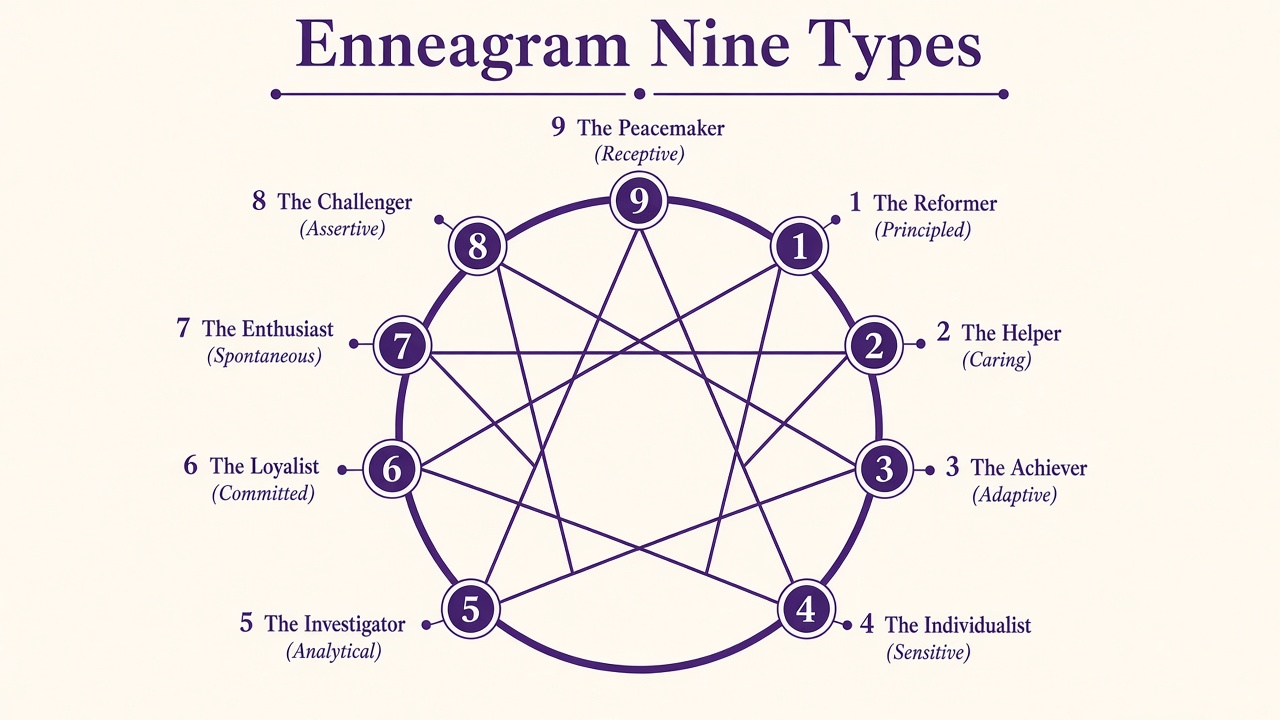
The Enneagram maps nine core motivation patterns. Each type describes a habitual focus, underlying fear, and typical stress response rather than a fixed behavior checklist.
Type 1 · Reformer
Integrity, standards, and improvement.
Type 2 · Helper
Connection through support and being needed.
Type 3 · Achiever
Value through goals, image, and success.
Type 4 · Individualist
Identity, depth, and authentic expression.
Type 5 · Investigator
Understanding, privacy, and competence.
Type 6 · Loyalist
Security, trust, and preparedness.
Type 7 · Enthusiast
Freedom, variety, and positive possibilities.
Type 8 · Challenger
Strength, protection, and control of your path.
Type 9 · Peacemaker
Harmony, comfort, and inclusive calm.
How it works
Three steps from first question to your type profile. Click Start Test to open the interactive quiz in a full-screen modal.
Answer 45 statements
Rate how much you agree with each motivation-style item on a five-point scale.
Items map to nine types
Your answers accumulate scores across all nine patterns. The highest score becomes your primary type.
View type, wing, and profile
Results show your type number, wing influence, score chart, strengths, growth edges, and stress notes.
Take the Enneagram test
Rate 45 motivation statements on a five-point agree-disagree scale. Your answers reveal a likely primary type (1 through 9) plus a wing from the neighboring type on the Enneagram circle.
Opens in a focused modal. No account required. Results stay on screen.
What your result means
Your primary type is the motivation pattern with the highest item score. The wing is the stronger of your two neighboring types, such as 4w5 or 9w1.
| Score pattern | Typical reading |
|---|---|
| One type clearly highest | Strong primary type signal; wing adds nuance |
| Two types close together | You may blend patterns; read both profiles |
| Flat scores across types | Many neutral answers or mixed motivations; retake when focused |
The nine Enneagram types
Types are arranged on a circle. Each number connects to neighbors (wings) and to stress and growth paths in advanced Enneagram teaching.
What this test can and cannot tell you
Can tell you
- Your self-reported motivation pattern among nine types
- A likely wing from neighboring types on the circle
- Plain-language strengths, growth edges, and stress notes
- A starting point for reflection or further Enneagram reading
Cannot tell you
- Official RHETI or Enneagram Institute certification
- Clinical diagnoses or mental health conditions
- Whether you should be hired or promoted
- A permanent identity that never shifts
Understanding the Enneagram framework
The Enneagram has roots in spiritual and psychological traditions and was popularized for personal growth by teachers such as Don Richard Riso and Russ Hudson. Unlike trait models that score continuous dimensions, the Enneagram emphasizes why you do what you do: core fears, desires, and habitual coping strategies grouped into nine types.
Many readers pair Enneagram results with other frameworks. The Big Five personality test offers research-backed trait percentiles. The MBTI type test maps four preference dichotomies. For team communication habits, the DISC personality test for teams scores Dominance, Influence, Steadiness, and Conscientiousness. Enneagram language is especially useful when you want to discuss motivation, stress loops, and personal growth paths rather than surface behaviors alone.
Free online Enneagram quizzes shorten the item count and use plain-language paraphrases. Treat any result as a hypothesis to explore, not a boxed identity. For internet-culture independence framing, try our sigma personality test for self-direction. Browse more tests on our personality psychology hub.
Enneagram test FAQ
What is the Enneagram?
The Enneagram is a personality framework that describes nine core motivation patterns. Each type has a distinct focus, fear, and growth path. Online quizzes estimate your likely type from self-report items.
How long does this Enneagram test take?
Most people finish in about 7 minutes. There are 45 agree-disagree statements. You can pause and return in the same browser session.
What is an Enneagram wing?
A wing is the neighboring type on the Enneagram circle that influences your primary type. For example, a 4w5 blends Individualist and Investigator patterns. Our quiz estimates your strongest adjacent wing.
Can my Enneagram type change?
Many teachers describe a core type as stable, but your expression can shift with stress, growth work, and life stage. Treat results as a snapshot for reflection.
How is the Enneagram different from MBTI or Big Five?
The Enneagram focuses on core motivations and stress patterns. MBTI maps four preference dichotomies. The Big Five measures continuous trait scores. Each framework offers a different lens on personality.
Is this an official Enneagram Institute assessment?
No. This is an educational self-report quiz with plain-language items. It is not the RHETI or other commercial Enneagram instruments.
Who reviewed this content?
Dr. James Whitfield, PhD, reviewed the test framing and result explanations. See our editorial policy for review standards.
Reviewed by