What this introvert extrovert test measures
This introvert extrovert test screens three social energy patterns that researchers often group under introversion and extroversion continua. Each domain uses original agree-disagree statements about how you tend to recharge and engage, not clinical symptom frequency over two weeks.
Social energy
Whether people and conversation recharge you or leave you needing recovery time afterward, even when interactions go well.
Solitude preference
How strongly you prefer alone time, solo routines, and smaller meetups over packed schedules and constant contact.
Group stimulation
Comfort with noise, crowds, fast-paced groups, and high-stimulation environments versus calm, smaller settings.
Energy style, not disorder
Results describe where you report gaining and losing social energy. They do not screen for social anxiety disorder or label you as disordered.
How it works
Three steps from first statement to your introvert-extrovert band. Click Start Test to open the interactive quiz in a full-screen modal.
Answer 27 statements
Rate how much you agree with each item on a five-point scale from strongly disagree to strongly agree. There is no timer and no auto-advance between items.
Items map to three domains
Your answers accumulate scores across social energy, solitude preference, and group stimulation. Some items are reverse-coded so that agreeing with outgoing behavior lowers your introversion score.
View percentages and band
Results show introversion and extroversion percentages, a band label from extrovert-leaning through ambivert blend to introvert-leaning, per-domain bars, and compassionate next steps that distinguish energy style from shyness.
Take the introvert extrovert test
Rate 27 social energy statements about how you tend to recharge and engage with others. Your answers produce introversion and extroversion percentages with an ambivert middle band and a domain breakdown chart.
Opens in a focused modal. No account required. Results stay on screen.
What your result means
Your introversion percentage is the sum of scored items normalized to 0 through 100. Extroversion percentage is the complement. Higher introversion means more agreement with recharge-through-solitude items. The band label groups that score into plain-language energy stages, not diagnostic categories.
| Energy band | Introversion range | Typical reading |
|---|---|---|
| Extrovert-Leaning | 0 to 35% | Social contact and lively settings tend to recharge you more than extended solitude |
| Ambivert Blend | 36 to 65% | Mixed pattern; domain chart shows whether energy, solitude, or stimulation drives the center |
| Introvert-Leaning | 66 to 100% | Solitude and lower stimulation tend to restore you more than constant social contact |
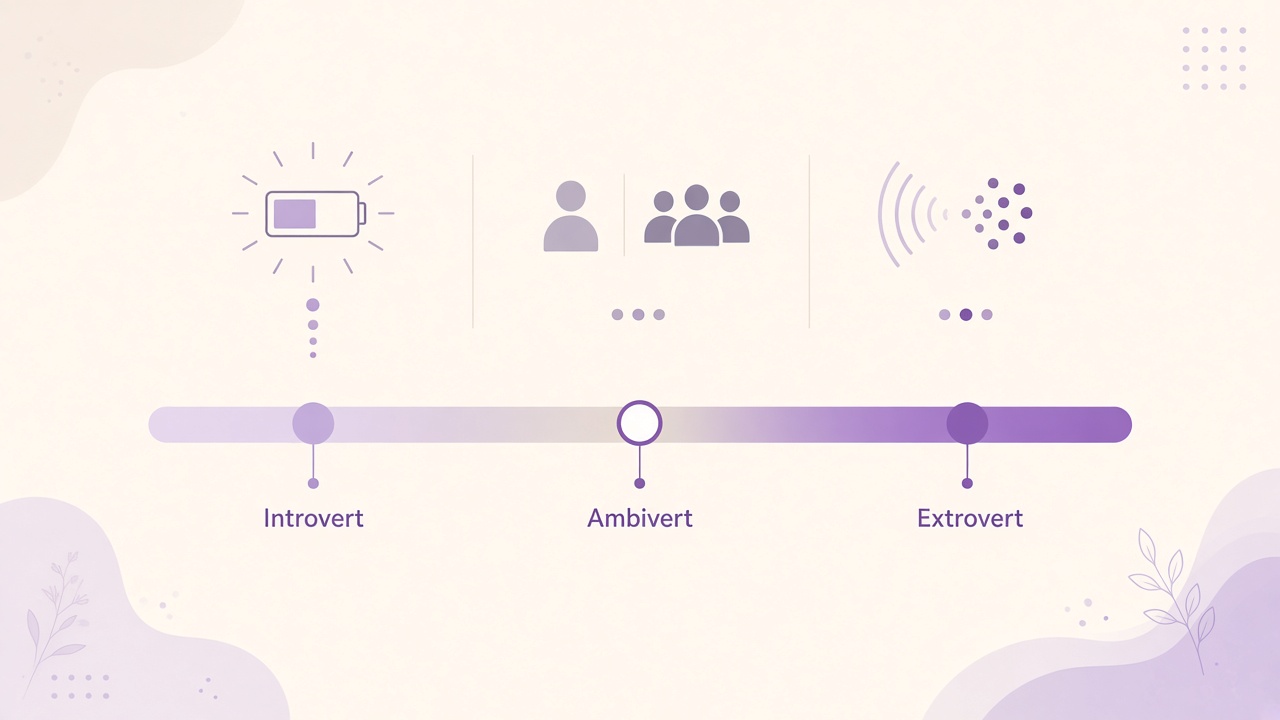
Three domains of social energy
The diagram below shows how domain scores feed an overall introversion percentage. High group stimulation sensitivity with moderate solitude preference, for example, can still land you in an ambivert blend band until patterns shift.
What this test can and cannot tell you
Can tell you
- How your self-reported social energy clusters across recharge, solitude, and stimulation
- Introversion and extroversion percentages for temperament reflection today
- Which domain bar leans most introverted or extroverted
- When to consider our shyness test, MBTI type test, or ambivert test
Cannot tell you
- Whether you have social anxiety disorder or any clinical diagnosis
- Whether you are shy, confident, or socially skilled (see our shyness test for inhibition)
- Whether you need medication, therapy type, or workplace accommodations
- How others objectively see you or your fixed personality across a lifetime
Social energy style versus shyness and type labels
Psychologist Carl Jung introduced extraversion and introversion as opposing attitudes toward the outer and inner world in the 1920s. Later personality frameworks, including Myers-Briggs type theory, kept the energy dichotomy while adding other preference pairs. Contemporary research often treats introversion and extroversion as a continuum rather than a strict binary, which is why this quiz reports percentages and an ambivert middle band instead of a single fixed label.
Shyness, by contrast, involves inhibition and approach hesitation even when you want connection. The shyness trait literature, including work by developmental psychologist Jerome Kagan on behavioral inhibition, focuses on holding back and feeling self-conscious rather than on where you recharge. The Quiz Hub built this introvert extrovert test as an energy-focused companion: it asks about solitude preference and group stimulation without two-week symptom frequency framing or diagnostic language.
| The Quiz Hub test | What it adds |
|---|---|
| Shyness test | Social inhibition, group discomfort, and approach behavior, not energy direction or recharge style |
| MBTI type test | Four-preference type language across energy, information, decisions, and structure |
| Ambivert test | Middle-band social energy with ambivert strength score and lean percentages, not full-spectrum dichotomy focus |
| This introvert extrovert test | Social energy, solitude preference, and group stimulation with introversion and extroversion percentages |
Sample item: agreeing that you need a quiet buffer after back-to-back social plans raises your social energy domain score toward introversion. Agreeing that meeting new people gives you a lasting buzz lowers it on a reverse-coded item. If inhibition rather than energy drain dominates, take our shyness test. Browse more screeners on our mental health and clinical hub or read how we review quizzes in our editorial policy.
Introvert extrovert test FAQ
What does this introvert extrovert test measure?
This introvert extrovert test measures self-reported agreement with statements about social energy, solitude preference, and group stimulation. It produces introversion and extroversion percentages plus an ambivert middle band. It describes energy style patterns, not a clinical diagnosis.
How is introversion different from shyness?
Introversion describes where you gain and lose social energy. Shyness describes inhibition, unease, and hesitation when approaching others. An introvert may feel calm but prefer solitude; a shy person may want connection but hold back from fear of awkwardness. Our shyness test focuses on inhibition rather than energy direction.
What is an ambivert blend result?
An ambivert blend means your introversion percentage falls in the 36 to 65% middle band. You may feel recharged by both solitude and social contact depending on context. Many adults land here during mixed seasons of work, relationships, and caregiving.
How do introversion and extroversion percentages work?
Each item contributes to an overall introversion score normalized to 0 through 100%. Extroversion percentage is the complement, so the two always sum to 100%. Domain bars show the same split for social energy, solitude preference, and group stimulation separately.
Should I take the MBTI type test instead?
Take the MBTI type test if you want four-preference type language across energy, information, decisions, and structure. Take this introvert extrovert test if you want a focused social energy snapshot with three domain bars and introvert-extrovert percentages only.
Who reviewed this content?
Dr. Elena Vasquez, PhD, reviewed the test framing and result explanations. See our editorial policy for review standards.
Reviewed by