What this shyness test measures
This shyness test screens three temperament patterns researchers often group under trait shyness. Each domain uses original agree-disagree statements about how you tend to behave and feel in social settings, not clinical symptom frequency over two weeks.
Social inhibition
Holding back speech, opinions, and visibility when others are present or when attention turns to you unexpectedly.
Social discomfort
Unease in groups, self-consciousness when observed, tension in unfamiliar settings, and replaying awkward moments afterward.
Approach behavior
Hesitating to initiate contact, join gatherings, accept invitations, or return messages without a social safety net.
Temperament, not disorder
Results describe how reserved or at-ease you report feeling socially. They do not screen for social anxiety disorder or label you as disordered.
How it works
Three steps from first statement to your shyness band. Click Start Test to open the interactive quiz in a full-screen modal.
Answer 21 statements
Rate how much you agree with each item on a five-point scale from strongly disagree to strongly agree. There is no timer and no auto-advance between items.
Items map to three domains
Your answers accumulate scores across social inhibition, social discomfort, and approach behavior. Some items are reverse-coded so that agreeing with outgoing behavior lowers your shyness score.
View band and domain chart
Results show an overall shyness index, a band label from Lower through Higher Shyness, per-domain bars, and compassionate next steps that distinguish temperament from disorder.
Take the shyness test
Rate 21 shyness-related statements about how you tend to feel and act around others. Your answers produce an overall shyness index and one of three trait bands with a domain breakdown chart.
Opens in a focused modal. No account required. Results stay on screen.
What your result means
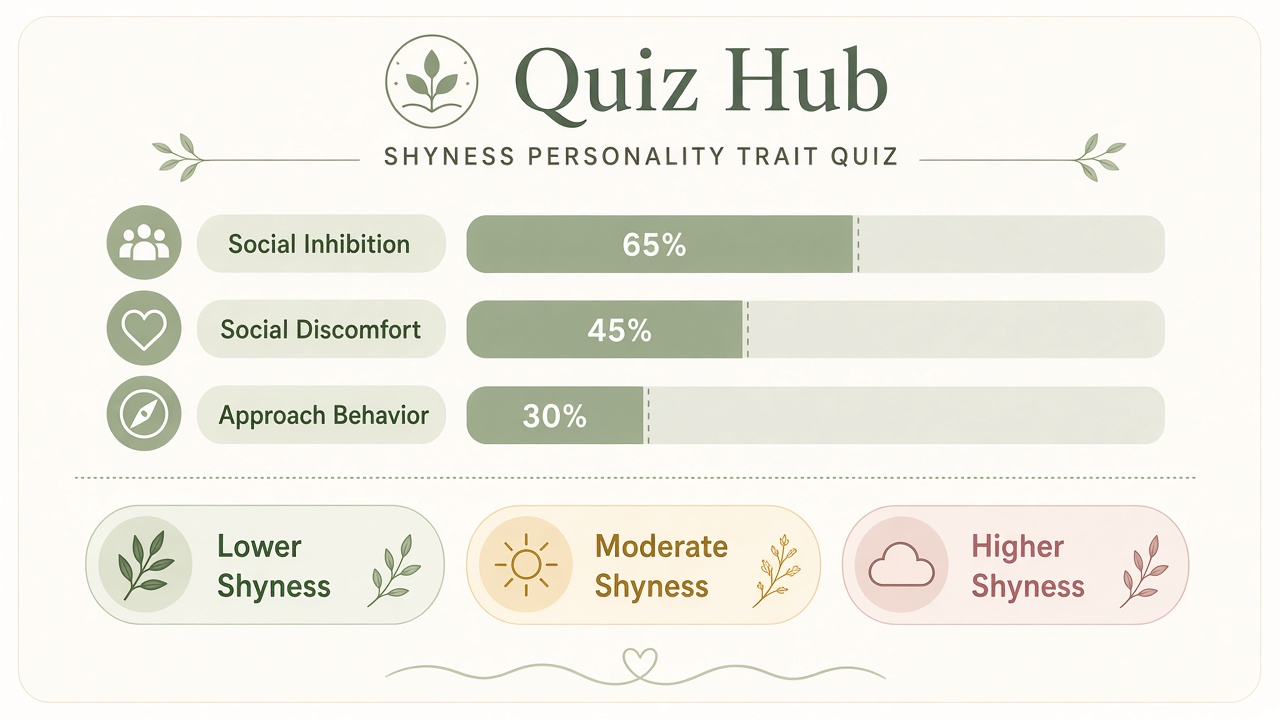
Your overall shyness index is the sum of scored items normalized to 0 through 100. Higher percentages mean more agreement with inhibition, discomfort, and approach-avoidance items. The band label groups that score into plain-language temperament stages, not diagnostic categories.
| Shyness band | Percentage range | Typical reading |
|---|---|---|
| Lower Shyness | 0 to 35% | More socially at-ease temperament on these items; nerves may still appear in high-stakes settings |
| Moderate Shyness | 36 to 65% | Mixed inhibition and ease; domain chart shows whether you hold back, feel tense, or avoid approaching |
| Higher Shyness | 66 to 100% | More reserved, inhibition-prone social style; consider social anxiety screening if fear severely limits life |
Three domains of shyness
The diagram below shows how domain scores feed an overall shyness index. High social discomfort with moderate inhibition, for example, can still land you in a Moderate Shyness band until patterns shift.
What this test can and cannot tell you
Can tell you
- How your self-reported shyness clusters across inhibition, discomfort, and approach behavior
- A band label and percentage for temperament reflection today
- Which domain bar scores highest and may deserve attention first
- When to consider our social anxiety test or professional support
Cannot tell you
- Whether you have social anxiety disorder or any clinical diagnosis
- Whether you are introverted, extroverted, or ambiverted (see our ambivert test or introvert extrovert test)
- Whether you need medication, therapy type, or workplace accommodations
- How others objectively see you or your fixed personality across a lifetime
Shyness as temperament versus social anxiety disorder
Developmental psychologist Jerome Kagan and colleagues studied behavioral inhibition in infants and young children beginning in the 1980s, linking early wariness in novel situations to later shy temperament in some participants. Shyness in adults often involves holding back, feeling self-conscious in groups, and hesitating before approach, even when you want connection. It is common, culturally variable, and not inherently pathological.
Social anxiety disorder, by contrast, involves persistent fear of negative evaluation, avoidance that impairs functioning, and often physical panic symptoms in social settings. The Social Phobia Inventory (SPIN), published by Connor et al. in 2000, screens those clinical patterns over a two-week window. The Quiz Hub built this shyness test as a temperament-focused companion: it asks about typical inhibition and discomfort without two-week symptom frequency framing or diagnostic language.
| The Quiz Hub test | What it adds |
|---|---|
| Social anxiety test | SPIN-inspired fear, avoidance, and arousal screening over two weeks, not temperament trait reflection |
| General anxiety test | GAD-7 inspired worry and tension domains, not social inhibition or group discomfort focus |
| Ambivert test | Balanced-middle social energy with ambivert strength score and lean percentages, not inhibition focus |
| Introvert extrovert test | Full-spectrum social energy style and preference for solitude versus groups, not inhibition or approach hesitation |
| This shyness test | Social inhibition, group discomfort, and approach behavior domain scores with trait bands |
Sample item: agreeing that you hold back from speaking in groups raises your social inhibition domain score. Agreeing that you are comfortable walking up to a small group lowers your approach behavior score on a reverse-coded item. If avoidance severely limits goals you care about, or if fear feels overwhelming rather than simply reserved, take our social anxiety test and consider talking with a clinician. Browse more screeners on our mental health and clinical hub or read how we review quizzes in our editorial policy.
Shyness test FAQ
What does this shyness test measure?
This shyness test measures self-reported agreement with statements about social inhibition, discomfort in groups, and approach-avoidance behavior. It produces an overall shyness index and three domain bars. It describes temperament patterns, not a clinical diagnosis.
Is shyness the same as social anxiety disorder?
No. Shyness is a common temperament trait involving reservation and self-consciousness in social settings. Social anxiety disorder involves persistent fear of judgment, avoidance that impairs functioning, and often physical panic symptoms. Our social anxiety test screens clinical-style symptoms over two weeks. This shyness test focuses on trait-level inhibition and discomfort without diagnostic language.
How is shyness different from introversion?
Introversion describes where you gain and lose social energy. Shyness describes inhibition, unease, and hesitation when approaching others. An introvert may feel calm but prefer solitude; a shy person may want connection but hold back from fear of awkwardness. Our introvert extrovert test and ambivert test focus on energy style rather than inhibition.
What do the three shyness bands mean?
Lower Shyness (0 to 35%) suggests a more socially at-ease temperament on these items. Moderate Shyness (36 to 65%) shows a mixed pattern with noticeable inhibition in some settings. Higher Shyness (66 to 100%) suggests a more reserved, inhibition-prone social style without labeling you as disordered.
Should I take the social anxiety test instead?
Take the social anxiety test if fear of judgment, physical panic in social settings, or severe avoidance limits work, school, or relationships over the past two weeks. Take this shyness test if you want a temperament snapshot about holding back, group discomfort, and approach hesitation without clinical screening framing.
Who reviewed this content?
Dr. Elena Vasquez, PhD, reviewed the test framing and result explanations. See our editorial policy for review standards.
Reviewed by