What the round or square test measures
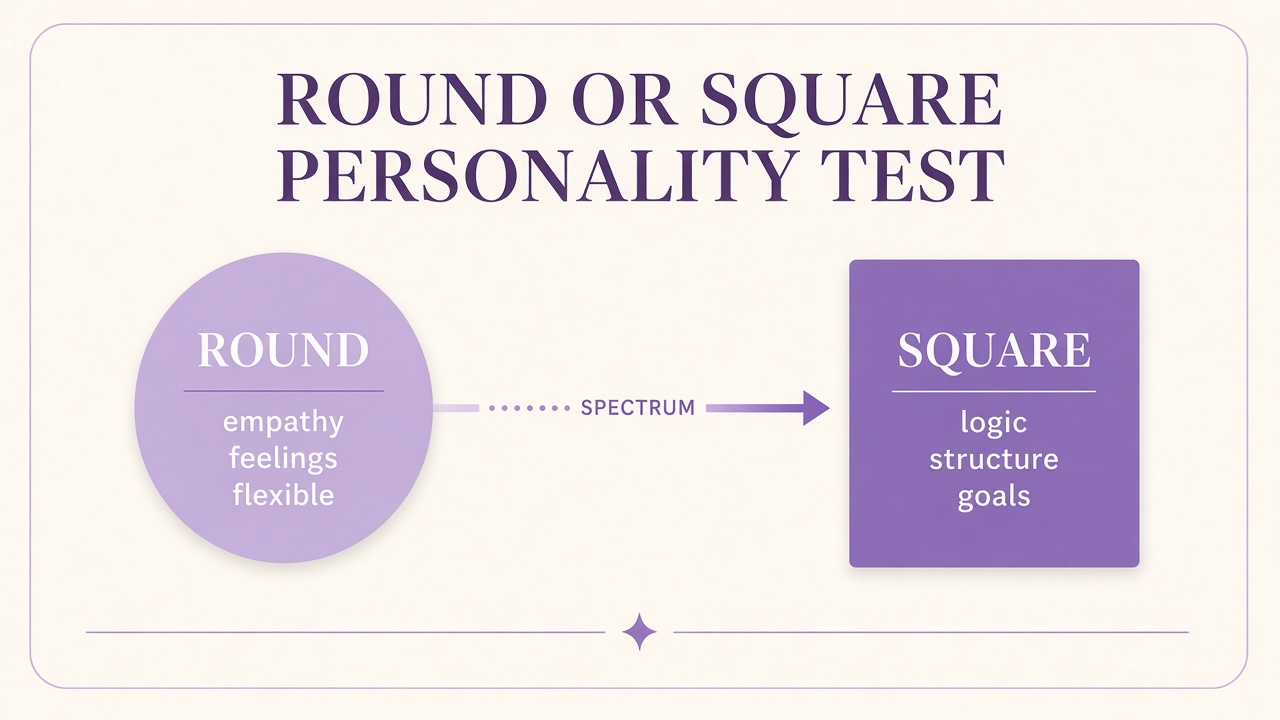
The round or square personality test maps a viral French metaphor onto everyday social and thinking habits. Round energy, in the rond ou carré trend, describes people who lead with empathy, read emotional cues, protect relationships, and keep plans flexible when someone needs support. Square energy describes people who prefer logic, explicit rules, direct speech, and goal-focused schedules. Neither shape is morally better; they are shorthand for contrasting styles that show up in conflict, decision making, and problem solving.
Our inventory uses twenty-six original agree-disagree statements across six domains: emotional style, decision making, social connection, conflict approach, planning style, and problem solving. Items are tagged to round or square poles with reverse scoring where agreement would otherwise flip the meaning. Your round spectrum score reflects how much of your total pole weight landed on round-tagged items after all twenty-six answers are complete.
-
Round traits
Empathy, emotional intuition, relationship focus, flexible pacing, harmony-first conflict.
-
Square traits
Logic, structure, direct goals, clear rules, efficiency-first problem solving.
-
Balanced mix
Context switching: round at home, square at work, or different leans per domain bar.
-
Six domains
Separate bars show where each shape appears even when the overall badge stays Balanced.
How scoring works
-
Rate 26 statements
Each item maps to a round or square pole. Reverse-scored items catch answers that flip the intended direction.
-
We sum pole totals
Round raw divided by round plus square raw yields your round spectrum score from 0 to 100. Square percentage is the complement.
-
See shape results
Results show a Round, Balanced, or Square badge, a band label, spectrum score, and six domain bars ranked by round percentage.
Take the round or square personality test
Answer every item honestly. The quiz autosaves in your browser and opens in a focused modal with Back and Next controls.
What your shape result means
Shape badges summarize the round spectrum score. Domain bars add nuance when you sit near the middle or when one area leans clearly round while another leans square.
| Round score | Shape badge | Typical pattern on these items |
|---|---|---|
| 66% to 100% | Round | Your answers lean toward empathy, relationship awareness, intuitive pacing, and flexible plans over rigid rules. |
| 36% to 65% | Balanced | Your answers mix round traits (empathy, flexibility) with square traits (logic, structure, direct goals). |
| 0% to 35% | Square | Your answers lean toward logic, clear rules, direct communication, and goal-focused planning over emotional cushioning. |
What your round or square report looks like
After all twenty-six items, you get a shape badge (Round, Balanced, or Square), a round spectrum score from 0 to 100, square percentage, band label, and six domain bars showing round lean by area. Percentages reflect pole totals on this quiz, not a clinical severity score.
What this test can and cannot do
Can
- Organize self-report on empathy versus structure using the viral shape metaphor
- Show round and square leans across six everyday domains with plain-language bars
- Spark conversation about French rond ou carré culture and how you show up socially
- Pair with trait tests when you want both meme framing and research-backed language
Cannot
- Replace validated instruments such as the Big Five or official MBTI products
- Diagnose personality disorders or predict hiring outcomes
- Prove you will always behave as one shape in every context
- Replicate the exact scoring of every TikTok filter or French-language clone
Rond ou carré and English shape quizzes
French creators popularized rond ou carré on TikTok and Instagram by asking whether someone feels round (soft, feeling-led, relationship-oriented) or square (sharp, logic-led, rule-oriented). Filter games and duet chains pushed participation past four hundred eighty thousand takers in Francophone feeds before English-language adaptations appeared. The trend borrows geometry as personality shorthand, similar to how online communities use color aura quizzes or MBTI memes, but without the decades of psychometric research behind trait models such as Costa and McCrae's Big Five work published through the American Psychological Association.
Psychologists treat personality as continuous dimensions measured with audited items and retest data. Viral shape quizzes trade that rigor for speed and shareability. That does not make them meaningless. Metaphors can still prompt useful questions: Do you soften conflict to protect harmony? Do you need listed pros and cons before deciding? Do plans flex when a friend needs help? Our English inventory keeps the round versus square frame while writing fresh items about social style, decision making, emotion versus logic, planning, and conflict rather than copying translated meme captions.
When you want research-backed trait language, pair this test with our Big Five personality test for openness, conscientiousness, extraversion, agreeableness, and neuroticism percentages. For four-letter preference snapshots, try the MBTI type test. For meme-culture contrast, compare scores with our SBTI test parody types. For French labels in results, try our bilingual sibling rond ou carré test with twenty-seven unique items and Rond/Carré badges.
| Quiz | Best for |
|---|---|
| This round or square test | Viral shape metaphor, empathy versus structure spectrum, French trend context |
| MBTI type test | Four dichotomies and sixteen type profiles with clarity scores |
| Big Five personality test | Continuous trait percentages with research-cited framing |
| SBTI test | Viral meme parody types for group chat sharing |
Round or square personality test FAQ
What is the round or square personality test?
The round or square personality test is a viral social style quiz inspired by the French TikTok and Instagram trend rond ou carré (round or square). Round shapes map to empathy, emotional awareness, relationship focus, and flexible plans. Square shapes map to logic, structure, direct goals, and clear rules. Our version uses 26 original agree-disagree items across six domains and returns a round spectrum score from 0 to 100, a shape badge (Round, Balanced, or Square), and domain bars.
Where did rond ou carré come from?
Rond ou carré spread on French TikTok and Instagram in 2025 and 2026, with creators asking whether someone has round (soft, feeling-led) or square (sharp, logic-led) energy. Hashtags and filter games pushed the trend past 480,000 takers in French-speaking communities before English-language adaptations appeared. The Quiz Hub built an English inventory with original wording rather than translating meme captions.
How is round vs square scored?
Each item maps to a round pole or square pole. After reverse scoring where needed, we sum round-tagged and square-tagged raw points, then convert to percentages. Your round spectrum score is round raw divided by the pole total, scaled to 0 through 100. Square percentage is the complement. Shape profiles use three bands: Square-dominant at 35 or below, Balanced from 36 to 65, Round-dominant at 66 or above. Six domain bars show where each lean is strongest.
Is this test scientifically validated?
No. The round or square metaphor is a cultural shorthand, not a peer-reviewed personality model like the Big Five or MBTI family instruments. Our quiz is a self-report snapshot for reflection and entertainment. It cannot diagnose traits, predict job fit, or replace conversation with a licensed psychologist. Treat results as one data point about how you answered these items today.
Can I be both round and square?
Yes. Many people land in the Balanced shape profile when round and square percentages stay within roughly fifteen points of each other. Domain bars often reveal a round lean in emotional style and a square lean in planning, or the reverse. Context matters: work stress can temporarily push square habits while home life stays round.
How is this different from the MBTI test?
The MBTI type test sorts preferences on four dichotomies (E/I, S/N, T/F, J/P) into sixteen four-letter types with clarity scores. The round or square test uses a single empathy-versus-structure spectrum with six social and cognitive domains tied to a French viral shape meme. Pair them when you want both dichotomy language and the rond ou carré metaphor.
Who reviewed this round or square test page?
Dr. James Whitfield, PhD in Personality Psychology, reviewed framing, scoring explanations, and disclaimers. See our editorial policy for review standards.
Reviewed by