What this Big Five personality test measures
The Big Five model groups stable individual differences into five broad trait domains. Each domain is scored on a continuum, not as a fixed type label.
-
Openness to Experience
Curiosity, imagination, and comfort with new ideas. High scorers often seek varied activities; lower scorers may prefer familiar routines.
-
Conscientiousness
Organization, follow-through, and impulse control. Useful for reflecting on work habits and planning style, not for job screening on this site.
-
Extraversion
Social energy, assertiveness, and positive emotion. Describes where you draw energy, not whether you are a skilled public speaker.
-
Agreeableness
Cooperation, trust, and warmth in relationships. Scores can rise when people answer in a socially desirable way.
-
Neuroticism
Emotional sensitivity and stress reactivity as a trait tendency. Not a diagnosis of anxiety or depression.
How it works
Three steps from first question to trait scores. Click Start Test to open the interactive quiz in a modal.
-
Answer 48 statements
Rate how much you agree with each plain-language item on a five-point scale from strongly disagree to strongly agree.
-
Items map to five traits
Your responses roll up into scores for openness, conscientiousness, extraversion, agreeableness, and neuroticism.
-
View scores with context
Results appear on screen with percentile-style charts and plain-language notes on what each score range typically suggests.
Take the Big Five personality test
Rate 48 IPIP-style trait statements on a five-point agree-to-disagree scale. Your answers are scored against approximate adult norms and mapped to openness, conscientiousness, extraversion, agreeableness, and neuroticism.
Opens in a focused modal. No account required. Results stay on screen.
What your result means
Scores are reported as percentile-style numbers relative to a reference sample. Mid-range scores (roughly 35 to 65) are common and do not mean "average personality."
| Score range | Typical reading |
|---|---|
| Below 30 | Noticeably lower than the reference midpoint on that trait |
| 30 to 45 | Slightly below average; trait is present but not a dominant tendency |
| 45 to 55 | Near the population midpoint; mixed expression by context |
| 55 to 70 | Moderately above average; trait shows up regularly in daily life |
| Above 70 | Strong tendency; may shape choices and reactions more often |
Single-session scores can shift with mood, sleep, and social context. Retaking after a few weeks often produces small changes even when your underlying traits are stable.
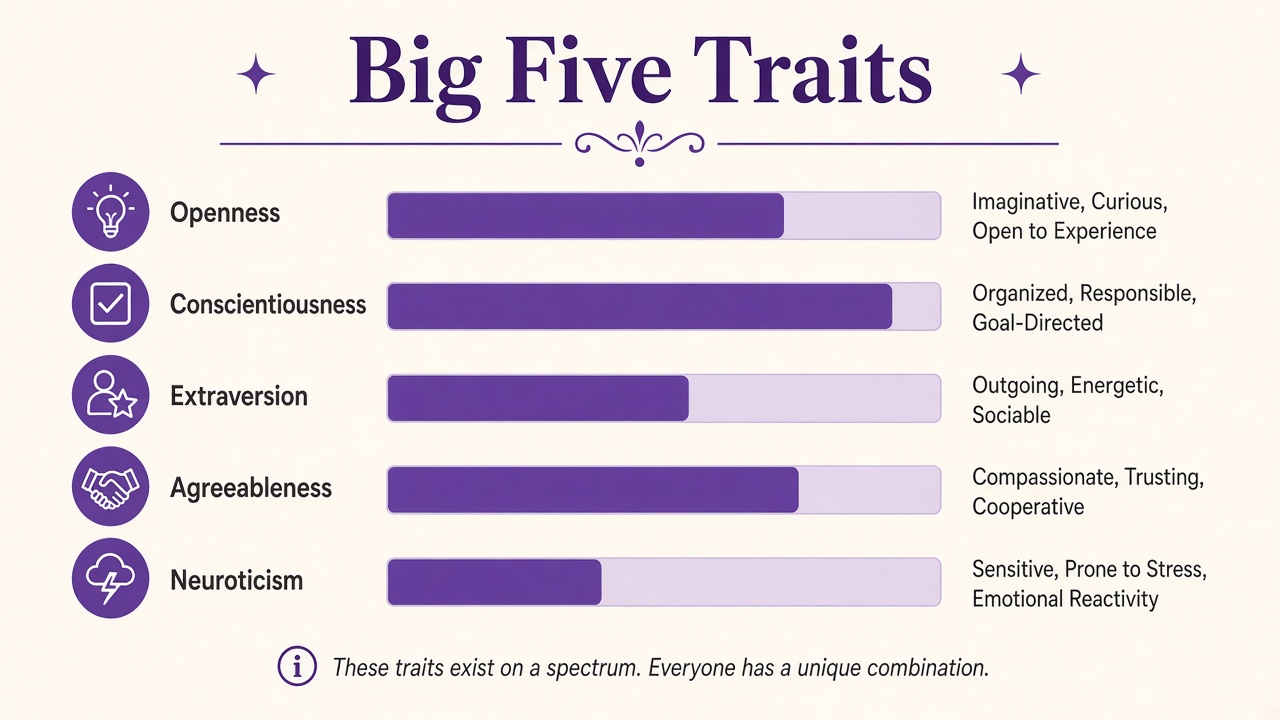
The five OCEAN traits at a glance
Each domain is scored independently on a continuum. Together they form the Big Five personality profile.
How Big Five scores are distributed
In large adult samples, each trait score tends to follow a bell-shaped (normal) curve. Most people cluster near the middle; extreme scores are less common.
Trait scores in the NEO personality inventory family (Costa & McCrae, 1992) are normed so that most adults score near the middle of each scale. Extreme scores are statistically less frequent.
A bell curve chart showing that Big Five trait scores in adult populations cluster around a mean of 50, with fewer people scoring very low or very high on any single trait.
What this test can and cannot tell you
Can tell you
- Your self-reported standing on five well-studied trait dimensions
- Which tendencies you notice in daily life, stated in plain language
- How your scores compare to a reference midpoint on each trait
- A starting point for reflection, conversation, or further reading
Cannot tell you
- Whether you have a mental health condition or personality disorder
- Whether you should be hired, promoted, or admitted to a program
- Fixed labels that will never change across your lifetime
- How other people experience you in every social context
Understanding the Big Five personality test framework
Personality psychologists have debated how to describe individual differences for over a century. Type models such as Myers-Briggs sort people into categories, while trait models measure continuous dimensions. The Big Five, also called the Five-Factor Model, emerged from repeated factor analyses of personality descriptors in multiple languages. Today it is the most widely used trait framework in research settings, including studies published through the American Psychological Association and funded by agencies such as the National Institute of Mental Health.
Robert McCrae and Paul Costa developed the NEO Personality Inventory, which became a standard reference for measuring openness, conscientiousness, extraversion, agreeableness, and neuroticism. Their 1992 revision established norms that many online quizzes, including shortened versions like ours, attempt to approximate. A free personality test on the web cannot replicate the full psychometric rigor of a proctored NEO-PI-R session, but it can introduce the same trait language in accessible form.
Why five factors instead of sixteen types or nine enneagram numbers?
Statisticians noticed that many personality adjectives cluster into five stable groups when people rate themselves or are rated by others. Extraversion captures sociability and positive emotion. Agreeableness reflects cooperation versus skepticism. Conscientiousness covers order and discipline. Neuroticism indexes emotional volatility. Openness covers intellectual curiosity and aesthetic interests. These five factors appear across cultures with only modest variation in labeling, which is why researchers treat them as basic dimensions rather than culturally specific categories.
Self-report bias and why your scores may shift
Every item on a web-based personality test depends on honest self-observation. Social desirability bias pushes answers toward what feels admirable: higher agreeableness, lower neuroticism, higher conscientiousness. Mood on the day you take the test also nudges scores. Sleep deprivation can inflate neuroticism responses temporarily. Reading about traits before answering can prime you to select items that match the description you prefer.
Researchers address some of these issues with validity scales and repeated measurement over months or years. Our quiz does not include lie scales or retest scheduling. Treat your result as one data point. If a score surprises you, ask whether context, recent stress, or wishful answering played a role. Longitudinal studies cited in the Costa and McCrae foundational work show that rank-order stability increases with age, but absolute levels still move with major life events such as starting a career, becoming a parent, or recovering from prolonged illness.
Openness: ideas, art, and willingness to try new things
High openness correlates with interest in abstract ideas, varied hobbies, and tolerance for ambiguity. Lower openness correlates with preference for concrete tasks, established traditions, and predictable schedules. Neither pole is better suited to all jobs or relationships. A software engineer and a logistics manager may both score moderately on openness while expressing it differently. Openness also has facets: intellectual curiosity does not always pair with aesthetic openness, and a person can score high on one facet and average on another.
Conscientiousness: planning, reliability, and impulse control
Conscientiousness predicts academic grades and job performance in meta-analyses, which is why employers sometimes misuse personality measures in hiring. Our test explicitly rejects that use case. For personal reflection, conscientiousness helps you name whether you rely on lists, deadlines, and tidy workspaces or whether you work in bursts and tolerate clutter. Low conscientiousness is not laziness; it can reflect creativity, spontaneity, or environments that punish rigid planning.
Extraversion: energy from people versus solitude
Extraversion is among the most recognizable traits because it maps onto everyday language about being outgoing. Psychologists measure multiple facets: warmth, gregariousness, assertiveness, activity level, excitement seeking, and positive emotions. An introvert can score low on gregariousness but average on assertiveness when speaking about a topic they know well. Ambiverts, people near the middle of the scale, are common and may switch styles by setting.
Agreeableness: cooperation, empathy, and conflict style
Agreeableness influences how you handle disagreement. High scorers prioritize harmony and trust; lower scorers prioritize direct critique and skepticism. Teams need both styles in balance. In self-report tests, agreeableness is especially vulnerable to social desirability because kindness is widely praised. Compare your score with feedback from people who know you well if you want an outside check.
Neuroticism: emotional reactivity, not a diagnosis
Neuroticism indexes how strongly you experience worry, sadness, anger, and stress in response to daily events. It correlates with, but is not equivalent to, clinical anxiety or depression. Someone with high neuroticism may manage emotions well through therapy, exercise, or support networks. Someone with low neuroticism may still experience acute grief after loss. Use the score as vocabulary for emotional patterns, not as a label for treatment decisions.
How online quizzes differ from research instruments
Published inventories undergo item analysis, factor confirmation, test-retest reliability checks, and cross-cultural validation before researchers trust them. A 48-item browser quiz compresses that process for casual use. Items are rewritten in plain language to avoid copying proprietary text. Norms are approximate rather than drawn from a freshly collected national sample. Confidence intervals are not reported. These limits are acceptable for curiosity and conversation but not for high-stakes decisions.
Using your results responsibly
Pair your scores with specific behaviors you want to understand. If conscientiousness is low and missed deadlines frustrate you, experiment with one planning tool for two weeks and notice whether behavior shifts faster than trait scores. If openness is high and you feel restless, explore structured ways to channel curiosity rather than treating the trait as a problem. Personality language works best when it connects to actions you can observe.
Share results with friends or partners only if everyone agrees on constructive framing. Trait scores are not excuses for hurtful behavior ("I am low agreeableness, so I do not apologize") or fixed limits on growth. They are shorthand for tendencies that interact with values, skills, and context.
If you want behavioral language tuned to teamwork rather than trait percentiles, try our free DISC behavioral style quiz, which scores Dominance, Influence, Steadiness, and Conscientiousness from everyday workplace scenarios. For informal hierarchy framing from internet culture, see our sigma personality test on self-reliance.
Further reading and sources
The Big Five framework continues to evolve. Researchers debate whether a sixth factor such as honesty-humility should join the model, and whether short forms lose facet-level detail. For authoritative overviews, start with the APA personality topic page and peer-reviewed summaries indexed on PubMed. Our editorial team links primary sources where possible so you can read beyond this page.
- American Psychological Association. Personality. Overview of trait theory and assessment for the public.
- Costa PT, McCrae RR. (1992). NEO PI-R professional manual. Foundational norms for the five-factor model used in research settings.
- National Institute of Mental Health. Personality Disorders. Clinical context distinguishing trait variation from diagnosable conditions.
Big Five personality test FAQ
Is this Big Five personality test the same as the NEO-PI-R?
No. Our quiz uses plain-language items inspired by Big Five research. It is shorter, unproctored, and not validated for clinical or employment use.
How long does the Big Five personality test take?
Most people finish in about 8 minutes. There are 48 agree-disagree statements. You can pause and return in the same browser session.
Do I need an account to take the Big Five test?
No. Results appear on screen when you finish. We do not require email sign-up for this Big Five personality test.
Can my Big Five trait scores change over time?
Trait scores can shift with age, stress, and life events. Treat results as a snapshot for reflection, not a permanent label.
What does a high neuroticism score mean on the Big Five?
A higher score suggests greater emotional sensitivity and stress reactivity as a trait tendency. It is not a diagnosis of anxiety or depression.
Can employers use this Big Five personality test for hiring?
No. This is an educational self-report quiz. It is not normed, proctored, or validated for selection or screening decisions.
Who reviewed this content?
Dr. James Whitfield, PhD, reviewed the test framing and result explanations. See our editorial policy for review standards.
Reviewed by