What this mental health test measures
This mental health test screens four areas that clinicians and primary care doctors often ask about during a wellbeing check. Each domain uses plain-language items about the past two weeks, not lifetime history or formal diagnostic criteria.
Mood
Interest, sadness, hopelessness, irritability, numbness, and brief moments of contentment.
Anxiety
Worry, restlessness, panic sensations, catastrophic thoughts, avoidance, and bodily tension.
Sleep
Trouble falling asleep, night waking, early rising, feeling unrested, and bedtime habits.
Daily functioning
Concentration, chores, social energy, decision-making, follow-through, and basic self-care.
How it works
Three steps from first question to your strain band. Click Start Test to open the interactive quiz in a full-screen modal.
Answer 30 statements
Rate how often each experience happened over the past two weeks on a five-point frequency scale. There is no timer and no auto-advance between items.
Items map to four domains
Your answers accumulate scores across mood, anxiety, sleep, and daily functioning. Higher domain bars mean more frequent strain in that area.
View band and domain chart
Results show an overall strain index, a band label from Lower Strain through Higher Distress, per-domain bars, and suggested next steps.
Take the mental health test
Rate 30 wellbeing statements about the past two weeks. Your answers produce an overall strain index and one of four bands with a domain breakdown chart.
Opens in a focused modal. No account required. Results stay on screen.
What your result means
Your overall strain index is the sum of scored items normalized to 0 through 100. Higher percentages mean more frequent distress items across domains. The band label groups that score into plain-language stages with proportionate next-step copy.
| Strain band | Percentage range | Typical reading |
|---|---|---|
| Lower Strain | 0 to 30% | Mostly typical ups and downs; still worth noting any single domain spike |
| Moderate Strain | 31 to 50% | Several areas strained enough to monitor and adjust routines |
| Elevated Strain | 51 to 70% | Sustained strain that may benefit from a clinician or counselor check-in |
| Higher Distress | 71 to 100% | Heavy strain across domains; professional support and crisis resources encouraged |
Four domains of general wellbeing
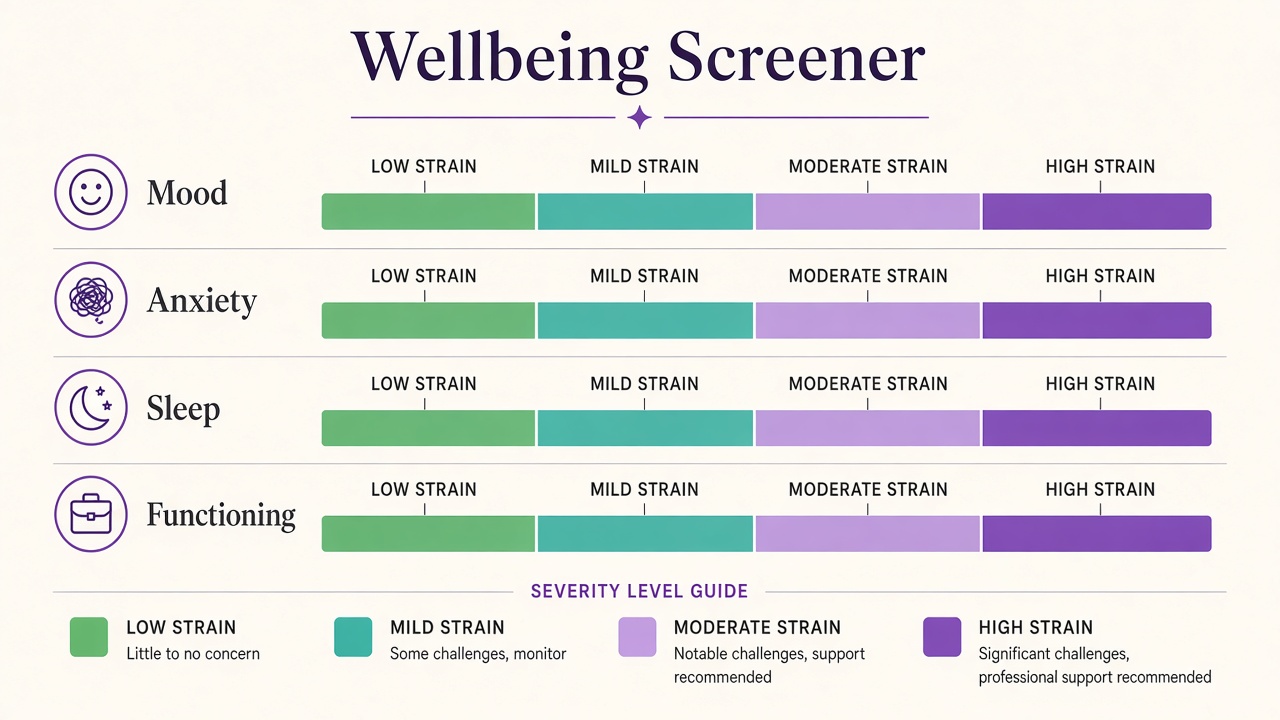
The diagram below shows how domain scores feed an overall strain index. High anxiety with fair sleep, for example, can still land you in a Moderate Strain band until patterns balance or worsen.
What this test can and cannot tell you
Can tell you
- How your self-reported strain clusters across mood, anxiety, sleep, and functioning
- A band label and percentage for reflection over the past two weeks
- Which domain bar scores highest and may need attention first
- A starting point for conversations with a doctor, therapist, or trusted friend
Cannot tell you
- Whether you have depression, anxiety disorder, bipolar disorder, or any diagnosis
- Whether you need medication, hospitalization, or time off work
- How you will feel next month or whether symptoms are permanent
- A substitute for crisis assessment if you feel unsafe right now
General wellbeing screening in everyday care
Primary care and counseling settings often start with short questions about mood, worry, sleep, and daily tasks before ordering longer assessments. The Patient Health Questionnaire (PHQ-9) and Generalized Anxiety Disorder scale (GAD-7) are two widely used screeners cited by the National Institute of Mental Health. The Quiz Hub test borrows that two-week timeframe but blends four domains into one informal snapshot rather than reproducing either instrument.
Online mental health tests vary in quality. Some use diagnostic language after a handful of items. The Quiz Hub states limits on every band, links crisis resources on elevated results, and assigns clinical review to Dr. Elena Vasquez. For a depression-focused screener with PHQ-inspired core items, take our live depression test. For mood cycling with manic and hypomanic symptoms, try our am I bipolar quiz. For worry-focused screening, see our anxiety test. For normality reflection without stigmatizing labels, try our am I normal quiz. For social scrutiny and avoidance patterns, try our social anxiety test. For personality-style reflection without clinical framing, see our maturity test on emotional regulation habits or browse the personality psychology hub.
Sample item: endorsing that you had trouble falling asleep most nights raises your sleep domain bar. Endorsing that you stayed on top of basic self-care lowers your functioning strain score on a reverse-coded item. Social desirability bias can under-report distress when people answer how they wish they felt. Read how we review quizzes in our editorial policy.
Mental health test FAQ
What does this mental health test measure?
This mental health test on The Quiz Hub screens self-reported strain across mood, anxiety, sleep, and daily functioning over the past two weeks. It produces an overall strain index and four domain bars. It is a general wellbeing screener, not a depression or anxiety diagnosis tool.
Is this mental health test a clinical diagnosis?
No. Results describe frequency patterns from thirty self-report items. They cannot diagnose depression, generalized anxiety disorder, insomnia, or any other condition. They are not a substitute for evaluation by a licensed mental health professional.
How long does the mental health test take?
Most people finish in about six minutes. There are thirty statements on a five-point frequency scale from not at all to nearly every day. You can pause and return in the same browser session.
What do the four strain bands mean?
Lower Strain (0 to 30%) suggests mostly typical ups and downs. Moderate Strain (31 to 50%) flags several areas worth monitoring. Elevated Strain (51 to 70%) may benefit from professional follow-up. Higher Distress (71 to 100%) suggests heavy strain across multiple domains and includes crisis resource links.
How is this different from a PHQ-9 or GAD-7?
PHQ-9 and GAD-7 are short validated screeners focused on depression or anxiety symptoms. The Quiz Hub test blends mood, anxiety, sleep, and functioning items into one general wellbeing snapshot for self-reflection. It is not equivalent to those instruments.
Who reviewed this content?
Dr. Elena Vasquez, PhD, reviewed the test framing and result explanations. See our editorial policy for review standards.
Reviewed by