What this focus test measures
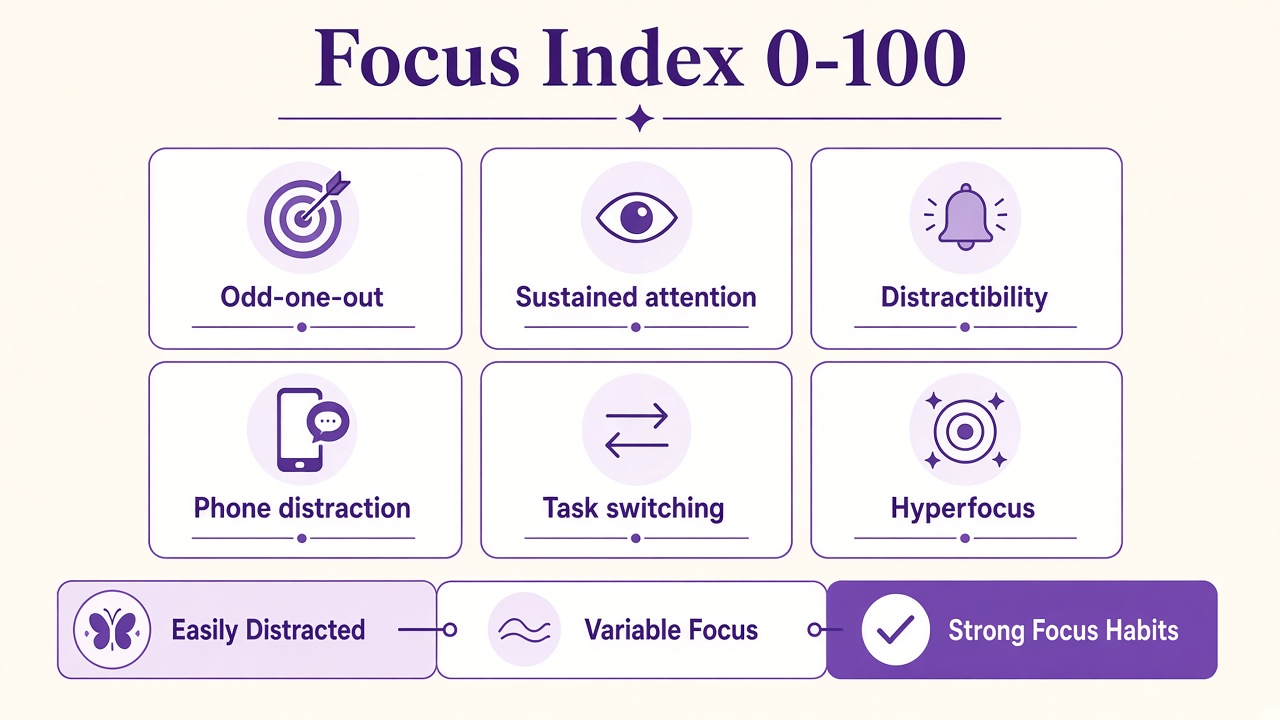
The focus test scores two sections that blend into one focus index. The challenge section uses odd-one-out sets and sustained-attention prompts such as vowel counts, letter counts, and short sequences. The habit section uses Likert items on distractibility, multitasking balance, hyperfocus episodes, phone distraction, task-switching cost, and procrastination versus focus.
Attention challenges
Twelve in-modal items test selective attention and sustained scanning without external notes.
Everyday habits
Twelve habit items capture how often distraction, phone checks, and context switches interrupt your day.
Focus index
0 to 100 summary blending challenge accuracy (55%) with habit ratings (45%).
Domain bars
Separate charts for odd-one-out, sustained attention, and six habit domains.
How it works
Three steps from first challenge to your focus result. Click Start Focus Test to open the interactive quiz in a full-screen modal.
Complete twelve attention challenges
Read each odd-one-out set or counting prompt in the modal, then pick the correct answer from four options.
Rate twelve focus habits
Answer agree-disagree statements about distractibility, phone use, multitasking, and task switching.
View index and domain bars
Results show focus index, challenge score, habit index, focus band, and domain percentage charts.
Take the focus test
Work through twelve in-modal attention challenges, then rate twelve everyday focus habit items. Your answers produce a focus index and focus band.
Opens in a focused modal. No account required. Results stay on screen.
What your result means
The focus index blends challenge accuracy with habit ratings on a 0 to 100 scale. Bands group that index for playful reflection. Challenge and habit subscores help you see whether puzzles or everyday distraction habits drove your band today.
| Focus band | Index range | Typical reading |
|---|---|---|
| Easily Distracted | 0% to 39% | Lower challenge accuracy and/or higher self-reported distraction and phone drift |
| Variable Focus | 40% to 69% | Mixed challenge performance with workable but uneven everyday focus habits |
| Strong Focus Habits | 70% to 100% | Most challenges answered correctly with favorable focus habit ratings |
Focus index map
Selective attention and everyday distraction habits are different skills. This diagram shows the challenge types and habit domains behind your focus index so you can compare with sibling cognitive quizzes on The Quiz Hub.
What this quiz can and cannot tell you
Can tell you
- How many in-modal attention challenges you answered correctly today
- Your self-reported distractibility, phone use, and task-switching patterns
- Domain percentage bars for odd-one-out, sustained attention, and six habit areas
- A starting point for attention warm-up before harder cognitive puzzles
Cannot tell you
- Whether you have ADHD or any clinical attention disorder
- Sustained attention capacity from normed neuropsychology batteries
- IQ, hiring readiness, or academic placement scores
- Whether attention problems require professional follow-up (seek evaluation if impairment is severe)
Why people search for a focus test online
People often want a quick check on whether their attention feels sharp after a notification-heavy day or poor sleep. A focus test that mixes odd-one-out puzzles with sustained-attention counting mirrors how researchers probe selective and sustained attention in lab settings, though our version is shortened for casual browsers. The habit section adds everyday context: phone checks during work, recovery time after interruptions, and whether interesting tasks pull you into hyperfocus.
Sample challenge: spotting that Triangle is the odd shape among Square, Pentagon, and Hexagon because it has three sides. Sample habit item: agreeing that you reach for your phone within minutes of starting focused work lowers your phone distraction domain score after reverse scoring. Neither item diagnoses anything; they only describe performance and self-report on this screener today.
Compare with sibling pages. The memory test scores recall drills that overlap when distraction breaks encoding. The IQ test covers broader reasoning puzzles. The cognitive test bundles working memory, math, pattern, verbal, and attention-switch warm-up items. The planned brain test will add processing-speed themes. For clinical inattention overlap, see the ADHD test on our mental health hub with its own limits.
Focus test FAQ
What does this focus test measure?
This focus test blends twelve in-modal attention challenges with twelve Likert habit items. Challenges cover odd-one-out pattern spotting and sustained-attention counting or sequencing. Habit items ask about distractibility, multitasking, hyperfocus episodes, phone distraction, task-switching cost, and procrastination versus focus. Results show a focus index from 0 to 100 plus challenge and habit subscores.
Is this an ADHD test or diagnosis?
No. The Quiz Hub built this as recreational attention warm-up, not clinical ADHD screening. Online habit quizzes cannot diagnose attention deficit hyperactivity disorder or any psychiatric condition. If attention problems impair work, school, or safety, seek evaluation from a qualified clinician.
How long does the focus test take?
Most people finish in about 7 minutes. There are 24 items: twelve attention challenges shown inside the quiz modal and twelve agree-disagree habit statements. You can pause and return in the same browser session thanks to autosave.
What is the focus index?
The focus index is a 0 to 100 summary that blends challenge accuracy (55 percent weight) with habit ratings (45 percent weight). Bands group that index into Easily Distracted, Variable Focus, or Strong Focus Habits for everyday reflection.
How do the attention challenges work?
Each challenge shows a stimulus inside the quiz modal: an odd-one-out set, a counting prompt, or a short sequence puzzle. You read carefully, then pick the correct answer from four options. There is no timer, but you should answer from attention, not by scrolling back repeatedly.
How is this different from the memory test or IQ test?
The memory test scores recall of digits, words, and patterns plus everyday memory confidence. The IQ test samples broader reasoning puzzles. This focus test targets attention drift, sustained scanning, and self-reported distraction habits. None replace licensed neuropsychological testing.
Who reviewed this content?
Dr. James Whitfield, PhD, reviewed the test framing and result explanations. See our editorial policy for review standards.
Reviewed by