What this social anxiety test measures
This social anxiety test estimates how often you experience fear of negative evaluation, social avoidance, and somatic arousal over the past two weeks. It groups 21 self-report items into three domains: seven core fear items inspired by the SPIN plus fourteen supplemental items on avoidance and physical symptoms in social settings.
Fear of negative evaluation
Worry about being judged, embarrassed, or seen as anxious, boring, or awkward by others in social situations.
Social avoidance
Skipping events, staying quiet, leaving early, or declining invitations to escape scrutiny or performance demands.
Somatic arousal in social settings
Racing heart, shaking, sweating, flushing, mind blanking, and nausea when observed or interacting with others.
Two-week recall window
Items ask about frequency over the past two weeks, matching common anxiety screener recall periods used in outpatient care.
How it works
Three steps from first question to your screening band. Click Start Test to open the interactive quiz in a full-screen modal.
Answer 21 frequency items
Rate each statement from Never to Very often. There is no timer and no auto-advance between items.
Items map to three domains
Your answers accumulate percentages for fear of evaluation, social avoidance, and somatic arousal, plus a SPIN equivalent score on the seven core fear items.
View screening band and next steps
Results show a Lower, Moderate, or Elevated screening signal with domain bars, highlights, and professional referral guidance when appropriate.
Take the social anxiety test
Rate 21 social anxiety-related statements on a five-point frequency scale. Your answers produce an overall screening percentage, three domain scores, and a SPIN equivalent score with plain-language next steps.
Opens in a focused modal. No account required. Results stay on screen.
What your result means
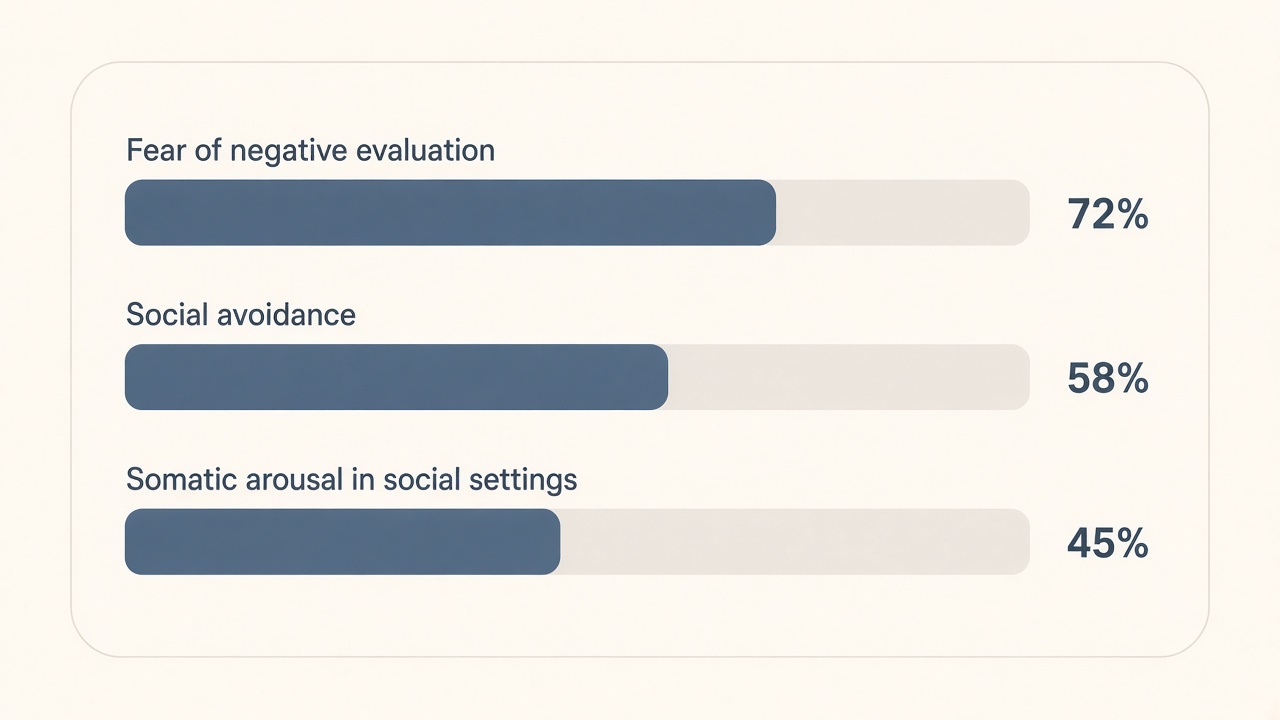
Your overall screening percentage is the average of fear of evaluation, social avoidance, and somatic arousal domain scores, each normalized to 0 through 100. The band groups that average into plain-language screening signals. Domain bars show whether fear thoughts, avoidance, or body arousal drives your result.
| Screening band | Score range | Typical reading |
|---|---|---|
| Lower Screening Signal | 0 to 35% | Fewer frequent symptoms; situational nerves may still occur |
| Moderate Screening Signal | 36 to 55% | Some frequent symptoms worth monitoring, especially if avoidance limits activities |
| Elevated Screening Signal | 56 to 100% | Frequent symptoms that may warrant professional social anxiety evaluation |
The seven core fear items also produce a SPIN equivalent score mapped to published cutoffs: 13 to 18 mild, 19 or higher moderate+ screening range. A score of 19 or higher triggers a positive moderate+ flag inspired by SPIN clinical use, not a diagnosis.
Social anxiety screening domains
The diagram below shows how domain scores appear in your results. High social avoidance with moderate somatic arousal might still land you in Moderate if your overall average sits between bands.
What this test can and cannot tell you
Can tell you
- Whether your self-reported social symptoms lean mild, moderate, or frequent on this screener
- A screening percentage and three domain scores for fear, avoidance, and arousal patterns
- A SPIN equivalent score on seven core fear items with published-style cutoffs
- A starting point for conversations with a clinician about social anxiety evaluation
Cannot tell you
- Whether you have social anxiety disorder or any other clinical condition
- Official SPIN scores comparable to published research norms
- Whether you need medication, therapy type, or workplace accommodations
- Whether symptoms are better explained by autism traits, trauma, or introversion alone
SPIN and social anxiety screening in practice
In 2000, Jonathan Connor and colleagues published the Social Phobia Inventory (SPIN), a 17-item self-report measure of fear, avoidance, and physical symptoms in social situations. The instrument uses a 0 to 4 frequency scale with a total score range of 0 to 68. A cutoff of 19 is widely cited for identifying probable social anxiety disorder in outpatient screening, though only clinical assessment can confirm a diagnosis.
The Quiz Hub built this social anxiety test as an expanded, plain-language screener inspired by SPIN themes. It uses seven core fear items plus fourteen supplemental avoidance and somatic arousal items on a five-point scale. That trade-off favors richer domain feedback for casual users while naming the Connor et al. (2000) source honestly. NIMH notes that social anxiety disorder affects millions of adults and that evidence-based treatments such as cognitive behavioral therapy can reduce symptom burden when avoidance limits daily life.
| The Quiz Hub test | What it adds |
|---|---|
| General anxiety test | GAD-7 inspired worry and tension domains, not social scrutiny focus |
| General mental health test | Four-domain wellbeing snapshot including mood and sleep, not SPIN fear items |
| Shyness test | Temperament-style inhibition and group discomfort, not clinical social anxiety screening |
| This social anxiety test | Core SPIN-style fear items plus avoidance and somatic arousal domain scores |
Sample item: rating Often on fearing embarrassment raises your fear-of-evaluation domain score. Rating Very often on turning down invitations raises social avoidance. Introversion and shyness can overlap with social anxiety but are not the same construct. Clinicians rule out generalized anxiety, autism-related social differences, and trauma during evaluation. Browse more screeners on our mental health and clinical hub or read how we review quizzes in our editorial policy.
Social anxiety test FAQ
What does this social anxiety test measure?
This social anxiety test measures self-reported frequency of fear of negative evaluation, social avoidance, and somatic arousal over the past two weeks. Twenty-one items cover seven core fear items inspired by SPIN themes plus fourteen supplemental avoidance and physical symptom questions. Results show a screening band, three domain scores, and a SPIN equivalent score. It is not a clinical diagnosis.
Does a positive screening result mean I have social anxiety disorder?
No. A positive screening signal means your responses suggest frequent social anxiety symptoms on this abbreviated screener. Only a licensed clinician can evaluate social anxiety disorder through structured interviews and rule-out of other causes. Online tests cannot confirm or deny a diagnosis.
How is this related to the SPIN?
The Social Phobia Inventory (SPIN) was developed by Connor et al. and published in 2000. Our online screener uses seven core fear items inspired by SPIN themes plus fourteen supplemental items on avoidance and somatic arousal in plain language. It is not the published SPIN instrument and is not validated for research or clinical use.
How is social anxiety different from shyness or generalized anxiety?
Shyness is a temperament trait that may feel uncomfortable but often does not limit daily life. Generalized anxiety involves broad worry across many domains. Social anxiety centers on fear of judgment and avoidance of social scrutiny. Our shyness test focuses on temperament rather than clinical screening. For broad worry, see our anxiety test.
What should I do if I get an elevated screening signal?
Consider scheduling an evaluation with your primary care doctor or a licensed therapist who treats anxiety in adults. Bring your result summary and describe which social settings feel hardest. If you feel unsafe or in crisis, call or text 988 (US) or your local crisis line.
Who reviewed this content?
Dr. Elena Vasquez, PhD, reviewed the test framing and result explanations. See our editorial policy for review standards.
Reviewed by