What this depression test measures
This depression test estimates how often you experience low mood, lost interest, fatigue, and daily functioning problems over the past two weeks. Nine core items follow PHQ-9 themes on anhedonia, sleep, appetite, guilt, concentration, and safety. Eleven supplemental items cover irritability, withdrawal, and performance without reproducing the full published instrument.
Mood and anhedonia
Low mood, hopelessness, guilt, irritability, crying spells, and lost pleasure in activities you used to enjoy.
Physical energy and sleep
Fatigue, sleep disruption, appetite shifts, body heaviness, and difficulty getting out of bed in the morning.
Daily functioning
Concentration, motivation, social withdrawal, neglected responsibilities, and slipping work or school performance.
PHQ core screening flag
Nine core items inspired by PHQ-9 logic. Five or more rated Often or Nearly every day triggers an elevated core signal, not a diagnosis.
How it works
Three steps from first question to your severity band. Click Start Test to open the interactive quiz in a full-screen modal.
Answer 20 frequency items
Rate each statement from Not at all to Nearly every day. There is no timer and no auto-advance between items.
Items map to three domains
Your answers accumulate percentages for mood, physical energy, and functioning, plus a PHQ core screening flag.
View severity band and next steps
Results show Minimal, Mild, Moderate, or Severe screening signals with domain bars, highlights, and crisis resources when appropriate.
Take the depression test
Rate 20 depression-related statements on a five-point frequency scale. Your answers produce an overall severity percentage, three domain scores, and a PHQ core flag with plain-language next steps.
Opens in a focused modal. No account required. Results stay on screen.
What your result means
Your overall screening percentage is the average of mood, physical energy, and functioning domain scores, each normalized to 0 through 100. The band groups that average into plain-language severity signals. Domain bars show whether low mood, fatigue, or daily tasks drive your result.
| Screening band | Score range | Typical reading |
|---|---|---|
| Minimal Screening Signal | 0 to 25% | Few frequent symptoms; brief low mood may still occur after stress or grief |
| Mild Screening Signal | 26 to 45% | Some frequent symptoms worth monitoring, especially if persistent beyond two weeks |
| Moderate Screening Signal | 46 to 65% | Frequent symptoms that may warrant professional mood evaluation |
| Severe Screening Signal | 66 to 100% | Heavy symptom burden with crisis resources and referral guidance shown |
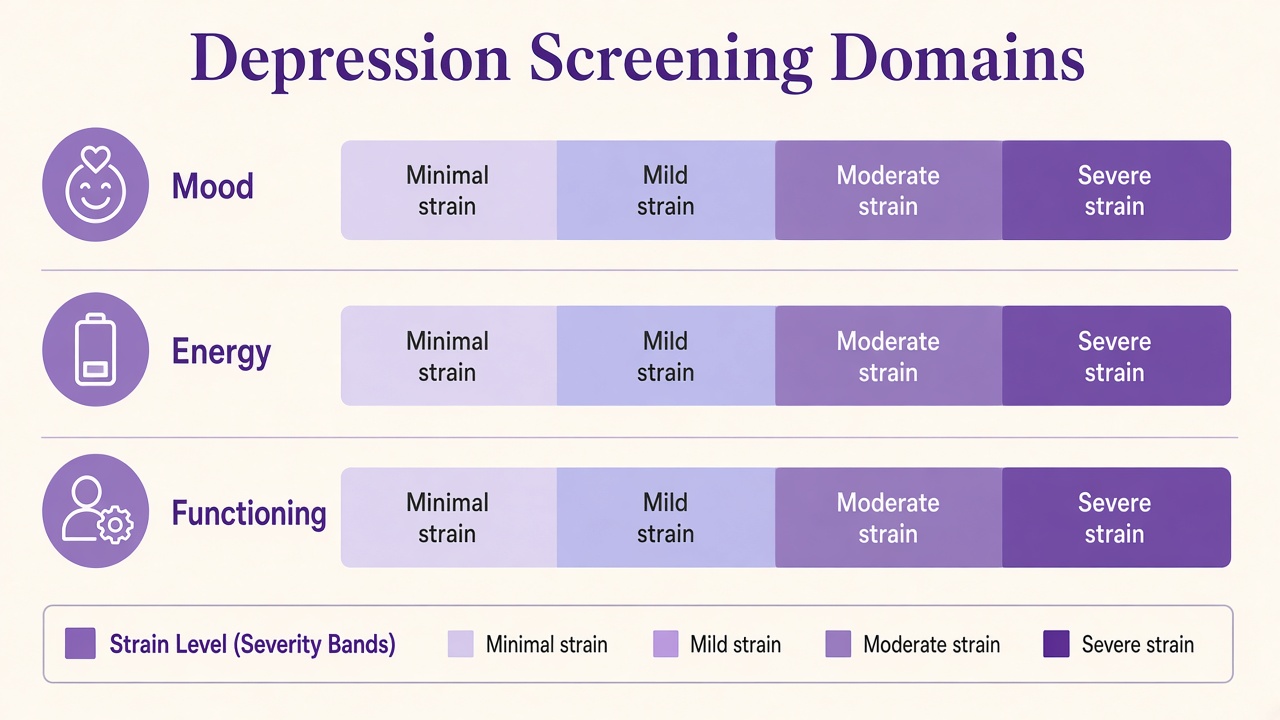
Mood, energy, and functioning domains
The diagram below shows how domain scores appear in your results. A high mood score with moderate functioning might still land you in Moderate if your overall average sits between bands.
What this test can and cannot tell you
Can tell you
- Whether your self-reported symptoms lean minimal, mild, moderate, or severe on this screener
- A severity percentage and three domain scores for mood, energy, and functioning
- A PHQ core flag inspired by published depression screening logic
- A starting point for conversations with a clinician about mood evaluation
Cannot tell you
- Whether you have major depressive disorder or any other clinical condition
- Official PHQ-9 scores comparable to published research norms
- Whether you need medication, hospitalization, or workplace clearance
- Medical causes such as thyroid disease, anemia, or medication side effects
PHQ-9 and depression screening research
In 2001, Robert Kroenke, Kurt Spitzer, and Janet Williams published the Patient Health Questionnaire-9 (PHQ-9) as a brief depression screener for primary care. The nine-item instrument asks about symptom frequency over the past two weeks, including the ninth item on thoughts of self-harm. Scores of 10 or higher often prompt follow-up evaluation, though only clinical assessment can confirm a depressive episode.
The Quiz Hub built this depression test as an expanded, plain-language screener inspired by PHQ-9 themes. It uses nine core items plus eleven supplemental functioning questions and four result bands rather than the full published instrument. That trade-off favors readability for casual users while naming the Kroenke et al. (2001) source honestly. The National Institute of Mental Health notes that depression is treatable and that early screening in primary care can connect people to therapy and medication when appropriate.
| The Quiz Hub test | What it adds |
|---|---|
| Mental health test | General wellbeing across mood, anxiety, sleep, and functioning, not depression-only screening |
| Am I bipolar quiz | MDQ-inspired depressive and manic/hypomanic poles over 12 months, not two-week PHQ recall |
| ADHD test | Inattention and hyperactivity domains, not mood symptom frequency |
| Emotional maturity quiz | Regulation and responsibility habits, not clinical depression screening |
| This depression test | PHQ-inspired core items plus supplemental functioning scores with crisis resources on elevated bands |
Sample item: rating Often on lost interest in hobbies raises your mood and anhedonia domain score. Rating Nearly every day on fatigue raises physical energy. Grief, seasonal changes, and medical conditions can mimic depression symptoms, so clinicians rule out other causes during evaluation. Browse more screeners on our mental health and clinical hub or read how we review quizzes in our editorial policy.
Depression test FAQ
What does this depression test measure?
This depression test measures self-reported frequency of low mood, anhedonia, fatigue, sleep and appetite changes, guilt, concentration problems, and daily functioning over the past two weeks. Twenty items include nine PHQ-inspired core questions plus eleven supplemental items on irritability, withdrawal, and performance. Results show a severity band, three domain scores, and a PHQ core screening flag. It is not a clinical diagnosis.
Does a high screening result mean I have depression?
No. A high screening signal means your responses suggest frequent symptoms on this abbreviated screener. Only a licensed clinician can evaluate depression through structured interviews, medical workups, and rule-out of other conditions. Online tests cannot confirm or deny a diagnosis.
How is this related to the PHQ-9?
The Patient Health Questionnaire-9 (PHQ-9) was developed by Kroenke, Spitzer, and Williams and is widely used in primary care for depression screening. Our online screener uses nine original plain-language items inspired by PHQ-9 themes with a two-week recall window, plus eleven supplemental functioning items. It is not the published PHQ-9 instrument and is not validated for research or clinical use.
What should I do if I endorsed thoughts of self-harm?
If you rated Often or Nearly every day on the self-harm item, or if you feel unsafe right now, call or text 988 (US) or your local crisis line immediately. You can also go to the nearest emergency room or tell someone you trust to stay with you while you call for support. This quiz is not an emergency service.
How long does the depression test take?
Most people finish in about 5 minutes. There are 20 items on a five-point frequency scale from Not at all to Nearly every day. You can pause and return in the same browser session thanks to autosave.
Who reviewed this content?
Dr. Elena Vasquez, PhD, reviewed the test framing and result explanations. See our editorial policy for review standards.
Reviewed by