What this why am I so tired quiz measures
This fatigue test estimates how often common tiredness drivers show up over the past two weeks. Twenty-five self-report items group into five domains: sleep quantity and quality, stress and mental load, physical health signals you can notice without lab tests, mood-related heaviness, and lifestyle rhythm. Your fatigue driver index averages the five domain percentages on a 0 to 100 scale. It is designed for adults wondering why everyday energy feels low, not for diagnosing chronic fatigue syndrome or any other condition.
Sleep quantity and quality
Unrefreshing sleep, insomnia, restless nights, and catch-up sleep on weekends.
Stress and mental load
Mental wear from worry, tension, overload, and difficulty unwinding after busy days.
Physical health signals
Self-reported sluggish movement, skipped meals, low hydration, and reduced activity patterns.
Mood-related fatigue
Heaviness, low motivation, emotional flatness, and routines that feel like extra effort.
Lifestyle rhythm
Late screens, irregular schedules, stimulant reliance, and days that blur together.
How it works
Three steps from first question to your fatigue screening band. Click Start Test to open the interactive quiz in a full-screen modal.
Answer 25 frequency items
Rate each statement from Never to Very often. There is no timer and no auto-advance between items.
Items map to five domains
Your answers accumulate percentages for sleep, stress, physical signals, mood fatigue, and lifestyle rhythm, plus an overall fatigue driver index.
View screening band and next steps
Results show Lower Fatigue Load, Moderate Tiredness Pattern, or Higher Fatigue Signals with domain bars and medical referral guidance when appropriate.
Take the why am I so tired quiz
Rate 25 fatigue-related statements on a five-point frequency scale. Your answers produce a fatigue driver index, five domain scores, and plain-language next steps based on your screening band.
Opens in a focused modal. No account required. Results stay on screen.
What your result means
Your overall fatigue driver index is the average of sleep, stress, physical signals, mood fatigue, and lifestyle rhythm domain scores, each normalized to 0 through 100. The band groups that average into plain-language screening signals. Domain bars show whether poor sleep, mental load, physical sluggishness, mood heaviness, or schedule chaos drives your result.
| Screening band | Score range | Typical reading |
|---|---|---|
| Lower Fatigue Load | 0 to 35% | Fewer frequent tiredness drivers; short sleep debt may still occur |
| Moderate Tiredness Pattern | 36 to 65% | Some frequent drivers worth monitoring, especially if persistent |
| Higher Fatigue Signals | 66 to 100% | Frequent tiredness patterns that may warrant medical and mood evaluation |
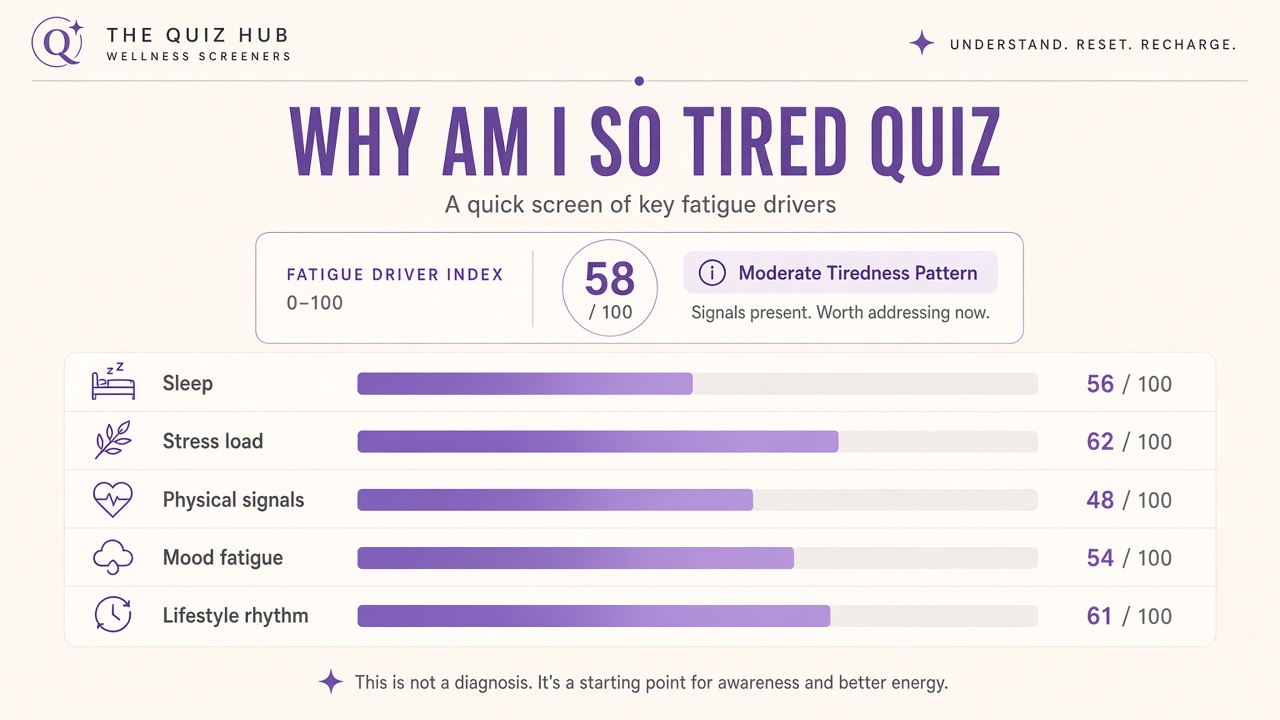
What your fatigue screening report looks like
After you finish all 25 items, your report shows a fatigue driver index score, a screening band badge, and five domain bars for sleep, stress load, physical signals, mood fatigue, and lifestyle rhythm. The highest bar highlights which tiredness driver shaped your result. Copy results to save a plain-text summary for a doctor visit. This is not medical clearance or a lab report.
What this test can and cannot tell you
Can tell you
- Whether your self-reported tiredness leans lower, moderate, or higher on this screener
- A fatigue driver index and five domain scores for sleep, stress, physical habits, mood, and rhythm
- Which domain bar scored highest when fatigue feels uneven across themes
- A starting point for conversations with a doctor about persistent low energy
Cannot tell you
- Whether you have anemia, thyroid disease, sleep apnea, diabetes, or chronic fatigue syndrome
- Whether low mood, anxiety, or burnout is the primary cause of your tiredness
- Lab values, sleep study results, or medication side effects
- Whether you need time off work, disability benefits, or specific treatments
Fatigue screening and when tiredness needs a doctor
In 2015, the National Academy of Medicine (then the Institute of Medicine) published diagnostic criteria for myalgic encephalomyelitis and chronic fatigue syndrome, emphasizing that persistent fatigue must be evaluated alongside sleep, pain, and cognitive symptoms by qualified clinicians. The Centers for Disease Control and Prevention (CDC) notes that unexplained tiredness lasting weeks can reflect treatable medical conditions such as anemia, hypothyroidism, sleep disorders, or infections, not only lifestyle habits.
The Quiz Hub built this why am I so tired quiz as a plain-language screener that separates sleep disruption, stress load, physical sluggishness, mood heaviness, and schedule chaos from occupational burnout themes. That trade-off favors readable domain feedback for casual users while encouraging medical follow-up when patterns stay high. The CDC chronic fatigue syndrome page reminds readers that only healthcare providers can diagnose ME/CFS after ruling out other causes.
| The Quiz Hub test | What it adds |
|---|---|
| Am I burnt out quiz | MBI-inspired exhaustion, cynicism, and efficacy domains over one month, not sleep hygiene or physical sluggishness |
| Depression test | PHQ-inspired low mood and anhedonia screening over two weeks, not hydration or schedule rhythm items |
| Anxiety test | GAD-7 inspired worry and tension screening, not sleep fragmentation or physical movement habits |
| Mental health test | Four-domain wellbeing snapshot including mood and sleep, not fatigue-specific physical and rhythm drivers |
| Focus test | Attention challenges and concentration habits, not unrefreshing sleep or stimulant reliance patterns |
| This why am I so tired quiz | Five fatigue driver domains with a two-week recall window and medical referral guidance |
Sample item: rating Often on waking unrefreshed raises your sleep domain score. Rating Very often on skipping movement raises physical health signals. Rating Rarely on feeling motivated lowers your mood fatigue score because that item is reverse-coded. Burnout, depression, and anxiety can all include tiredness, so clinicians often screen multiple themes during evaluation. Browse more screeners on our mental health and clinical hub or read how we review quizzes in our editorial policy.
Why am I so tired quiz FAQ
What does this why am I so tired quiz measure?
This fatigue screener measures self-reported frequency of tiredness drivers across sleep quantity and quality, stress and mental load, physical health signals such as hydration and movement, mood-related heaviness, and lifestyle rhythm over the past two weeks. Twenty-five original plain-language items map to five domains. Results show a screening band and domain scores on a 0 to 100 fatigue driver index. It is not a clinical diagnosis.
Does a higher screening result mean I have a medical condition?
No. A higher screening signal means your responses suggest frequent tiredness patterns on this abbreviated screener. Only a licensed clinician can evaluate anemia, thyroid disease, sleep apnea, depression, chronic fatigue syndrome, or other causes through exams and labs. Online tests cannot confirm or deny a diagnosis.
How is this different from the am I burnt out quiz?
The am I burnt out quiz focuses on occupational strain themes such as emotional exhaustion, cynicism, and reduced efficacy over one month. This why am I so tired quiz maps sleep disruption, physical sluggishness, mood heaviness, and schedule chaos separately from workplace burnout. Fatigue and burnout overlap but are not identical.
When should I see a doctor about fatigue?
Consider medical evaluation when tiredness lasts more than two to four weeks without a clear cause, worsens with minimal activity, or comes with unexplained weight change, fever, severe pain, or shortness of breath. Bring your result summary and describe sleep patterns, medications, and daily impact. If you feel unsafe or in crisis, call or text 988 (US) or your local crisis line.
How long does the why am I so tired quiz take?
Most people finish in about 6 minutes. There are 25 items on a five-point frequency scale from Never to Very often with a two-week recall window. You can pause and return in the same browser session thanks to autosave.
Who reviewed this content?
Dr. Elena Vasquez, PhD, reviewed the test framing and result explanations. See our editorial policy for review standards.
Reviewed by