What this autism test measures
This autism test maps self-reported patterns linked with autism spectrum traits in research settings: social comfort, communication friction, imagination play, and routine switching. The framework draws on Baron-Cohen Autism Quotient domain themes from developmental psychology, adapted here with original item wording across four focused dimensions.
Social interaction
Group comfort, friendship effort, small talk strain, and energy after social events.
Communication style
Literal language, conversation timing, sarcasm grasp, and indirect speech confusion.
Imagination and play
Pretend play interest, fiction absorption, perspective taking, and deep topic focus.
Attention switching
Routine flexibility, task focus, sensory sensitivity, and recovery after interruptions.
How it works
Three steps from first question to your trait band. Click Start Quiz to open the interactive autism test in a full-screen modal.
Answer 30 statements
Rate how much you agree with each item on a five-point scale from strongly disagree to strongly agree.
Items map to four dimensions
Your answers accumulate scores across social, communication, imagination, and attention switching clusters.
View band and dimension chart
Results show a percentage, low/moderate/elevated band, dimension bars, highlights, and honest limits.
Take the autism test
Rate 30 statements about social life, communication habits, imagination, and routine flexibility. Your overall percentage maps to a trait band from low through elevated.
Opens in a focused modal. No account required. Results stay on screen.
What your result means
Your overall percentage sums all thirty items on a 30-to-150 raw scale. The band label groups that total into plain-language ranges. Read dimension bars when the headline band feels too broad or you want to know which facet drives your score.
| Score range | Band | Typical reading |
|---|---|---|
| 0% to 39% | Low trait band | Fewer reported social, communication, or routine-switching strains |
| 40% to 69% | Moderate trait band | Mixed comfortable and strained answers depending on context |
| 70% to 100% | Elevated trait band | Stronger agreement with autistic-type trait items worth discussing with a clinician |
Four dimensions on one autism trait spectrum
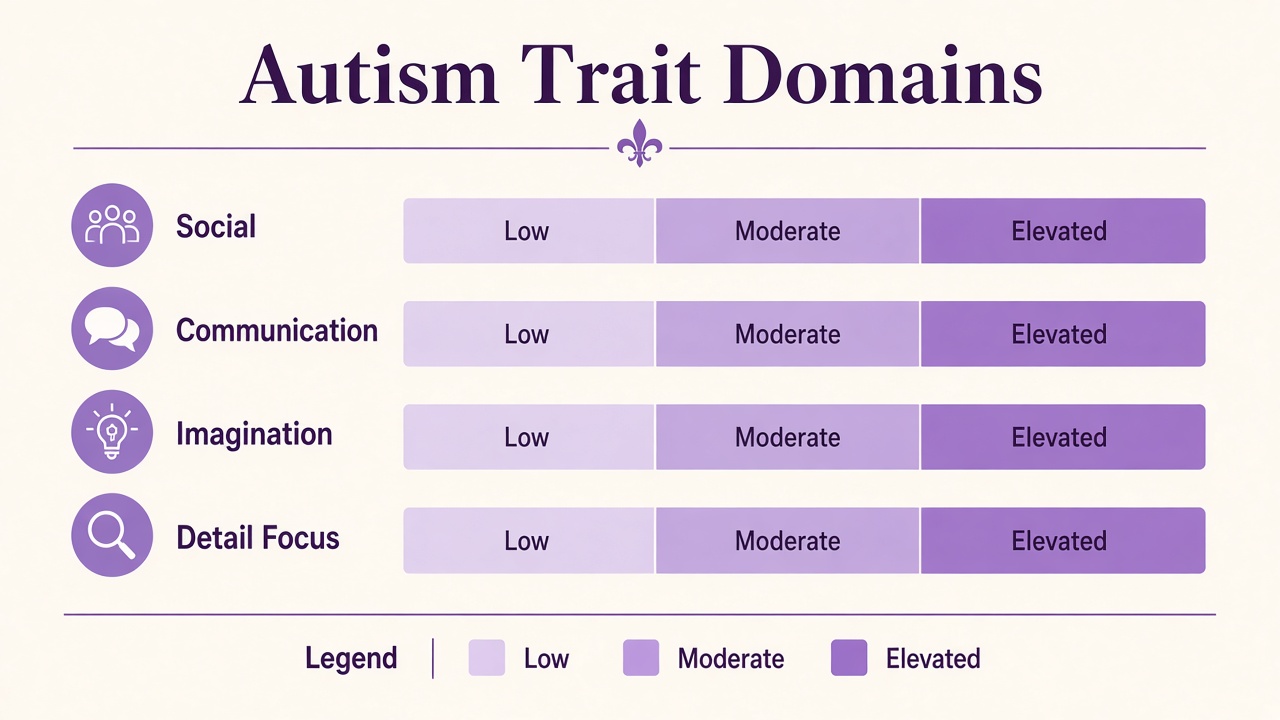
Autism research treats social, communication, imagination, and attention switching as continuous dimensions, not a type you either have or lack. This diagram shows the three bands used on The Quiz Hub plus the four domain areas behind your score. Compare with our VVIQ imagery quiz for visual imagination reflection or the Big Five personality test for broad trait domains.
What this test can and cannot tell you
Can tell you
- How strongly your self-report matches social, communication, imagination, and switching items
- Which of four dimensions score highest for you today
- A plain-language low/moderate/elevated band for reflection before formal evaluation
- A starting point when exploring neurodevelopmental patterns with a clinician
Cannot tell you
- Whether you have autism spectrum disorder, Asperger syndrome, or ADHD
- Clinical cutoffs from the published AQ-10, AQ-50, or RAADS-R instruments
- School accommodations, workplace adjustments, or disability eligibility
- Scores that replace developmental history interviews with a licensed provider
Where autism trait screening research comes from
Developmental psychologists study autism spectrum traits through structured questionnaires and clinical interviews. Simon Baron-Cohen and colleagues published the Autism Quotient (AQ) in 2001 as a self-report measure spanning social skill, attention switching, attention to detail, communication, and imagination domains. AQ scores correlate with clinical samples but online abbreviations cannot replicate validated cutoffs.
The Quiz Hub autism test uses thirty original items across four AQ-inspired clusters, not a verbatim published clinical form. Scoring follows the same idea: higher agreement with trait items raises your overall percentage. If you want broader personality context, start with our Big Five personality test. For mental health screeners in the same hub, browse mental health and clinical tests. Peer-reviewed context appears in Autism journal literature on adult screening tools.
Sample item: "I get confused when people hint instead of stating what they want directly." High agreement nudges your communication dimension score. Low agreement does not mean you never miss subtext; it may mean you usually catch indirect speech in familiar settings. Trait scores shift with masking, mood, and setting, so treat bands as conversation starters with trusted clinicians, not verdicts. Late-diagnosed adults often score elevated here while still needing formal assessment to confirm fit.
Autism test FAQ
What does this autism test measure?
This screener measures self-reported patterns across social interaction, communication style, imagination and play, and attention switching from thirty agree-disagree statements. It groups answers into low, moderate, or elevated autistic-type trait bands for reflection. It is not a diagnosis of autism spectrum disorder.
Does an elevated band mean I am autistic?
No. An elevated band means you agreed more with items about social friction, literal communication, limited pretend play, or routine distress in this quiz. Only a qualified clinician can assess autism spectrum disorder. Many elevated scorers pursue formal evaluation and still receive varied outcomes.
How is this different from the official AQ-10 or AQ-50?
Baron-Cohen Autism Quotient instruments use validated item sets and cutoffs for research settings. The Quiz Hub autism test uses thirty original items inspired by AQ domain themes, not verbatim published forms. Scores here cannot be compared to clinical AQ thresholds.
How long does the autism test take?
Most people finish in about six minutes. There are thirty items on a five-point agree scale. You can pause and return in the same browser session thanks to autosave.
Is this quiz clinical or diagnostic?
No. It does not screen for autism spectrum disorder, Asperger syndrome, or any neurodevelopmental condition. It does not replace developmental history interviews or licensed assessment. It is educational self-reflection only, with crisis resources linked on the limits section.
Who reviewed this content?
Dr. Elena Vasquez, PhD, reviewed the test framing and result explanations. See our editorial policy for review standards.
Reviewed by