What this am I anxious or normal quiz measures
Searching "am I anxious or normal" usually means you notice worry or tension and wonder whether it is ordinary life stress or something more persistent. This quiz maps 23 self-report items across three domains over the past two weeks: everyday stress reactivity, persistent worry and body signals, and functional interference with sleep, work, and relationships.
-
Everyday stress reactivity
Situational nerves before deadlines, busy weeks, and proportional stress that many adults recognize and recover from.
-
Persistent worry and body signals
Uncontrollable worry, dread, reassurance seeking, rumination, and physical arousal without clear triggers.
-
Functional interference
Sleep disruption, concentration problems, avoidance, and strain on work performance or relationships.
-
Two-week recall window
Items ask about frequency over the past two weeks, matching common primary care anxiety screening recall periods.
How it works
Three steps from first question to your screening band. Click Start Quiz to open the interactive quiz in a full-screen modal.
-
Answer 23 frequency items
Rate each statement from Never to Very often. There is no timer and no auto-advance between items.
-
Items map to three domains
Your answers build percentages for everyday stress, persistent worry, and functional interference, then combine into an anxiety-vs-baseline index from 0 to 100.
-
View screening band and domain bars
Results show a Mostly Everyday Stress, Mixed Worry Pattern, or Higher Anxiety Signals band with three domain bars and plain-language next steps.
Take the am I anxious or normal quiz
Rate 23 statements on a five-point frequency scale. Your answers produce an anxiety-vs-baseline index, three domain scores, and a screening band with honest limits on what self-report can show.
Opens in a focused modal. No account required. Results stay on screen.
What your result means
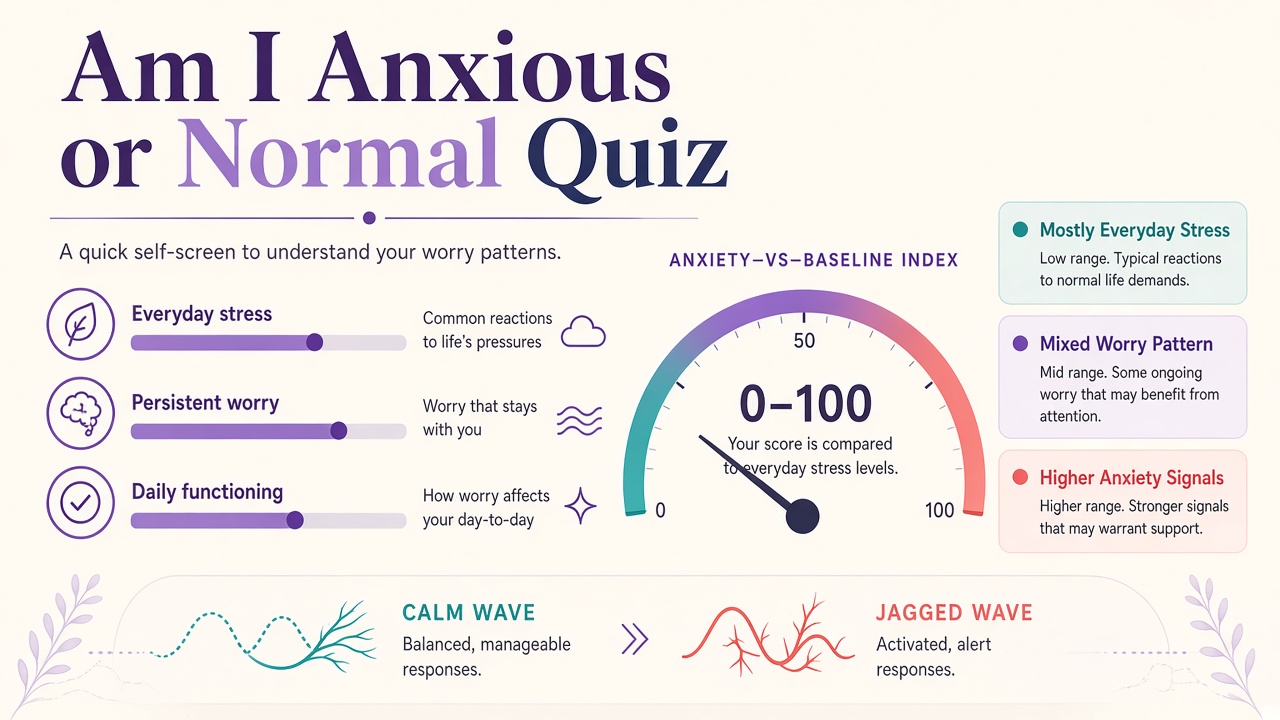
Your anxiety-vs-baseline index is the average of everyday stress, persistent worry, and functional interference domain scores, each normalized to 0 through 100. The screening band groups that average into plain-language patterns. Domain bars show whether situational nerves, racing thoughts, or daily interference drives your result.
| Screening band | Index range | Typical reading |
|---|---|---|
| Mostly Everyday Stress | 0 to 35 | Lower persistent worry and interference; stress looks situational |
| Mixed Worry Pattern | 36 to 65 | Blend of everyday nerves and more persistent worry worth monitoring |
| Higher Anxiety Signals | 66 to 100 | Frequent worry, tension, or daily interference that may warrant evaluation |
What your anxiety screening report looks like
Your results screen shows the anxiety-vs-baseline index as a score from 0 to 100 with a screening band badge underneath. Three domain bars rank everyday stress, persistent worry, and daily functioning so you can see whether your pattern looks like baseline nerves or more persistent clinical worry signals.
What this quiz can and cannot tell you
Can tell you
- Whether your self-reported symptoms lean toward everyday stress or more persistent worry patterns
- An anxiety-vs-baseline index and three domain scores for comparison
- Which domain (stress reactivity, worry, or functioning) drives your screening band
- A starting point for conversations with a clinician about anxiety evaluation
Cannot tell you
- Whether you have generalized anxiety disorder or any other clinical condition
- Whether your worry is "normal" or "anxious" as a verdict label
- Whether you need medication, therapy type, or workplace accommodations
- Whether symptoms are better explained by thyroid disease, substance use, or trauma
Everyday nerves versus clinical anxiety patterns
The American Psychological Association notes that anxiety is a normal stress response when it is brief and tied to a real threat or deadline. Clinical anxiety patterns differ when worry persists without a clear cause, physical symptoms appear during calm moments, and sleep, work, or relationships suffer for weeks. The National Institute of Mental Health (NIMH) reports that anxiety disorders are among the most common mental health conditions and that evidence-based treatments such as cognitive behavioral therapy can reduce symptom burden when patterns persist.
The Quiz Hub built this am I anxious or normal quiz for people who search that exact question and want a structured comparison rather than a yes-or-no label. Twenty-three items separate situational stress reactivity from persistent worry and functional interference so your screening band reflects patterns, not a verdict that you are "normal" or "anxious."
| Related test | What it adds |
|---|---|
| Anxiety test | GAD-7 inspired core items plus supplemental worry and somatic tension domains with GAD-7 equivalent score |
| Social anxiety test | SPIN-inspired fear, avoidance, and arousal domains for judgment-focused worry, not generalized baseline comparison |
| Depression test | PHQ-inspired mood and anhedonia items over two weeks, not anxiety-vs-baseline framing |
| Mental health test | Four-domain wellbeing snapshot including mood and sleep, not anxiety-specific baseline comparison |
| Am I normal quiz | Emotional stability, social comparison, and functioning reflection, not worry frequency over two weeks |
| This quiz | Everyday stress vs persistent worry vs functional interference with anxiety-vs-baseline index |
Sample item: rating Often on losing sleep before a known stressful event raises your everyday stress domain. Rating Very often on worry without a clear trigger raises persistent worry. Caffeine, sleep debt, and thyroid problems can mimic anxiety symptoms, so clinicians rule out other causes during evaluation. Browse more screeners on our mental health and clinical hub or read how we review quizzes in our editorial policy.
Am I anxious or normal quiz FAQ
What does the am I anxious or normal quiz measure?
This quiz compares three patterns over the past two weeks: everyday stress reactivity (situational nerves most adults recognize), persistent worry and body signals (uncontrollable worry, dread, tension), and functional interference (sleep, work, and relationship strain). Results show an anxiety-vs-baseline index from 0 to 100 and three screening bands. It is not a clinical diagnosis.
Does a higher screening band mean I have an anxiety disorder?
No. A higher band means your responses suggest more frequent worry, tension, or daily interference on this screener. Only a licensed clinician can evaluate generalized anxiety disorder or other conditions through structured interviews and rule-out of medical causes. Online tests cannot confirm or deny a diagnosis.
How is this different from the anxiety test?
The anxiety test on The Quiz Hub uses GAD-7 inspired core items plus supplemental worry and somatic tension domains. This am I anxious or normal quiz frames the same search intent differently: it separates everyday stress reactivity from persistent clinical worry patterns so you can see whether your symptoms look like baseline nerves or something worth tracking further.
What is the difference between everyday nerves and clinical anxiety?
Everyday nerves usually tie to a clear trigger (a deadline, interview, or argument) and ease once the situation passes. Clinical anxiety patterns often include worry without a clear cause, physical arousal during calm moments, and interference with sleep, work, or relationships that persists across settings. This quiz maps both patterns on separate domain bars.
What should I do if I get a Higher Anxiety Signals band?
Consider scheduling an evaluation with your primary care doctor or a licensed therapist who treats anxiety in adults. Bring your result summary and describe when symptoms began and how they affect daily life. If you feel unsafe or in crisis, call or text 988 (US) or your local crisis line.
How long does the quiz take?
Most people finish in about 5 minutes. There are 23 items on a five-point frequency scale from Never to Very often. You can pause and return in the same browser session thanks to autosave.
Who reviewed this content?
Dr. Elena Vasquez, PhD, reviewed the test framing and result explanations. See our editorial policy for review standards.
Reviewed by