What this hikikomori test measures
This hikikomori test estimates how often you avoid social contact, stay confined at home, and struggle with daily responsibilities over the past several months. Twenty-five original items follow HQ-25 themes without reproducing the published instrument. Results group your answers into three domains and one overall screening band.
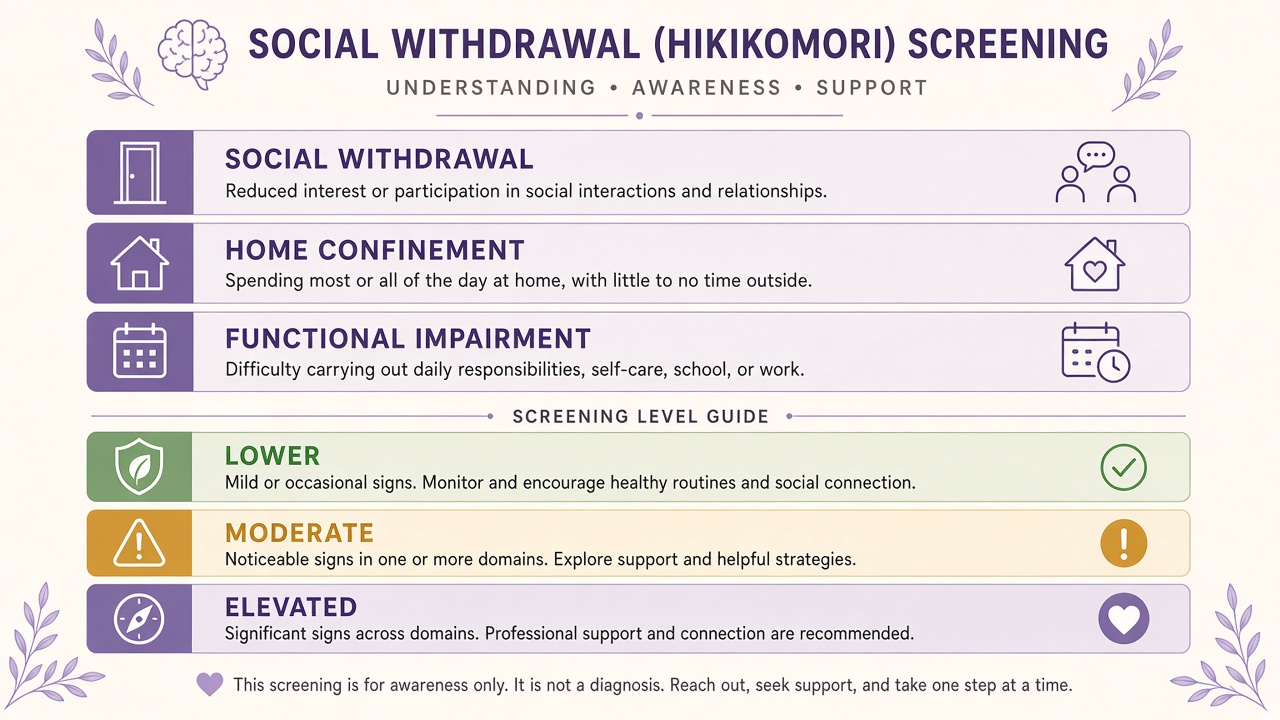
Social withdrawal
Avoiding people, declining invitations, losing touch with others, and preferring isolation over connection.
Home confinement
Staying indoors for long stretches, anxiety about leaving home, and relying on others for outside tasks.
Functional impairment
Falling behind on work, chores, self-care, sleep, meals, and other daily responsibilities.
Three screening bands
Lower, Moderate, and Elevated withdrawal bands with domain bars and crisis resources on elevated results.
How it works
Three steps from first question to your withdrawal band. Click Start Test to open the interactive quiz in a full-screen modal.
Answer 25 frequency items
Rate how often each withdrawal statement applied over the past several months on a five-point scale from Not at all to Nearly always. There is no timer and no auto-advance between items.
Items map to three domains
Your answers accumulate percentages for social withdrawal, home confinement, and functional impairment.
View band and next steps
Results show Lower, Moderate, or Elevated withdrawal with domain bars, highlights, and 988 crisis links when appropriate.
Take the hikikomori test
Rate 25 withdrawal-related statements on a five-point frequency scale. Your answers produce an overall withdrawal index, three domain scores, and a screening band with plain-language next steps.
Opens in a focused modal. No account required. Results stay on screen.
What your result means
Your overall withdrawal index is the sum of scored items normalized to 0 through 100. Higher percentages mean more frequent endorsement of withdrawal, confinement, and functioning items. Domain bars show whether social avoidance, staying indoors, or daily strain drives your result.
| Screening band | Score range | Typical reading |
|---|---|---|
| Lower Withdrawal | 0 to 35% | Relatively lower withdrawal patterns; brief homebound stretches may still occur after stress |
| Moderate Withdrawal | 36 to 65% | Mixed patterns worth monitoring, especially if persistent over months |
| Elevated Withdrawal | 66 to 100% | Frequent withdrawal that may benefit from professional support and crisis resources if distressed |
Social withdrawal, confinement, and functioning domains
The diagram below shows how domain scores appear in your results. High home confinement with moderate social contact, for example, can still land you in Moderate if your overall score sits between bands.
What this test can and cannot tell you
Can tell you
- Whether your self-reported withdrawal leans lower, moderate, or elevated on this screener
- A withdrawal index and three domain scores for social, confinement, and functioning patterns
- Which domain bar scores highest and may need attention first
- A starting point for conversations about isolation with a clinician or counselor
Cannot tell you
- Whether you have hikikomori, agoraphobia, depression, or any clinical diagnosis
- Official HQ-25 scores comparable to published research norms
- Whether your withdrawal is cultural, medical, or purely psychological in origin
- Medical causes such as chronic illness, mobility limits, or caregiving duties that keep you home
HQ-25 research and compassionate withdrawal screening
In 2018, Alan Teo and colleagues published the Hikikomori Questionnaire (HQ-25) to screen for severe social withdrawal patterns first described in Japanese clinical literature. The instrument measures social isolation, home-bound behavior, and functioning impairment over months rather than days. Research on hikikomori has since expanded internationally, with studies noting overlap between withdrawal, depression, and social anxiety cited by the National Institute of Mental Health on social connection and health.
The Quiz Hub built this hikikomori test as a plain-language screener inspired by HQ-25 themes. It uses 25 original frequency items across social withdrawal, home confinement, and functional impairment rather than the full published scale. We treat hikikomori as a severe withdrawal pattern, not a joke or insult. For perceived lack of connection when you do want contact, take our loneliness test. For low mood and anhedonia over two weeks, try our depression test. For broader wellbeing across mood, anxiety, sleep, and functioning, see our mental health test.
| The Quiz Hub test | What it adds |
|---|---|
| Loneliness test | UCLA-inspired emotional, social, and connectedness domains, not prolonged home confinement screening |
| Depression test | PHQ-inspired low mood, anhedonia, and functioning over two weeks, not months-long withdrawal patterns |
| Mental health test | General wellbeing across mood, anxiety, sleep, and functioning, not withdrawal-specific screening |
| This hikikomori test | HQ-25-inspired social withdrawal, home confinement, and functioning domains with three screening bands and 988 on elevated results |
Sample item: rating Often on avoiding meeting people raises your social withdrawal bar. Rating Nearly always on spending most waking hours indoors raises home confinement. Chronic illness, remote work, and caregiving can increase home time without reflecting hikikomori. Read how we review quizzes in our editorial policy or browse more screeners on our mental health and clinical hub.
Hikikomori test FAQ
What does this hikikomori test measure?
This hikikomori test screens self-reported social withdrawal, home confinement, and functional impairment over the past several months using 25 original plain-language items inspired by HQ-25 themes. Results show an overall withdrawal index, three domain bars, and a screening band from Lower through Elevated. It is a self-screening snapshot, not a clinical diagnosis.
What is hikikomori?
Hikikomori is a Japanese clinical term for severe social withdrawal lasting months or longer, often with significant impact on work, school, and relationships. It is not an insult or a label for introverts. This test uses the term respectfully to describe a pattern of prolonged isolation and functioning strain, not everyday shyness or a preference for quiet time.
How is this related to the HQ-25 questionnaire?
The Hikikomori Questionnaire (HQ-25) was developed by Teo and colleagues to screen for hikikomori-related social withdrawal and functioning impairment. Our online screener uses original wording on similar themes such as avoiding contact, staying indoors, and falling behind on daily tasks, but it is not the published HQ-25 instrument and is not validated for research or clinical use.
Is hikikomori the same as depression or loneliness?
Withdrawal, depression, and loneliness often overlap but are not identical. Depression includes low mood, hopelessness, and loss of interest. Loneliness focuses on perceived lack of connection. Hikikomori emphasizes prolonged social avoidance and home confinement with functioning impact. This test screens withdrawal specifically. If sadness or disconnection also dominate, take our depression test, loneliness test, or mental health test.
What should I do if I scored in the Elevated band?
An Elevated band suggests frequent withdrawal patterns on these items. Consider talking with a counselor, therapist, or primary care clinician about gradual re-entry and underlying causes such as anxiety or depression. If hopelessness or self-harm thoughts appear, call or text 988 (US) or your local crisis line immediately. This quiz is not an emergency service.
Who reviewed this content?
Dr. Elena Vasquez, PhD, reviewed the test framing and result explanations. See our editorial policy for review standards.
Reviewed by