What this loneliness test measures
This loneliness test estimates how often you feel emotionally isolated, socially understaffed, or disconnected from the bonds others seem to share. Twenty-two original items follow UCLA Loneliness Scale themes without reproducing the published instrument. Results group your answers into three domains and one overall screening band.
Emotional loneliness
Missing confiding relationships, intimate understanding, and someone to turn to when life gets hard.
Social loneliness
Lacking day-to-day companionship, friend networks, invitations, and regular social contact you would prefer.
Connectedness deficit
Feeling left out, out of touch, or like an outsider when others form bonds you are not part of.
Three screening bands
Lower, Moderate, and Elevated loneliness bands with domain bars and crisis resources on elevated results.
How it works
Three steps from first question to your loneliness band. Click Start Test to open the interactive quiz in a full-screen modal.
Answer 22 frequency items
Rate how often each loneliness statement applies from Never to Very often. There is no timer and no auto-advance between items.
Items map to three domains
Your answers accumulate percentages for emotional loneliness, social loneliness, and connectedness deficit.
View band and next steps
Results show Lower, Moderate, or Elevated loneliness with domain bars, highlights, and 988 crisis links when appropriate.
Take the loneliness test
Rate 22 loneliness-related statements on a five-point frequency scale. Your answers produce an overall loneliness index, three domain scores, and a screening band with plain-language next steps.
Opens in a focused modal. No account required. Results stay on screen.
What your result means
Your overall loneliness index is the average of emotional, social, and connectedness domain scores, each normalized to 0 through 100. Higher percentages mean more frequent endorsement of loneliness items. Domain bars show whether missing intimacy, lacking friends, or feeling left out drives your result.
| Screening band | Score range | Typical reading |
|---|---|---|
| Lower Loneliness | 0 to 35% | Relatively lower perceived loneliness; brief spells may still occur after transitions |
| Moderate Loneliness | 36 to 65% | Mixed connection and loneliness worth monitoring, especially if persistent |
| Elevated Loneliness | 66 to 100% | Frequent loneliness that may benefit from connection-focused support and crisis resources if distressed |
Emotional, social, and connectedness domains
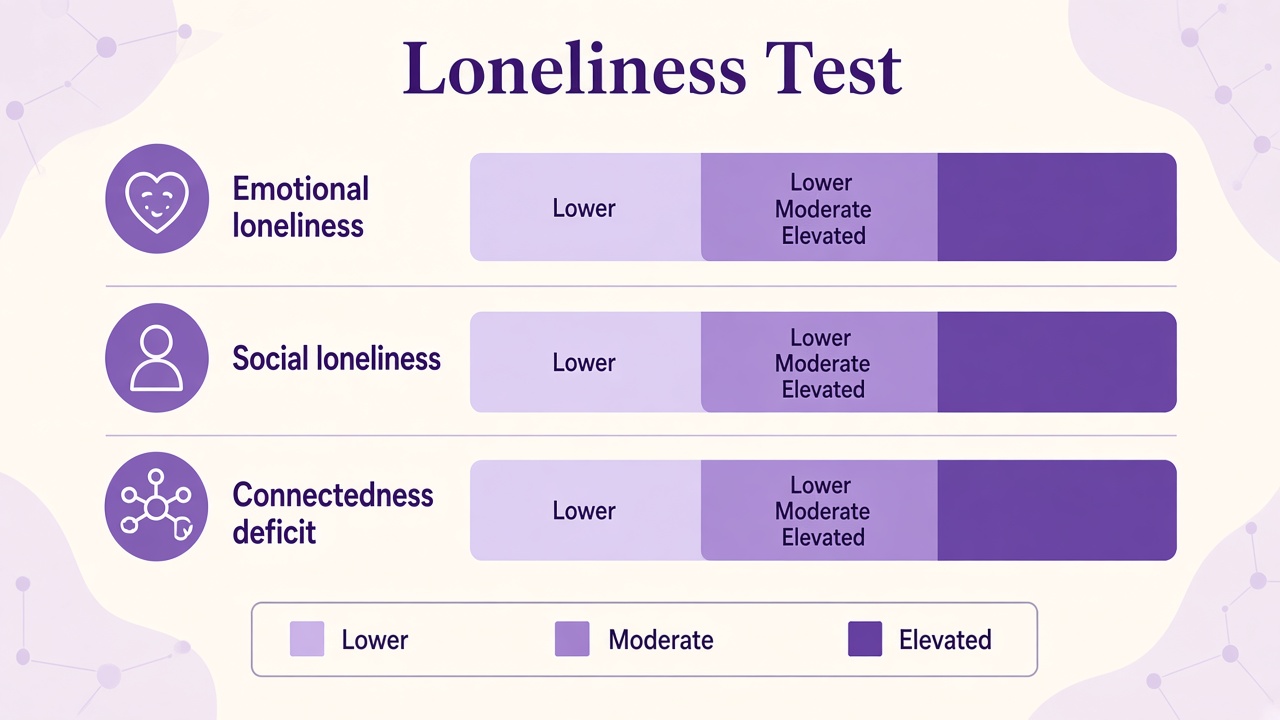
The diagram below shows how domain scores appear in your results. High emotional loneliness with moderate social contact, for example, can still land you in Moderate if your overall average sits between bands.
What this test can and cannot tell you
Can tell you
- Whether your self-reported loneliness leans lower, moderate, or elevated on this screener
- A loneliness index and three domain scores for emotional, social, and connectedness patterns
- Which domain bar scores highest and may need attention first
- A starting point for conversations about social connection with a clinician or counselor
Cannot tell you
- Whether you have depression, social anxiety disorder, or any clinical condition
- Official UCLA Loneliness Scale scores comparable to published research norms
- How many friends you objectively have or whether others perceive you as lonely
- Medical causes such as hearing loss, mobility limits, or caregiving isolation
UCLA loneliness research and everyday connection
In 1978, Daniel Russell and colleagues published the UCLA Loneliness Scale, later revised as Version 3 in 1996. The instrument measures subjective loneliness through items about lacking companionship, feeling left out, and missing confiding relationships. High loneliness scores predict poorer sleep, immune function, and mood over time in longitudinal research cited by the National Institute of Mental Health.
The Quiz Hub built this loneliness test as a plain-language screener inspired by UCLA themes. It uses 22 original frequency items across emotional loneliness, social loneliness, and connectedness deficit rather than the full published scale. That trade-off favors readability for casual users while naming the Russell et al. source honestly. For mood-focused screening when sadness and withdrawal dominate, take our depression test. For broader wellbeing across mood, anxiety, sleep, and functioning, try our mental health test. For fear of judgment and social avoidance over two weeks, see our social anxiety test.
| The Quiz Hub test | What it adds |
|---|---|
| Depression test | PHQ-inspired low mood, anhedonia, and functioning over two weeks, not loneliness-specific screening |
| Mental health test | General wellbeing across mood, anxiety, sleep, and functioning, not connection deficit alone |
| Social anxiety test | SPIN-inspired fear, avoidance, and arousal in social settings, not perceived lack of companionship |
| This loneliness test | UCLA-inspired emotional, social, and connectedness domains with three screening bands and 988 on elevated results |
Sample item: rating Often on lacking someone to turn to raises your emotional loneliness bar. Rating Very often on feeling left out raises connectedness deficit. Remote work, bereavement, and chronic illness can increase loneliness without reflecting a personality flaw. Read how we review quizzes in our editorial policy or browse more screeners on our mental health and clinical hub.
Loneliness test FAQ
What does this loneliness test measure?
This loneliness test measures self-reported frequency of emotional loneliness, social loneliness, and connectedness deficit using 22 original plain-language items inspired by UCLA Loneliness Scale themes. Results show an overall loneliness index, three domain bars, and a screening band from Lower through Elevated. It is a self-screening snapshot, not a clinical diagnosis.
Is loneliness the same as being alone?
No. Being alone describes how much time you spend without others. Loneliness describes whether your social and emotional needs feel met. Many people enjoy solitude yet feel connected, while others can feel lonely in a crowd. This test asks about perceived lack of companionship and belonging, not hours spent alone.
How is this related to the UCLA Loneliness Scale?
The UCLA Loneliness Scale (Version 3) was developed by Russell and colleagues and is widely used in loneliness research. Our online screener uses original wording on similar themes such as lacking companionship, feeling left out, and missing confiding relationships, but it is not the published UCLA instrument and is not validated for research or clinical use.
Can loneliness cause depression?
Persistent loneliness and depression often overlap. Loneliness can worsen low mood, sleep, and motivation over time, while depression can make social contact harder to initiate. This test screens loneliness specifically. If sadness, hopelessness, or withdrawal dominate, take our depression test or mental health test and consider talking with a clinician.
What should I do if I scored in the Elevated band?
An Elevated band suggests frequent perceived loneliness on these items. Consider structured social connection, support groups, or counseling focused on belonging. If hopelessness or self-harm thoughts appear, call or text 988 (US) or your local crisis line immediately. This quiz is not an emergency service.
Who reviewed this content?
Dr. Elena Vasquez, PhD, reviewed the test framing and result explanations. See our editorial policy for review standards.
Reviewed by