
What this Type A B C D test measures
The Type A B C D model groups temperament patterns linked to pace, perfectionism, and stress response. Friedman and Rosenman popularized Type A (competitive, urgent) versus Type B (relaxed). Later writers added Type C (detail-anxious) and Denollet's Type D (distressed, inhibited).
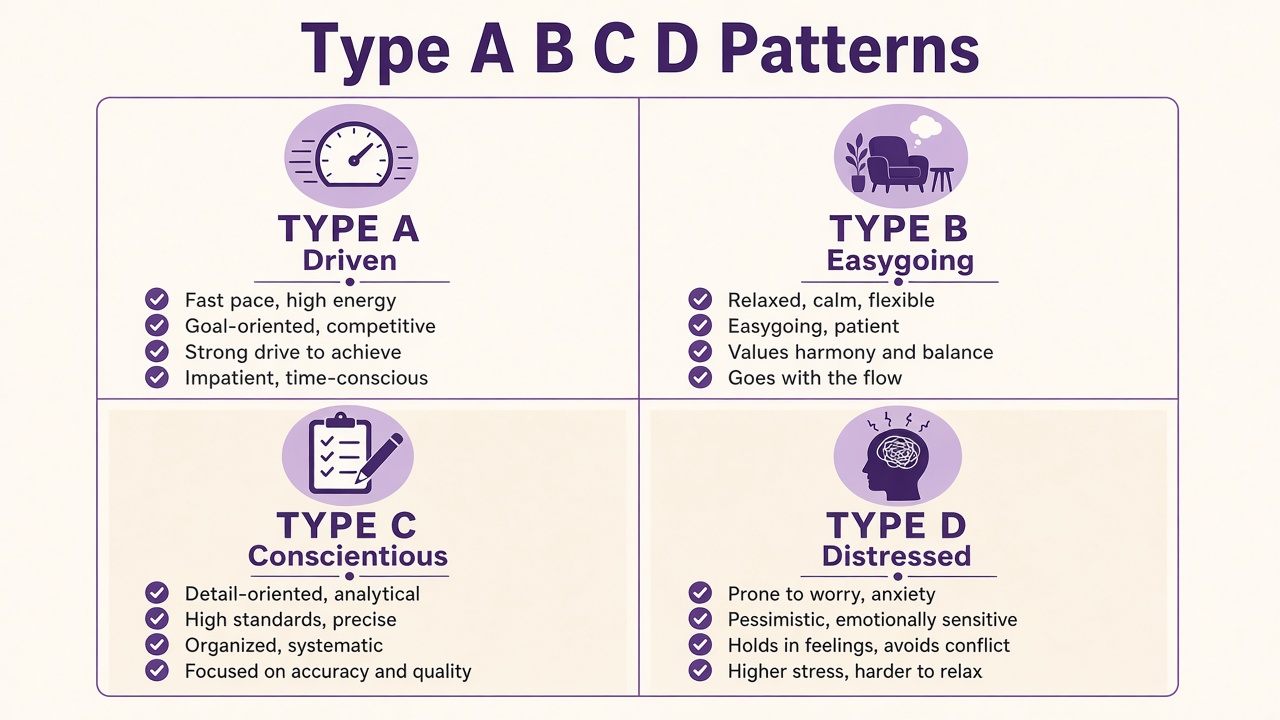
Type A · Driven
Competitive, time-urgent, achievement-focused pace.
Type B · Easygoing
Patient, flexible, lower sense of deadline pressure.
Type C · Conscientious
Detail-oriented, careful, worry about errors.
Type D · Distressed
Pessimistic outlook with social inhibition.
How it works
Three steps from first question to your type profile. Click Start Test to open the interactive quiz in a full-screen modal.
Answer 48 statements
Rate how much you agree with each temperament item on a five-point scale.
Items map to four types
Your answers accumulate scores across driven, easygoing, conscientious, and distressed patterns.
View primary type and blend
Results show your highest type, secondary influence, score chart, strengths, and stress notes.
Take the Type A B C D personality test
Rate 48 temperament statements on a five-point agree-disagree scale. Your answers reveal a likely primary type (A, B, C, or D) plus a secondary influence that adds nuance.
Opens in a focused modal. No account required. Results stay on screen.
What your result means
Your primary type is the pattern with the highest item score. The secondary type is the next highest, forming a blend label such as AB or CD.
| Score pattern | Typical reading |
|---|---|
| One type clearly highest | Strong primary signal; secondary adds nuance |
| Two types close together | You may blend patterns; read both profiles |
| High Type D score | May reflect distress; consider professional support if persistent |
| Flat scores across types | Many neutral answers; retake when you can respond decisively |
The four Type A B C D patterns
Types A and B emerged from cardiology research on behavior and stress. Types C and D appear in health psychology and popular temperament writing with less standardized definitions.
What this test can and cannot tell you
Can tell you
- Your self-reported pace, worry, and stress-response tendencies
- A likely primary and secondary type blend from 48 items
- Plain-language strengths, growth edges, and stress notes
- A starting point for reflection on work-life pace and coping
Cannot tell you
- Cardiac risk or any medical diagnosis
- Official Friedman-Rosenman Structured Interview results
- Whether you should be hired or promoted
- Clinical depression, anxiety, or personality disorder status
Understanding the Type A B C D framework
In the 1950s, cardiologists Meyer Friedman and Ray Rosenman observed that some patients showed a cluster of competitive, impatient behaviors they called Type A, contrasted with a calmer Type B style. Their early work linked Type A to heart disease risk, though later meta-analyses found smaller and more complex effects than first reported. The model entered popular culture as shorthand for "workaholic" versus "laid-back" temperament.
Type C and Type D are not part of the original Friedman-Rosenman pair. Type C appears in wellness writing as a perfectionistic, worry-prone pattern. Psychologist Johan Denollet defined Type D (distressed) as negative affectivity combined with social inhibition, with research tying it to poorer outcomes in cardiac rehabilitation. Our quiz uses plain-language items inspired by these threads but is not a validated clinical instrument.
Many readers pair Type A B C D results with other frameworks. The Big Five personality test offers research-backed trait percentiles including neuroticism and conscientiousness. The DISC behavioral style test scores workplace pace and priorities. For motivation patterns, the Enneagram motivation quiz maps nine core types. Browse more tests on our personality psychology hub.
Type A B C D personality test FAQ
What are Type A, B, C, and D personalities?
Type A describes competitive, time-urgent patterns linked to cardiologists Meyer Friedman and Ray Rosenman. Type B describes a more relaxed, patient style. Type C often refers to detail-focused, anxious perfectionism in popular writing. Type D (distressed) combines negative outlook with social inhibition, studied by psychologist Johan Denollet.
How long does this Type A B C D test take?
Most people finish in about 8 minutes. There are 48 agree-disagree statements. You can pause and return in the same browser session.
Is Type A personality linked to heart disease?
Early Friedman-Rosenman research suggested Type A behavior correlated with cardiac risk, but later studies found weaker and more nuanced links. This online quiz cannot assess your cardiovascular health or replace medical evaluation.
What is the difference between Type C and Type D?
Type C in popular models emphasizes perfectionism and worry about mistakes. Type D (distressed) emphasizes pessimism plus reluctance to share feelings. They overlap in worry but differ in social withdrawal and outlook.
How is this different from DISC or Big Five?
Type A B C D models focus on pace, stress response, and health-related temperament labels. DISC maps workplace behavioral styles. The Big Five measures continuous trait scores across five research domains.
Can I use this test for hiring or diagnosis?
No. This quiz is for personal reflection and education only. It is not a clinical instrument, not the original Structured Interview, and not validated for employment or medical decisions.
Who reviewed this content?
Dr. James Whitfield, PhD, reviewed the test framing and result explanations. See our editorial policy for review standards.
Reviewed by
