What this brain test measures
This brain test screens seven self-reported engagement domains that shape how mentally active your days feel. Twenty-four agree-disagree statements cover sharpness, curiosity, puzzle enjoyment, fatigue, sleep and caffeine, brain-training habits, and reading time. Three light multiple-choice puzzles add a small accuracy check without turning the quiz into an IQ exam.
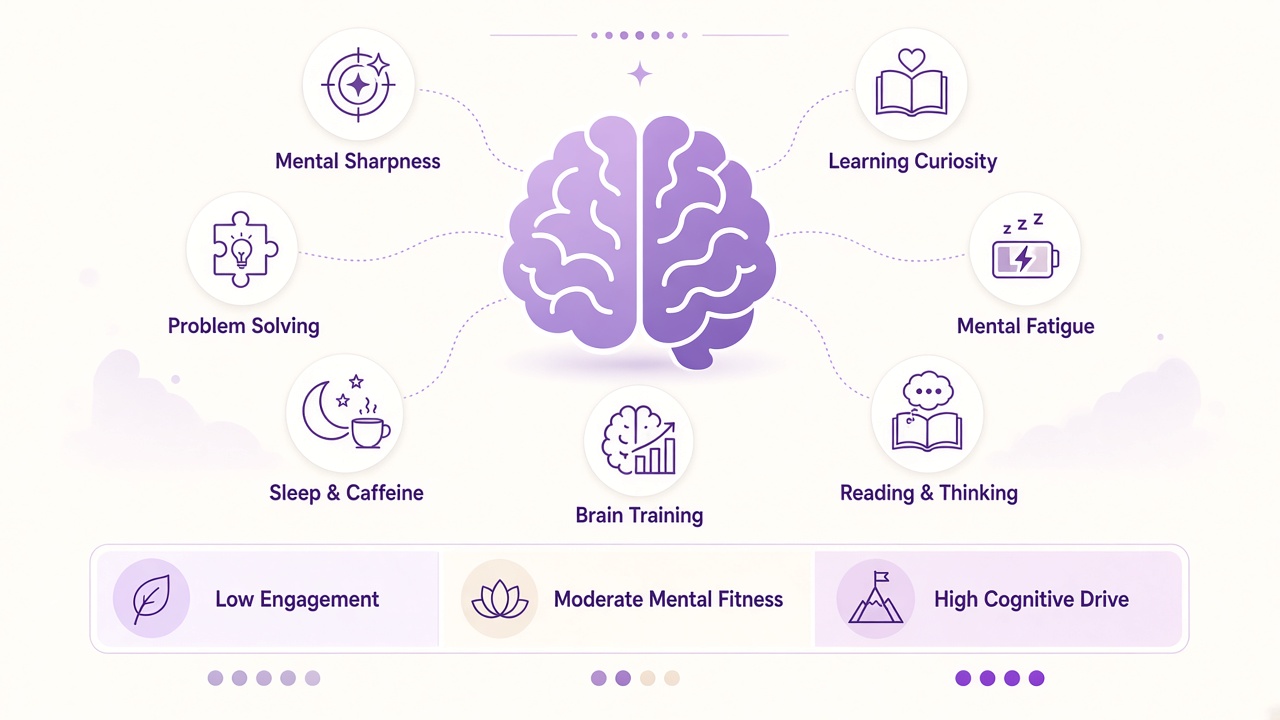
Mental sharpness
How alert and quick your thinking feels after waking and during ordinary tasks.
Learning curiosity
Interest in new topics, random facts, and skills beyond your daily routine.
Problem-solving enjoyment
Whether puzzles, strategy, and tricky tasks feel fun rather than draining.
Mental fatigue patterns
Afternoon slumps, post-work brain fog, and how fast you recover focus.
Sleep and caffeine
Self-reported rest quality and whether caffeine is required to feel switched on.
Brain training habits
Use of apps, games, or drills aimed at mental warm-up and exercise.
Reading and thinking time
Weekly reading, reflection, and whether scrolling crowds out deeper thought.
How it works
Three steps from first statement to your brain engagement band. Click Start Brain Test to open the interactive quiz in a full-screen modal.
Answer 24 habit statements
Rate how much you agree with each item on a five-point scale from strongly disagree to strongly agree. Some items are reverse-coded so that agreeing with brain fog lowers your score.
Solve 3 light puzzles
Three short multiple-choice items test sequences, analogies, and simple patterns. They carry 10 percent weight in the final index.
View index and domain chart
Results show a brain engagement index from 0 to 100, a band label, seven domain bars ranked lowest to highest, and suggested next steps.
Take the brain test
Rate 24 cognitive engagement statements about how your brain feels and what you do for mental stimulation today. Three light puzzles add a small accuracy check. Your answers produce a brain engagement index and one of three bands with a seven-domain breakdown chart.
Opens in a focused modal. No account required. Results stay on screen.
What your result means
Your brain engagement index blends habit ratings (90 percent) with light puzzle accuracy (10 percent) on a 0 to 100 scale. Higher percentages mean more agreement with engaged-habit items and less agreement with fog, avoidance, or passive-scroll items. The band label groups that score into plain-language stages for self-reflection.
| Engagement band | Index range | Typical reading |
|---|---|---|
| Low Engagement | 0% to 35% | More fatigue, less curiosity, or lighter mental stimulation habits on these items |
| Moderate Mental Fitness | 36% to 65% | Mixed strengths across domains; chart shows where growth edges sit |
| High Cognitive Drive | 66% to 100% | Steadier curiosity, reading, and puzzle enjoyment on this snapshot |
Seven domains of cognitive engagement
The diagram below shows how domain scores feed a brain engagement index. Strong curiosity with weaker sleep habits, for example, can still land you in a Moderate Mental Fitness band until rest patterns catch up.
What this test can and cannot tell you
Can tell you
- How your self-reported engagement habits cluster across seven domains
- A band label and percentage for reflection today
- Which domain bar scores lowest and may deserve attention first
- A starting point for sleep, reading, or puzzle routines
Cannot tell you
- Whether you have dementia, Alzheimer disease, or any neurological condition
- Your real IQ score or clinical cognitive capacity
- Whether brain-training apps will permanently raise intelligence
- Medical causes of persistent brain fog or memory loss
Brain engagement habits and online brain tests
Researchers study cognitive engagement through sleep quality, learning novelty, and mentally stimulating leisure. Popular brain-training apps market daily drills, but peer-reviewed reviews find mixed transfer to real-world tasks. The Quiz Hub brain test borrows the habit-framing approach with twenty-seven original items focused on how you feel and what you do, not clinical biomarkers.
Sample habit item: agreeing that you enjoy learning something new even when it is not required raises your learning curiosity domain score. Agreeing that you need caffeine just to feel switched on lowers your sleep and caffeine score on a reverse-coded item. Sample puzzle: the sequence 3, 6, 9, 12 continues with 15 because the step is plus three each time.
For reasoning contrast, take our live IQ test with twenty-eight logic puzzles. For hemisphere thinking-style reflection, take our live left brain right brain test. For recall warm-up, take our live memory test. For emotional skill reflection, take our live EQ test. Read how we review quizzes in our editorial policy.
Brain test FAQ
What does this brain test measure?
This brain test screens self-reported cognitive engagement habits across seven domains: mental sharpness, learning curiosity, problem-solving enjoyment, mental fatigue patterns, sleep and caffeine impact, brain training app use, and reading or thinking time. It also includes three light multiple-choice puzzles. Results show a brain engagement index from 0 to 100, seven domain bars, and a band such as Low Engagement, Moderate Mental Fitness, or High Cognitive Drive. It is an informal snapshot, not a neurological diagnosis.
Is this brain test a dementia or Alzheimer screening tool?
No. The Quiz Hub built this as a recreational engagement reflection quiz, not clinical dementia screening. Online habit screeners cannot diagnose Alzheimer disease, mild cognitive impairment, or any neurological condition. If memory loss or confusion worries you, see a qualified doctor for proper evaluation.
How long does the brain test take?
Most people finish in about seven minutes. There are 27 items: twenty-four agree-disagree statements and three light puzzles. You can pause and return in the same browser session thanks to autosave.
What is the brain engagement index?
The brain engagement index is a 0 to 100 summary that blends habit ratings from twenty-four Likert items (90 percent weight) with light puzzle accuracy (10 percent weight). Bands group that index into Low Engagement, Moderate Mental Fitness, or High Cognitive Drive for everyday reflection.
How is this different from an IQ test?
The IQ test on The Quiz Hub scores correct answers on logic and pattern puzzles for a practice index. This brain test focuses on daily engagement habits such as curiosity, reading time, fatigue, and caffeine use. Neither replaces licensed neuropsychological testing.
Who reviewed this content?
Dr. James Whitfield, PhD, reviewed the test framing and result explanations. See our editorial policy for review standards.
Reviewed by