What this am I burnt out quiz measures
This burnout test estimates how often you experience emotional drain, cynicism, and reduced efficacy over the past month. Twenty-two self-report items group into three domains inspired by Maslach Burnout Inventory themes but written in original plain language for work, school, caregiving, and daily life. Your burnout index averages the three domain percentages on a 0 to 100 scale.
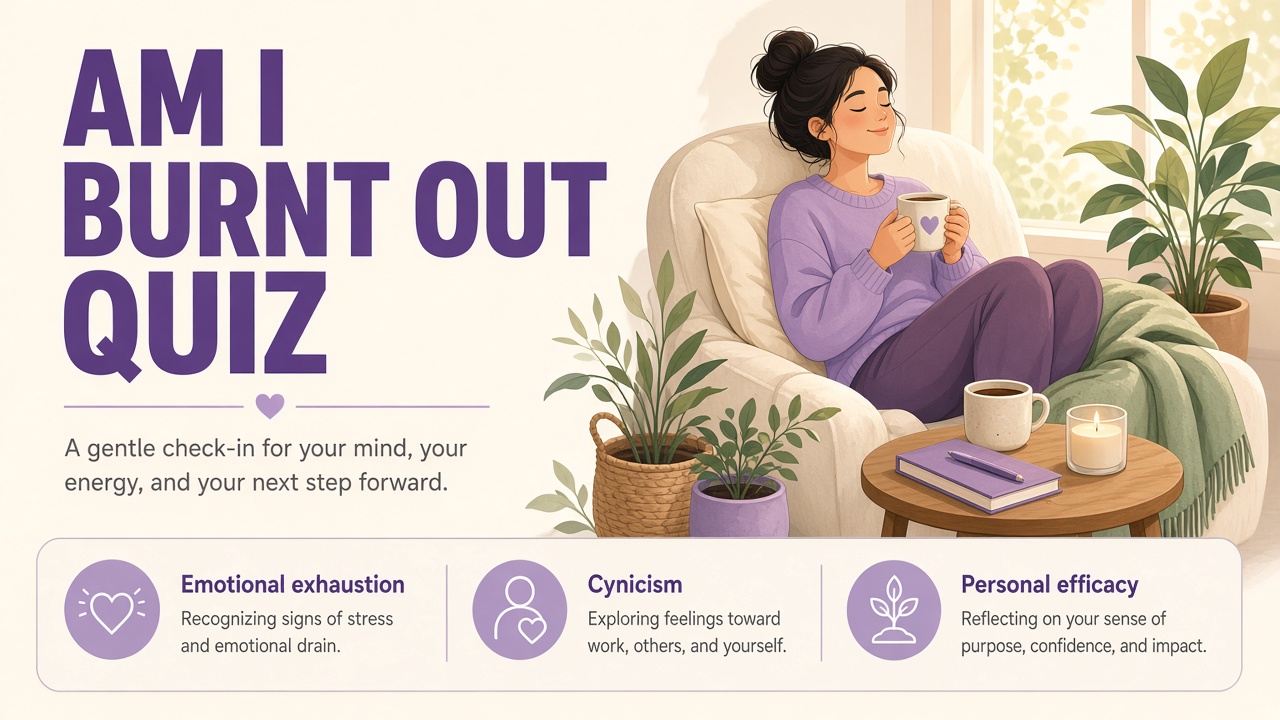
Emotional exhaustion
Feeling depleted, running on empty, struggling to start tasks, and needing extra stimulation just to get through the day.
Cynicism and detachment
Detachment from meaningful work, impatience with others, numbness, and going through the motions.
Reduced personal efficacy
Self-doubt about performance, concentration struggles, and lower confidence in your contributions.
One-month recall window
Items ask about frequency over the past month, matching common burnout screening recall used in occupational health settings.
How it works
Three steps from first question to your burnout screening band. Click Start Test to open the interactive quiz in a full-screen modal.
Answer 22 frequency items
Rate each statement from Never to Very often. There is no timer and no auto-advance between items.
Items map to three domains
Your answers accumulate percentages for emotional exhaustion, cynicism, and personal efficacy, plus an overall burnout index.
View screening band and next steps
Results show Lower Burnout Signals, Moderate Strain, or Higher Burnout Signals with domain bars and professional referral guidance when appropriate.
Take the am I burnt out quiz
Rate 22 burnout-related statements on a five-point frequency scale. Your answers produce an overall burnout index, three domain scores, and plain-language next steps based on your screening band.
Opens in a focused modal. No account required. Results stay on screen.
What your result means
Your overall burnout index is the average of emotional exhaustion, cynicism, and personal efficacy domain scores, each normalized to 0 through 100. The band groups that average into plain-language screening signals. Domain bars show whether drain, detachment, or self-doubt drives your result.
| Screening band | Score range | Typical reading |
|---|---|---|
| Lower Burnout Signals | 0 to 35% | Fewer frequent strain items; short stress spikes may still occur |
| Moderate Strain | 36 to 65% | Some frequent strain worth monitoring, especially if persistent across settings |
| Higher Burnout Signals | 66 to 100% | Frequent strain that may warrant professional evaluation and workload review |
What your burnout screening report looks like
After you finish all 22 items, your report shows a burnout index score, a screening band badge, and three domain bars for emotional exhaustion, cynicism, and personal efficacy. The highest bar highlights which theme drove your result. Copy results to save a plain-text summary for a doctor, therapist, or HR conversation. This is not employment certification or medical clearance.
What this test can and cannot tell you
Can tell you
- Whether your self-reported strain leans lower, moderate, or higher on this screener
- A burnout index and three domain scores for exhaustion, cynicism, and efficacy
- Which domain bar scored highest when strain is uneven across themes
- A starting point for conversations with a clinician or manager about workload and recovery
Cannot tell you
- Whether you have burnout syndrome, depression, anxiety, or any other clinical condition
- Official Maslach Burnout Inventory scores comparable to published research norms
- Whether you qualify for sick leave, disability benefits, or workplace accommodations
- Medical causes such as thyroid disease, anemia, sleep apnea, or medication side effects
Burnout screening and the Maslach framework
In 1981, Christina Maslach and Susan Jackson published the Maslach Burnout Inventory (MBI), a widely cited measure of occupational burnout across emotional exhaustion, depersonalization, and reduced personal accomplishment. The World Health Organization included burnout in the International Classification of Diseases (ICD-11) as an occupational phenomenon characterized by exhaustion, cynicism, and reduced professional efficacy, though it is not classified as a medical disorder. Primary care and occupational health teams often screen for these themes when patients report chronic workplace stress.
The Quiz Hub built this am I burnt out quiz as an expanded, plain-language screener inspired by MBI themes. It uses 22 original items with a one-month recall window on a five-point frequency scale. That trade-off favors readable domain feedback for casual users while naming the Maslach and Jackson (1981) source honestly. The World Health Organization notes that burnout results from chronic workplace stress that has not been successfully managed and that recovery often requires both rest and structural changes to demands.
| The Quiz Hub test | What it adds |
|---|---|
| Mental health test | Four-domain wellbeing snapshot including mood and sleep, not burnout-specific exhaustion and cynicism |
| Depression test | PHQ-inspired low mood and anhedonia screening over two weeks, not occupational cynicism domains |
| Anxiety test | GAD-7 inspired worry and tension screening, not efficacy and detachment at work |
| Focus test | Attention challenges and focus habits, not emotional exhaustion or cynicism frequency |
| Why am I so tired quiz | Sleep, stress load, physical sluggishness, mood heaviness, and lifestyle rhythm domains, not occupational cynicism |
| This am I burnt out quiz | MBI-inspired exhaustion, cynicism, and efficacy domains with a one-month recall window |
Sample item: rating Often on feeling emotionally drained raises your exhaustion domain score. Rating Very often on questioning whether your effort matters raises cynicism. Rating Rarely on feeling proud of accomplishments lowers your efficacy score because that item is reverse-coded. Grief, caregiving, and untreated mood symptoms can overlap with burnout patterns, so clinicians rule out other causes during evaluation. Browse more screeners on our mental health and clinical hub or read how we review quizzes in our editorial policy.
Am I burnt out quiz FAQ
What does this am I burnt out quiz measure?
This burnout screener measures self-reported frequency of emotional exhaustion, cynicism or detachment, and reduced personal efficacy over the past month. Twenty-two original plain-language items map to three domains inspired by Maslach Burnout Inventory themes. Results show a screening band and domain scores on a 0 to 100 index. It is not a clinical diagnosis.
Does a higher screening result mean I have burnout?
No. A higher screening signal means your responses suggest frequent strain on this abbreviated screener. Only a licensed clinician can evaluate burnout syndrome, depression, anxiety, or medical causes through structured interviews. Online tests cannot confirm or deny a diagnosis and cannot certify disability or sick leave.
How is this related to the Maslach Burnout Inventory?
Christina Maslach and Susan Jackson developed the Maslach Burnout Inventory (MBI) to measure emotional exhaustion, depersonalization, and reduced personal accomplishment in work settings. Our online screener uses original items inspired by those three themes in plain language for work, school, and life demands. It is not the published MBI and is not validated for research or employment decisions.
What should I do if I get a higher burnout screening signal?
Consider scheduling an evaluation with your primary care doctor, occupational health clinician, or a licensed therapist who treats stress-related conditions. Bring your result summary and describe when symptoms began and how they affect work, sleep, or relationships. If you feel unsafe or in crisis, call or text 988 (US) or your local crisis line.
How long does the am I burnt out quiz take?
Most people finish in about 5 minutes. There are 22 items on a five-point frequency scale from Never to Very often with a one-month recall window. You can pause and return in the same browser session thanks to autosave.
Who reviewed this content?
Dr. Elena Vasquez, PhD, reviewed the test framing and result explanations. See our editorial policy for review standards.
Reviewed by