What this am I overwhelmed quiz measures
This am I overwhelmed quiz estimates how often you experience capacity strain over the past two weeks. Twenty-two original items group into four domains that research and occupational health literature often treat separately from clinical anxiety or depression screeners: cognitive overload, emotional flooding, time pressure, and decision fatigue. Your overwhelm load index averages these patterns into a 0 to 100 score with plain-language bands.
Cognitive overload
Too many competing tasks, racing thoughts, mental clutter, and difficulty settling on one priority when everything feels urgent.
Emotional flooding
Feelings swelling faster than you can process, rapid mood shifts when demands pile up, and little emotional buffer left.
Time pressure
Schedules exceeding realistic energy, falling behind on responsibilities, rushing deadlines, and postponing recovery.
Decision fatigue
Small choices feeling draining, avoidance of decisions, second-guessing, and relief when others choose for you.
How it works
Three steps from first question to your overwhelm screening report. Click Start Quiz to open the interactive quiz in a full-screen modal.
Answer 22 frequency items
Rate each statement from Never to Very often over the past two weeks. There is no timer and no auto-advance between items.
Items map to four domains
Your answers accumulate percentages for cognitive overload, emotional flooding, time pressure, and decision fatigue, plus an overall overwhelm load index.
View screening band and next steps
Results show Lower Overwhelm, Moderate Overload, or Higher Overwhelm Signals with domain bars, highlights, and professional referral guidance when appropriate.
Take the am I overwhelmed quiz
Rate 22 overwhelm-related statements on a five-point frequency scale. Your answers produce an overwhelm load index from 0 to 100, four domain scores, and a screening band with plain-language next steps.
Opens in a focused modal. No account required. Results stay on screen.
What your result means
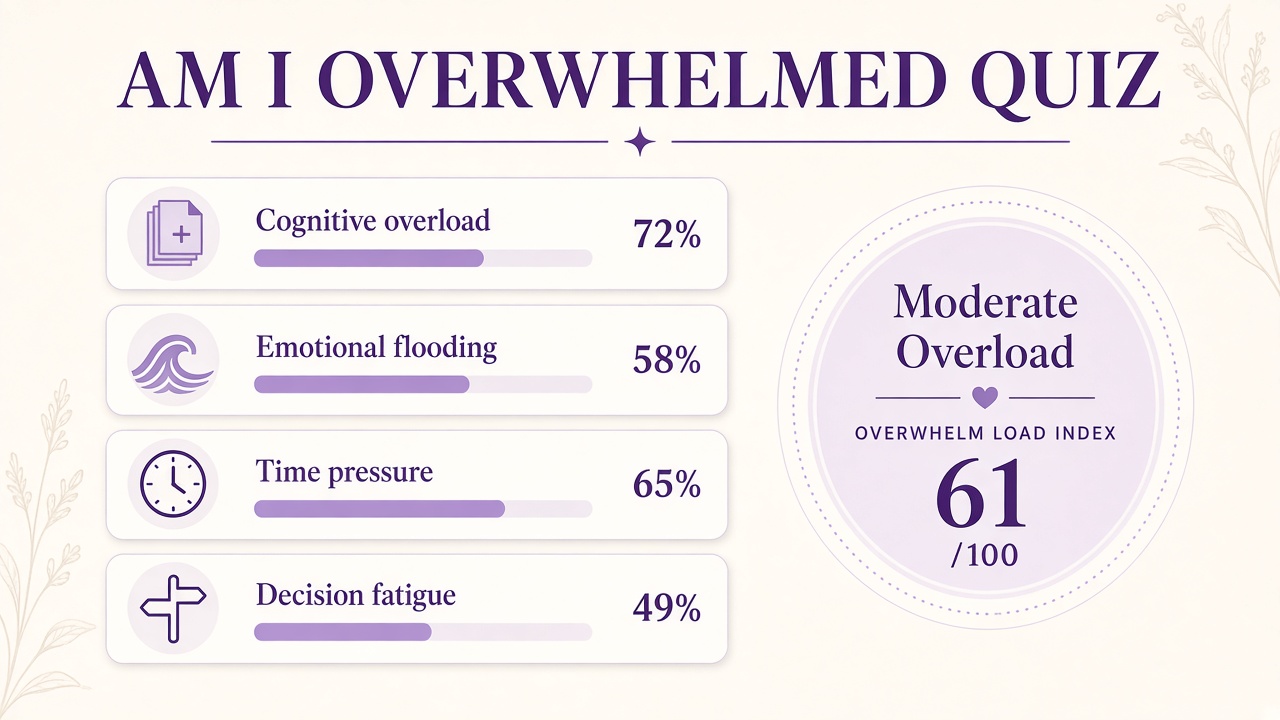
Your overwhelm load index is the normalized total across all 22 items on a 0 to 100 scale. The band groups that index into plain-language screening signals. Domain bars show whether mental clutter, emotions, time pressure, or decisions drive your result most.
| Screening band | Score range | Typical reading |
|---|---|---|
| Lower Overwhelm | 0 to 35 | Fewer frequent overload signals; brief busy seasons may still occur |
| Moderate Overload | 36 to 65 | Noticeable capacity strain worth monitoring, especially if persistent across weeks |
| Higher Overwhelm Signals | 66 to 100 | Frequent overload patterns that may warrant workload triage and professional support |
What your overwhelm screening report looks like
After all 22 items, you get an overwhelm load index from 0 to 100, a screening band, and four domain bars for cognitive overload, emotional flooding, time pressure, and decision fatigue. Percentages reflect how often you endorsed overload items, not a clinical severity diagnosis.
What this quiz can and cannot tell you
Can tell you
- Whether your self-reported overload patterns lean lower, moderate, or higher on this screener
- An overwhelm load index and four domain scores for capacity strain patterns
- Which domain (thoughts, emotions, time, or decisions) drives your result most
- A starting point for conversations with a clinician, coach, or manager about workload
Cannot tell you
- Whether you have anxiety, depression, ADHD, burnout, or any other clinical condition
- Whether you need medication, time off, hospitalization, or workplace accommodations
- Medical causes such as thyroid disease, anemia, or sleep apnea
- How someone else experiences overwhelm in their life
Overwhelm, capacity strain, and burnout research
In 2019, Christina Maslach and Michael Leiter published the Areas of Worklife model update, describing how workload, control, reward, community, fairness, and values mismatch contribute to burnout over time. Burnout centers on chronic exhaustion, cynicism, and reduced professional efficacy. Overwhelm is different: it describes a felt gap between demands and capacity in the present moment, even when someone still cares about their work or relationships.
Occupational health researchers also study cognitive load and decision fatigue as separate strain patterns. When open loops multiply, emotional reactions outpace recovery, schedules exceed energy, and small choices feel heavy, people often search "am I overwhelmed quiz" before they search clinical terms. The Quiz Hub built this screener to answer that question with four domain scores and honest limits. It is not a published clinical instrument. The National Institute of Mental Health notes that stress, anxiety, and mood symptoms often overlap and that professional evaluation helps clarify which patterns need treatment.
| The Quiz Hub test | What it adds |
|---|---|
| Am I burnt out quiz | Chronic depletion, cynicism, and long-term exhaustion over months, not present-moment capacity overload |
| Anxiety test | GAD-7 inspired worry, tension, and restlessness over two weeks, not mental clutter or schedule strain alone |
| Mental health test | General wellbeing across mood, anxiety, sleep, and functioning, not overwhelm-specific domains |
| Focus test | Attention habits and in-modal challenges, not emotional flooding or decision fatigue frequency |
| This am I overwhelmed quiz | Four-domain overwhelm load index with cognitive, emotional, time, and decision strain items |
Sample item: rating Often on having more open tasks in your head than you can focus on raises your cognitive overload domain score. Rating Very often on postponing rest because something urgent always comes first raises time pressure. Overwhelm can spike during caregiving, exam seasons, or notification-heavy jobs without meeting criteria for any disorder. If exhaustion and cynicism dominate for months, pair this quiz with our am I burnt out quiz. Browse more screeners on our mental health and clinical hub or read how we review quizzes in our editorial policy.
Am I overwhelmed quiz FAQ
What does the am I overwhelmed quiz measure?
This am I overwhelmed quiz measures self-reported frequency of cognitive overload, emotional flooding, time pressure, and decision fatigue over the past two weeks. Twenty-two original items produce an overwhelm load index from 0 to 100, four domain bars, and a screening band from Lower Overwhelm through Higher Overwhelm Signals. It is a self-screening snapshot, not a clinical diagnosis.
Is overwhelm the same as burnout?
No. Overwhelm usually describes a capacity mismatch: too many demands relative to available time, energy, or mental bandwidth right now. Burnout describes chronic depletion, cynicism, and reduced efficacy that build over months. You can feel overwhelmed without being burnt out, and burnt out people often feel overwhelmed too. This quiz screens overload patterns. Our am I burnt out quiz focuses on long-term exhaustion when it launches.
Does a higher band mean I have an anxiety disorder?
No. A higher band means your responses suggest elevated overwhelm signals on this screener. Anxiety, ADHD, depression, and sleep loss can all raise overwhelm scores. Only a licensed clinician can evaluate clinical conditions through structured interviews and rule-out of other causes. Online tests cannot confirm or deny a diagnosis.
How is this different from the anxiety test?
The anxiety test screens worry, tension, and restlessness with GAD-7 inspired items. This overwhelm quiz screens mental clutter, emotional flooding, schedule strain, and decision drain. Worry and overload overlap, but they are not identical. Many people take both when racing thoughts and capacity strain appear together.
What should I do if I get a Higher Overwhelm Signals band?
Consider workload triage, boundary setting, and professional support if patterns persist beyond a stressful month. Bring your result summary to a therapist, coach, or primary care clinician and describe when overload began. If you feel unsafe or in crisis, call or text 988 (US) or your local crisis line.
Who reviewed this content?
Dr. Elena Vasquez, PhD, reviewed the test framing and result explanations. See our editorial policy for review standards.
Reviewed by