
What this Mach IV test measures
This Mach IV test maps self-reported Machiavellianism patterns from personality research: how cynical you are about motives, how tactical you are in influence, and how flexible you feel about rules when outcomes matter. The framework comes from Christie and Geis work on Mach scales, adapted here with original item wording for online self-reflection.
Cynical views
Skepticism about fairness, reciprocity, and whether public kindness is sincere.
Tactical style
Comfort with charm, timing, hidden information, and strategic maneuvering.
Moral flexibility
Willingness to bend rules or accept cold-looking choices when goals justify them.
How it works
Three steps from first question to your Mach band. Click Start Test to open the interactive quiz in a full-screen modal.
Answer 20 statements
Rate how much you agree with each Mach-inspired item on a five-point scale.
Items map to three facets
Your answers accumulate scores across cynical views, tactical style, and moral flexibility.
View Mach band and facet chart
Results show a percentage, low/moderate/high Mach band, facet bars, highlights, and honest limits.
Take the Mach IV test
Rate 20 statements about trust, strategy, and rule-bending. Your overall percentage maps to a Mach band from Low Mach through High Mach.
Opens in a focused modal. No account required. Results stay on screen.
What your result means
Your Mach percentage sums all twenty items on a 20-to-100 raw scale. The band label groups that total into plain-language ranges. Read facet bars when the headline band feels too broad.
| Mach score range | Band | Typical reading |
|---|---|---|
| 0% to 39% | Low Mach | More idealistic, trusting, and rule-guided answers |
| 40% to 69% | Moderate Mach | Mixed strategy and skepticism depending on context |
| 70% to 100% | High Mach | Stronger cynical, tactical, and ends-oriented agreement |
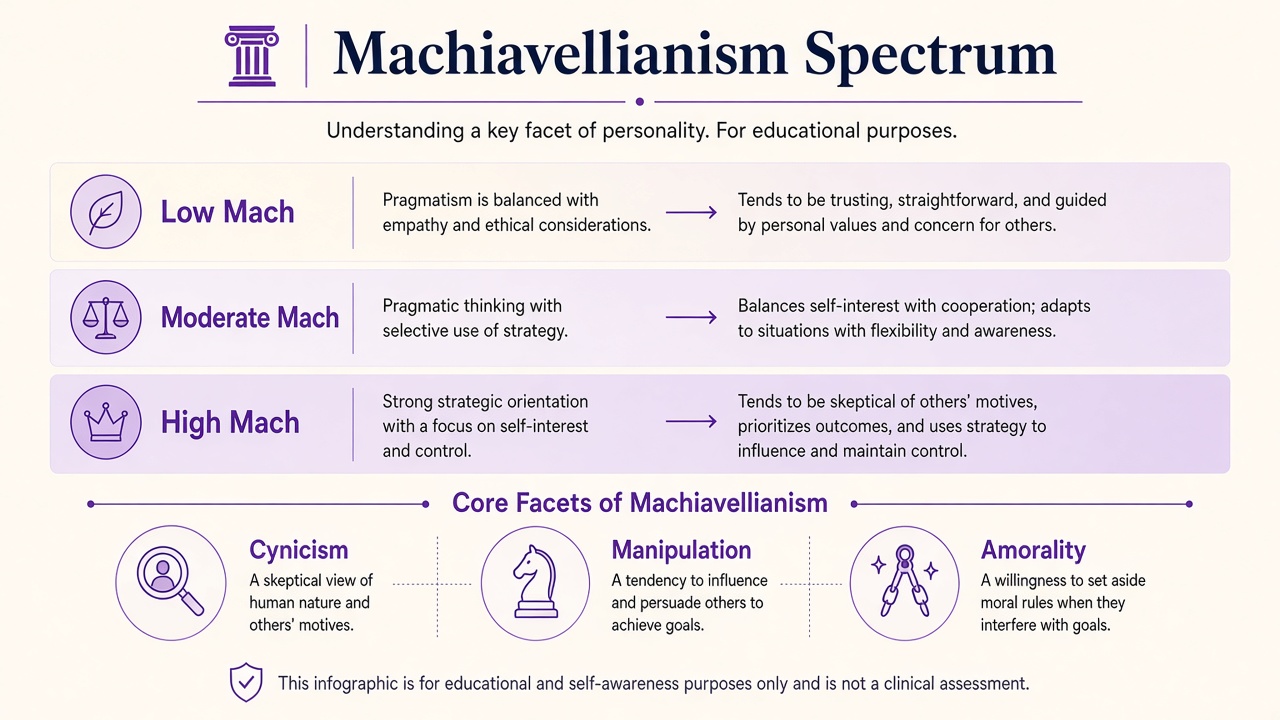
Low, moderate, and high Mach on one spectrum
Christie and Geis described Machiavellianism as a continuous trait, not a type you either are or are not. This diagram shows the three bands used on The Quiz Hub plus the three facet areas behind your score. Compare with our Big Five personality test for broader trait coverage or future dark-triad sibling quizzes when they ship.
What this test can and cannot tell you
Can tell you
- How strongly your self-report matches Mach-inspired items
- Which of three facets score highest for you
- A plain-language low/moderate/high Mach band for reflection
- A starting point before deeper personality or ethics quizzes
Cannot tell you
- Whether you are manipulative, evil, or a bad person
- Psychopathy, narcissism, or personality disorder status
- Hiring fit, trustworthiness for legal use, or relationship verdicts
- Scores from the official published Mach IV clinical form
Where the Mach IV scale comes from
Richard Christie and Florence Geis introduced Machiavellianism scales in the 1970s to study how people handle deception, trust, and power in everyday life. Their Mach IV inventory became a staple in social psychology classrooms because it turned abstract cynicism into countable self-report patterns. The trait later joined narcissism and psychopathy in dark triad research, but Machiavellianism on its own is about strategy and skepticism, not a clinical diagnosis.
The Quiz Hub version uses twenty original items inspired by that framework, not the verbatim published Mach IV form. Scoring follows the same idea: higher agreement with cynical and tactical items raises your Mach percentage. If you want validated trait models, start with our Big Five personality test. For motivation typing, try the Enneagram test. For workplace behavior style, see the DISC personality test. Peer-reviewed context appears in the Journal of Personality and Social Psychology literature on interpersonal strategy.
Sample item: "I keep certain cards hidden until the timing is right." High agreement nudges your tactical style facet. Low agreement does not mean you are naive; it may mean you prefer transparency or work in settings where openness already pays off. Mach scores shift with mood, stakes, and social desirability bias, so treat bands as conversation starters, not verdicts. Browse more quizzes on our personality psychology hub.
Mach IV test FAQ
What does the Mach IV test measure?
This quiz measures self-reported Machiavellianism patterns inspired by Richard Christie and Florence Geis: cynical views of human motives, tactical interpersonal style, and moral flexibility when goals conflict with rules. It is an educational self-report tool, not the official Mach IV clinical form.
What is a high Mach score?
A high Mach band on this quiz means you agreed more with cynical, tactical, and ends-oriented items. In research language, high Mach describes interpersonal strategy and skepticism, not a diagnosis. Scores from 70% to 100% on this quiz map to the High Mach band.
How long does the Mach IV test take?
Most people finish in about 4 minutes. There are 20 agree-disagree statements across three facets. You can pause and return in the same browser session.
Is the Mach IV test the same as a psychopathy screening?
No. Machiavellianism is one trait in the dark triad research cluster, but this quiz does not screen for psychopathy, narcissism, or personality disorder. It does not provide clinical labels or hiring advice.
What do low, moderate, and high Mach bands mean?
Low Mach (0% to 39%) suggests more idealistic and rule-guided answers. Moderate Mach (40% to 69%) reflects mixed strategy by context. High Mach (70% to 100%) suggests stronger cynical and tactical agreement. Read facet bars when the headline band feels too broad.
Who reviewed this content?
Dr. James Whitfield, PhD, reviewed the test framing and result explanations. See our editorial policy for review standards.
Reviewed by
