What this manipulative test measures
This manipulative test maps self-reported patterns linked with covert interpersonal control: how you steer outcomes, use guilt, and manage what others know. The framework draws on influence and deception research from social psychology and clinical communication studies, adapted here with original item wording across three focused dimensions.
Influence tactics
Charm, timing, silence, triangulation, and obligation cues used to shape someone else's choice without direct force.
Guilt patterns
Emotional pressure through martyrdom, withdrawal, sacrifice reminders, and boundary pressure that induces compliance.
Deception patterns
Selective disclosure, half-truths, strategic omission, and misleading answers that control how others react.
How it works
Three steps from first question to your tendency band. Click Start Quiz to open the interactive manipulative test in a full-screen modal.
Answer 30 statements
Rate how much you agree with each item on a five-point scale prefixed with "In relationships, I".
Items map to three dimensions
Your answers accumulate scores across influence tactics, guilt patterns, and deception patterns.
View band and dimension chart
Results show a percentage, low/moderate/elevated band, dimension bars, highlights, and honest limits.
Take the manipulative test
Rate 30 statements about influence, guilt pressure, and selective honesty. Your overall percentage maps to a tendency band from low through elevated.
Opens in a focused modal. No account required. Results stay on screen.
What your result means
Your overall percentage sums all thirty items on a 30-to-150 raw scale. The band label groups that total into plain-language ranges. Read dimension bars when the headline band feels too broad or you want to know which facet drives your score.
| Score range | Band | Typical reading |
|---|---|---|
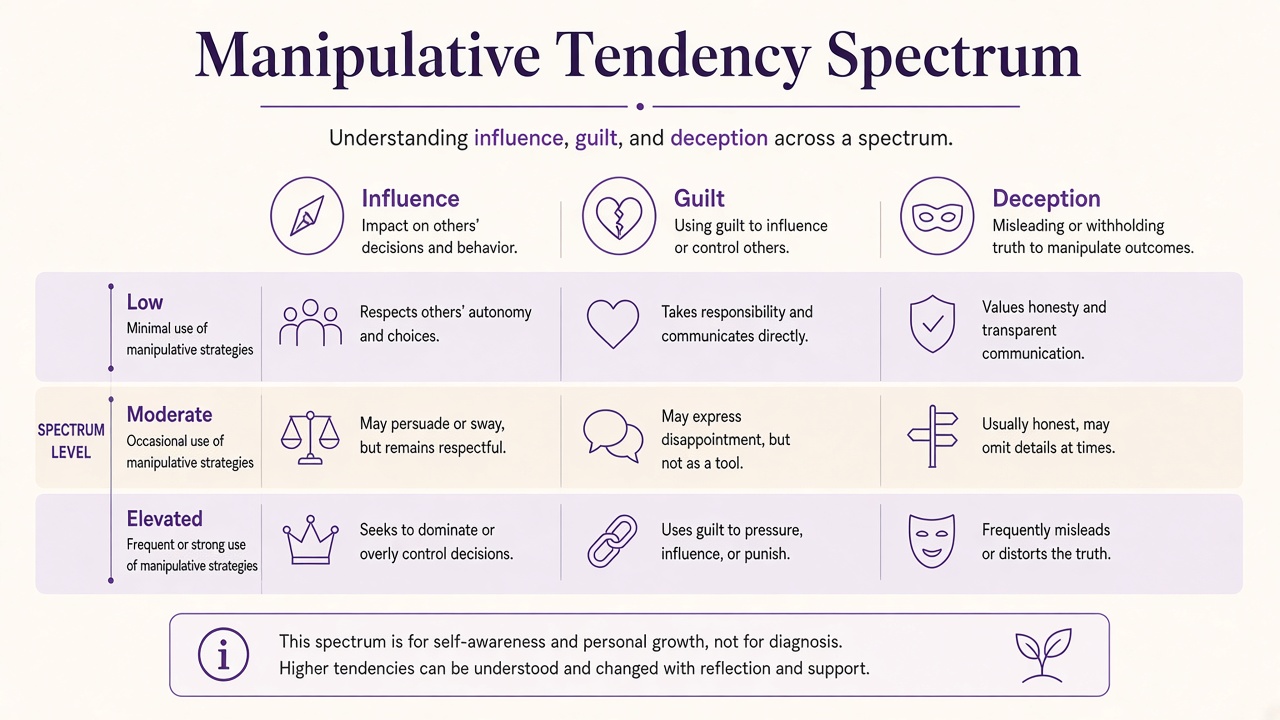
| 0% to 39% | Low tendency | More direct, transparent, and guilt-free influence answers |
| 40% to 69% | Moderate tendency | Mixed strategic and cooperative responses depending on context |
| 70% to 100% | Elevated tendency | Stronger agreement with influence, guilt, or deception items |
Three dimensions on one manipulative spectrum
Interpersonal influence researchers treat manipulative-style behaviors as continuous dimensions, not a type you either are or are not. This diagram shows the three bands used on The Quiz Hub plus the three dimension areas behind your score. Compare with our difficult person test for broader antagonistic traits or the Mach IV test for Machiavellian strategy facets.
What this test can and cannot tell you
Can tell you
- How strongly your self-report matches influence, guilt, and deception items
- Which of three dimensions score highest for you
- A plain-language low/moderate/elevated band for reflection
- A starting point before deeper dark-triad sibling quizzes on The Quiz Hub
Cannot tell you
- Whether you are toxic, abusive, or a bad person
- Narcissistic personality disorder, psychopathy, or emotional abuse diagnosis
- Relationship verdicts, hiring fit, or legal trustworthiness
- Scores from any published clinical manipulation inventory
Where manipulative tendency research comes from
Social psychologists and communication researchers study how people influence each other through direct requests, guilt induction, and information control. Work by scholars such as Gerald R. Miller on compliance-gaining tactics and later dark-triad research on Machiavellianism describe overlapping patterns: guilt trips, strategic silence, and selective honesty when stakes feel high.
The Quiz Hub manipulative test uses thirty original items across three clusters, not a verbatim published clinical form. Scoring follows the same idea: higher agreement with influence, guilt, or deception items raises your overall percentage. If you want broader trait models, start with our Big Five personality test. For empathy and integrity reflection, try the am I a bad person quiz. For five-facet antagonistic style, see the difficult person test. Peer-reviewed context appears in the Journal of Personality and Social Psychology literature on interpersonal influence.
Sample item: "In relationships, I leave out details I know would change someone's mind about my decision." High agreement nudges your deception dimension score. Low agreement does not mean you never omit context; it may mean you default toward fuller disclosure with people you trust. Manipulative tendency scores shift with mood, stakes, and social desirability bias, so treat bands as conversation starters, not verdicts. Browse more quizzes on our personality psychology hub.
Manipulative test FAQ
What does the manipulative test measure?
This quiz measures self-reported patterns across influence tactics, guilt pressure, and deception from thirty agree-disagree statements. It groups answers into low, moderate, or elevated tendency bands for reflection. It is not a diagnosis or proof you are manipulative.
Does an elevated band mean I am a manipulative person?
No. An elevated band means you agreed more with items about strategic pressure, guilt induction, or selective honesty in this quiz. That describes self-reported style worth examining, not a fixed character label. Many people score elevated during stressful seasons and change patterns with support.
How is this different from the difficult person test?
The difficult person test covers five DPS-inspired traits including callousness and grandiosity. This manipulative test focuses narrowly on influence tactics, guilt patterns, and deception. Use both when you want a broad antagonistic profile versus a targeted look at covert control styles.
How long does the manipulative test take?
Most people finish in about five minutes. There are thirty items on a five-point agree scale. You can pause and return in the same browser session thanks to autosave.
Is this quiz clinical or diagnostic?
No. It does not screen for narcissistic personality disorder, psychopathy, or emotional abuse. It does not diagnose relationship toxicity. It is educational self-reflection only, with crisis resources linked on the limits section.
Who reviewed this content?
Dr. James Whitfield, PhD, reviewed the test framing and result explanations. See our editorial policy for review standards.
Reviewed by