What this memory test measures
The memory test scores two sections that blend into one practice index. The challenge section uses digit span sequences, five-word lists shown in the quiz modal, and simple pattern completion. The confidence section uses Likert items on names and faces, appointments, where you left things, verbal instructions, reading retention, and general memory trust.
Recall challenges
Ten in-modal items test short-term holding of digits, words, and patterns without external notes.
Everyday confidence
Ten habit items capture how often you trust memory for names, lists, and appointments.
Practice index
0 to 100 summary blending challenge accuracy (55%) with confidence ratings (45%).
Domain bars
Separate charts for digit span, word list, pattern recall, and six confidence domains.
How it works
Three steps from first challenge to your memory practice result. Click Start Memory Test to open the interactive quiz in a full-screen modal.
Complete ten recall challenges
Memorize each stimulus shown in the modal, then pick the correct digit sequence, list word, or pattern answer.
Rate ten confidence habits
Answer agree-disagree statements about everyday memory for names, errands, and instructions.
View index and domain bars
Results show memory practice index, challenge score, confidence index, recall band, and domain percentage charts.
Take the memory test
Work through ten in-modal recall challenges, then rate ten everyday memory confidence items. Your answers produce a memory practice index and recall band.
Opens in a focused modal. No account required. Results stay on screen.
What your result means
The memory practice index blends challenge accuracy with confidence ratings on a 0 to 100 scale. Bands group that index for playful reflection. Challenge and confidence subscores help you see whether recall puzzles or everyday habits drove your band today.
| Recall band | Index range | Typical reading |
|---|---|---|
| Needs More Practice | 0% to 39% | Lower challenge accuracy and/or lower confidence on everyday memory habits |
| Moderate Recall | 40% to 69% | Mixed challenge performance with workable everyday memory confidence |
| Strong Recall Habits | 70% to 100% | Most challenges answered correctly with confident everyday memory ratings |
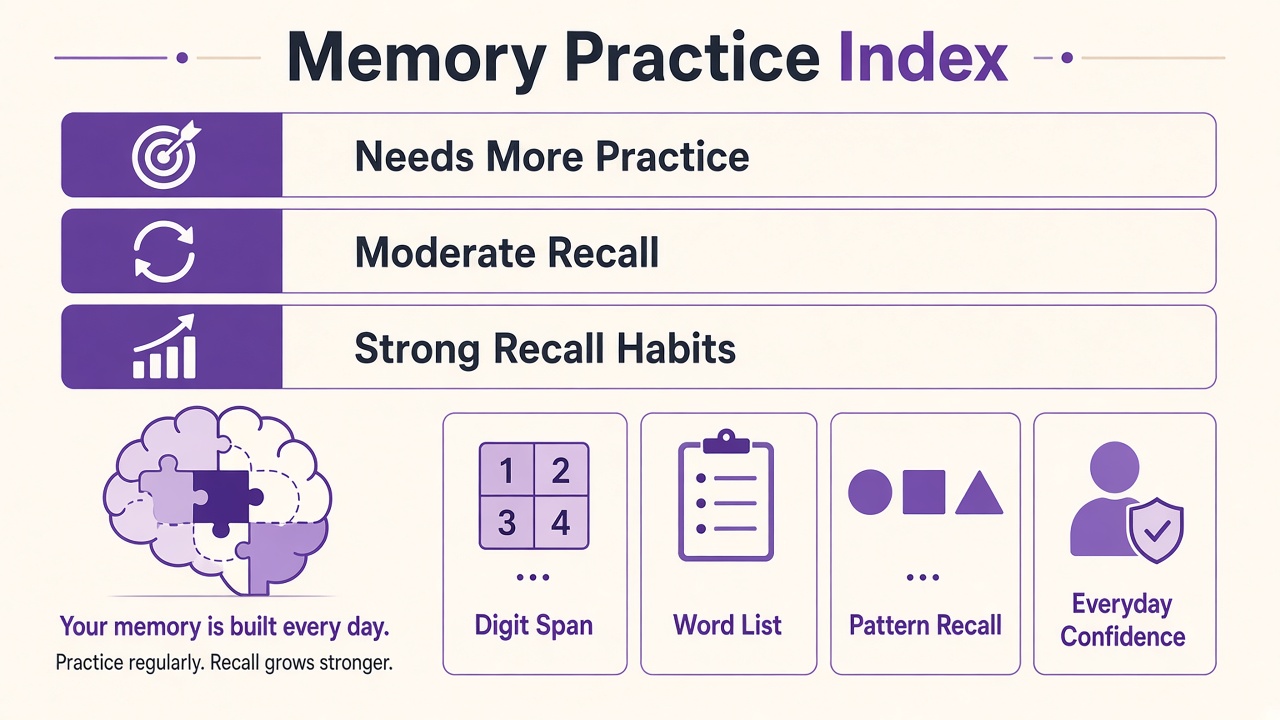
Memory practice index map
Short-term recall and everyday confidence are different skills. This diagram shows the four challenge types and confidence domains behind your memory practice index so you can compare with sibling cognitive quizzes on The Quiz Hub.
What this quiz can and cannot tell you
Can tell you
- How many in-modal recall challenges you answered correctly today
- Your self-reported confidence on everyday memory habits
- Domain percentage bars for digits, words, patterns, and confidence areas
- A starting point for memory warm-up before harder cognitive puzzles
Cannot tell you
- Whether you have dementia, Alzheimer disease, or mild cognitive impairment
- Clinical working memory capacity from normed neuropsychology batteries
- IQ, hiring readiness, or academic placement scores
- Whether memory problems require medical follow-up (ask a doctor if concerned)
Why people search for a memory test online
People often want a quick check on whether their recall feels sharp after a stressful week or poor sleep. A memory test that mixes digit span puzzles, word list drills, and pattern items mirrors how researchers probe short-term holding in lab settings, though our version is shortened for casual browsers. The confidence section adds everyday context: names at parties, errands without a list, and remembering why you entered a room.
Sample challenge: memorizing 7 · 3 · 9 · 1 · 4 inside the quiz modal, then choosing the matching sequence from four options. Sample confidence item: agreeing that you remember a new name after one meeting raises your names-and-faces domain score. Neither item diagnoses anything; they only describe performance and self-report on this screener today.
Compare with sibling pages. The IQ test covers broader reasoning puzzles. The focus test scores attention habits that overlap with recall. The cognitive test bundles working memory, math, pattern, verbal, and attention-switch warm-up items. For visual imagery reflection, try the VVIQ test on our personality psychology hub.
Memory test FAQ
What does this memory test measure?
This memory test blends ten in-modal recall challenges with ten Likert confidence items. Challenges cover digit span sequences, five-word lists, and simple pattern completion. Confidence items ask about names, appointments, object location, verbal instructions, reading retention, and general memory trust. Results show a memory practice index from 0 to 100 plus challenge and confidence subscores.
Is this a dementia or Alzheimer screening test?
No. The Quiz Hub built this as recreational mental warm-up, not clinical dementia screening. Online recall puzzles cannot diagnose Alzheimer disease, mild cognitive impairment, or any neurological condition. If memory loss worries you or affects daily safety, see a qualified doctor for proper evaluation.
How long does the memory test take?
Most people finish in about 6 minutes. There are 20 items: ten recall challenges shown inside the quiz modal and ten agree-disagree confidence statements. You can pause and return in the same browser session thanks to autosave.
What is the memory practice index?
The memory practice index is a 0 to 100 summary that blends challenge accuracy (55 percent weight) with confidence ratings (45 percent weight). Bands group that index into Needs More Practice, Moderate Recall, or Strong Recall Habits for everyday reflection.
How do the recall challenges work?
Each challenge shows a stimulus inside the quiz modal: a digit sequence, a five-word list, or a pattern prompt. You memorize it, then pick the correct answer from four options. There is no timer, but you should answer from memory rather than scrolling back.
How is this different from a formal IQ or neuropsych test?
Formal instruments such as the Wechsler Memory Scale or digit span subtests from the WAIS use standardized administration, normed scoring, and clinician interpretation. Our online memory test uses original plain-language items for casual practice. It is not validated for research, hiring, or clinical use.
Who reviewed this content?
Dr. James Whitfield, PhD, reviewed the test framing and result explanations. See our editorial policy for review standards.
Reviewed by