What this cognitive test measures
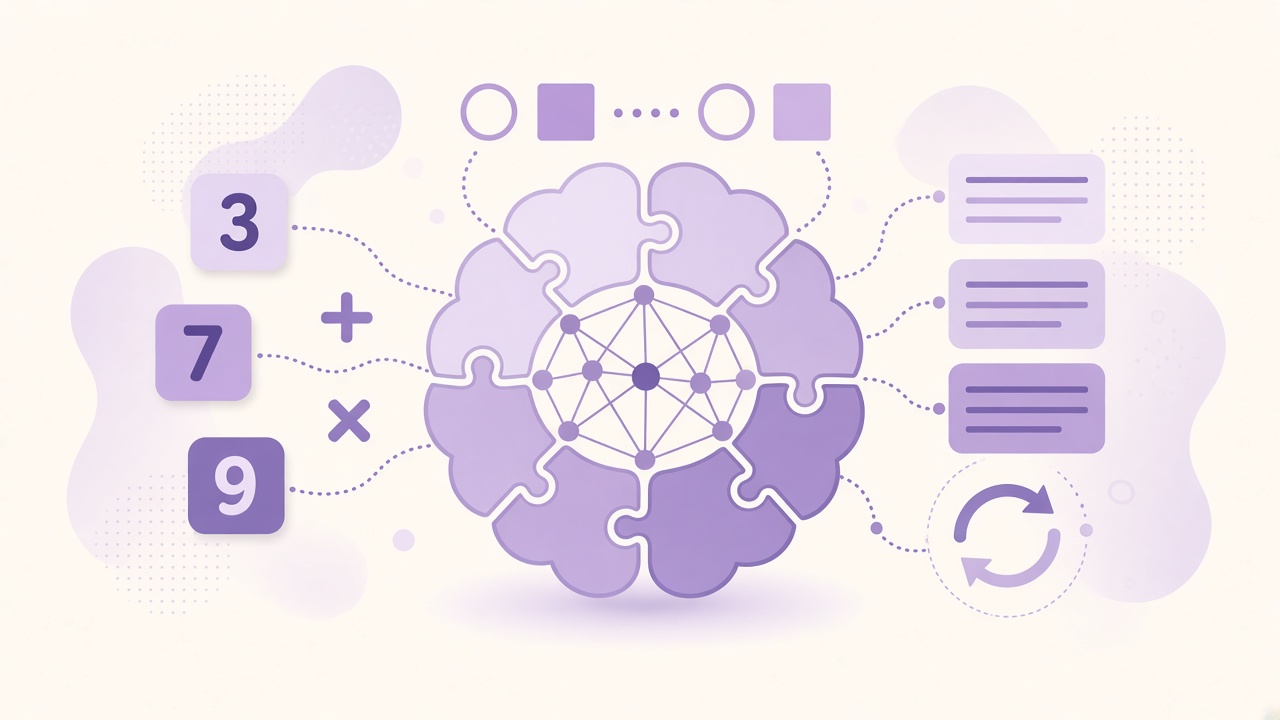
This cognitive test samples five everyday warm-up domains with original multiple-choice items. It is a practice quiz for mental agility, not a shortened MoCA or MMSE battery and not a path to clinical cognitive diagnosis.
Working memory
Short holds for digits, words, letters, and shapes you read once in the prompt.
Mental math
Addition, multiplication, division, percentages, and multi-term sums without a calculator.
Pattern completion
Shape, color, letter, and number sequences that repeat or grow in predictable steps.
Verbal reasoning
Analogies, category odd-one-out, and plain-language logic with fictional terms.
Attention switch
Rule-following, sorting, counting, and multi-step task switches in one prompt.
How the free cognitive test works
Three steps from first question to your cognitive practice index. Click Start Test to open the interactive quiz in a full-screen modal with session autosave.
Answer 28 multiple-choice items
Choose the best option for each memory hold, math problem, pattern, verbal prompt, or attention-switch scenario. There is no countdown timer and no auto-advance.
Items map to five domains
Correct answers accumulate a cognitive practice index from 0 to 100 plus per-domain accuracy bars.
View band and domain chart
Results show a Developing Skills, Solid Practice, Strong Session, or Sharp Warm-Up label, a spectrum marker, domain bars, and practical notes.
Take the cognitive test
Answer 28 cognitive warm-up questions with four options each. Your correct count converts to a cognitive practice index and one of four bands with a five-domain breakdown chart.
Opens in a focused modal. No account required. Results stay on screen.
What your cognitive practice index means
Your cognitive practice index equals correct answers divided by 28, scaled to 0 through 100. Bands group that index into plain-language warm-up labels. Domain bars show whether memory holds, math, patterns, verbal reasoning, or attention switches drove your score. None of this is clinical cognitive assessment.
| Practice band | Index range | Typical reading |
|---|---|---|
| Developing Skills | 0 to 49 | Fewer than half the items correct; more warm-up practice may help on this quiz type |
| Solid Practice | 50 to 69 | Balanced mix of correct and missed items across domains |
| Strong Session | 70 to 84 | Most items correct on this recreational item set |
| Sharp Warm-Up | 85 to 100 | Nearly all items correct; still not MoCA, MMSE, or clinical assessment |
Cognitive practice index spectrum
The diagram below shows how cognitive practice index scores map across the four bands. A high score on mental math with misses on attention-switch rules might still land you in Solid Practice if working memory holds carry the average.
What this cognitive test can and cannot tell you
Can tell you
- How many of 28 recreational warm-up items you answered correctly today
- A cognitive practice index from 0 to 100 with a four-band label
- Which of five domains scored highest or lowest on this quiz
- A starting point for mental warm-up before formal testing
Cannot tell you
- Whether you have dementia, mild cognitive impairment, or any clinical condition
- MoCA, MMSE, or licensed neuropsychological test equivalents
- Processing speed or sustained attention measured under proctored norms
- Ability free from fatigue, distraction, education, or practice-effect bias
Cognitive warm-up quizzes vs clinical screening
Licensed clinicians administer instruments such as MoCA or MMSE under standardized conditions. Those tools screen for cognitive impairment with validated cutoffs and follow-up protocols. Free online cognitive tests, including this The Quiz Hub practice quiz, skip proctoring, clinical norms, and diagnostic thresholds.
We built this cognitive test as a recreational warm-up shorter in feel than our IQ test. It uses 28 original multiple-choice items across five domains and maps correct answers to a cognitive practice index with Developing Skills, Solid Practice, Strong Session, and Sharp Warm-Up bands. That trade-off favors readable mental exercise while refusing clinical assessment claims.
| The Quiz Hub test | What it adds |
|---|---|
| IQ test | Longer logic puzzles with number sequences, matrix grids, and syllogisms |
| Memory test | Hybrid recall challenges plus everyday memory confidence items |
| Focus test | Attention challenges and focus habit ratings |
| This cognitive test | Five-domain warm-up bundle with cognitive practice index bands |
Sample item: the digits 7-3-9 place 3 in the middle position. Fatigue or guessing can drop scores quickly, so retake after a rested session if results feel off. Browse more options on our IQ and cognitive hub or read how we review quizzes in our editorial policy.
Cognitive test FAQ
What is this free cognitive test?
It is a recreational multiple-choice quiz with 28 items covering working memory holds, simple mental math, pattern completion, verbal reasoning, and attention-switch scenarios. Correct answers convert to a cognitive practice index from 0 to 100 with Developing Skills, Solid Practice, Strong Session, or Sharp Warm-Up bands.
Is this a clinical cognitive assessment?
No. This practice index is not clinical cognitive assessment, not a MoCA or MMSE substitute, and not a licensed neuropsychological battery. Formal screening uses proctored subtests, timed norms, and validated instruments that online warm-up quizzes cannot replicate.
What do the cognitive practice index bands mean?
Developing Skills (0 to 49%) means fewer than half the items were correct. Solid Practice (50 to 69%) is a balanced mix. Strong Session (70 to 84%) means most items correct. Sharp Warm-Up (85 to 100%) means nearly all items correct on this quiz only.
How is this different from the IQ test?
The IQ test focuses on longer logic puzzles with number sequences, matrix grids, and syllogisms across 28 items. This cognitive test is shorter in feel and mixes everyday warm-up domains like memory holds, mental math, and task-switch rules. Both report practice indices, not real IQ or clinical scores.
Can I retake the cognitive test?
Yes. Session autosave lets you pause in the same browser. Retakes on similar item types can raise scores through practice effects without changing underlying ability, so treat repeat scores as entertainment.
Who reviewed this content?
Dr. James Whitfield, PhD, reviewed the test framing and result explanations. See our editorial policy for review standards.
Reviewed by