What this emotional intelligence test measures
This EQ test screens six skill areas that researchers often group under emotional intelligence. Each domain uses original agree-disagree statements inspired by the Goleman and Mayer-Salovey traditions, not the verbatim MSCEIT or proprietary corporate EQ batteries used in hiring.
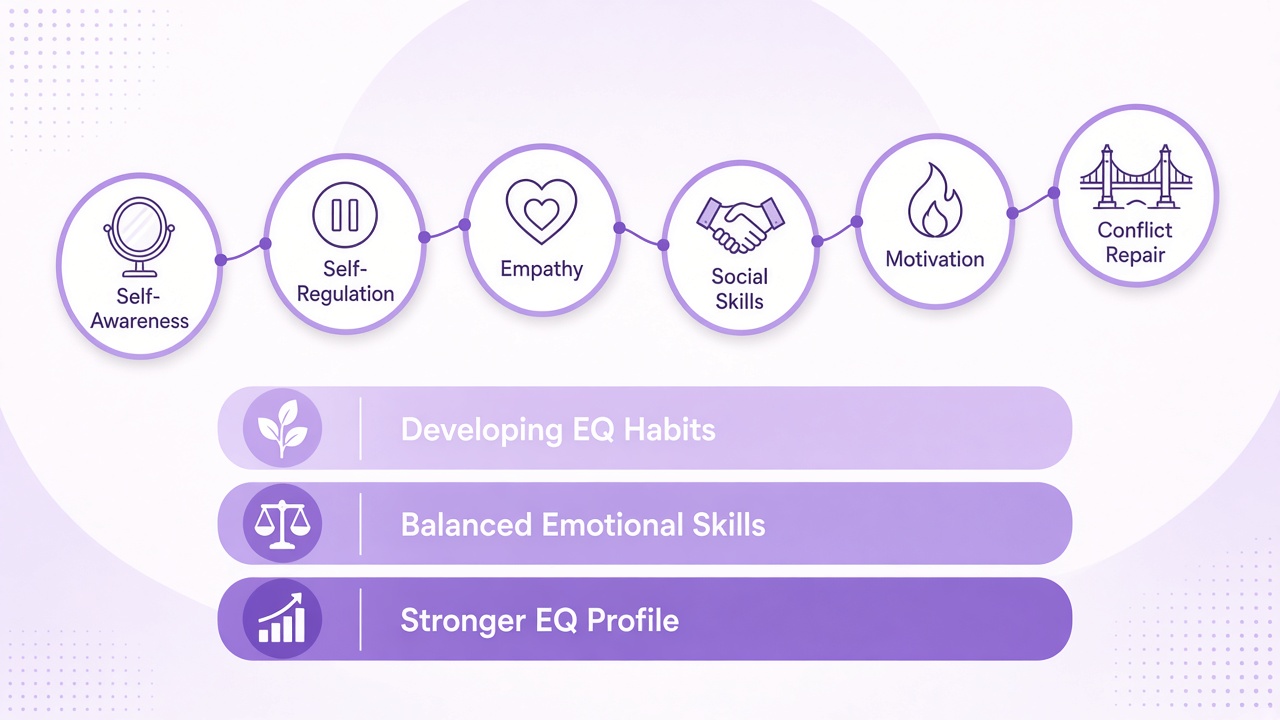
Self-awareness
Recognizing emotions, triggers, and mood shifts as they happen in daily life.
Self-regulation
Pausing under stress, calming reactions, and recovering without prolonged spirals.
Empathy
Reading others' feelings and considering their perspective before judging.
Social skills
Adjusting tone, listening well, and giving feedback without attacking.
Motivation
Sustaining effort toward meaningful goals when energy or group momentum dips.
Conflict repair
Owning your part, apologizing, and following through after disagreements.
How it works
Three steps from first statement to your EQ band. Click Start Test to open the interactive quiz in a full-screen modal.
Answer 26 statements
Rate how much you agree with each item on a five-point scale from strongly disagree to strongly agree. There is no timer and no auto-advance between items.
Items map to six domains
Your answers accumulate scores across awareness, regulation, empathy, social skills, motivation, and conflict repair. Some items are reverse-coded so that agreeing with impulsive reactions lowers your score.
View index and domain chart
Results show an EQ reflection index from 0 to 100, a band label, six domain bars ranked lowest to highest, and suggested next steps.
Take the EQ test
Rate 26 emotional intelligence statements about how you handle feelings and relationships today. Your answers produce an EQ reflection index and one of three bands with a six-domain breakdown chart.
Opens in a focused modal. No account required. Results stay on screen.
What your result means
Your EQ reflection index is the sum of scored items normalized to 0 through 100. Higher percentages mean more agreement with reflective emotional habit items and less agreement with impulsive or avoidant items. The band label groups that score into plain-language stages for self-reflection.
| EQ band | Percentage range | Typical reading |
|---|---|---|
| Developing EQ Habits | 0 to 35% | More friction with awareness, regulation, or repair on these items |
| Balanced Emotional Skills | 36 to 65% | Mixed strengths across domains; chart shows where growth edges sit |
| Stronger EQ Profile | 66 to 100% | Steadier emotional habits on this snapshot; one domain may still lag |
Six domains of emotional intelligence
The diagram below shows how domain scores feed an overall EQ reflection index. Strong empathy with weaker conflict repair, for example, can still land you in a Balanced Emotional Skills band until repair habits catch up.
What this test can and cannot tell you
Can tell you
- How your self-reported EQ habits cluster across six domains
- A band label and percentage for reflection today
- Which domain bar scores lowest and may deserve attention first
- A starting point for coaching, therapy, or communication practice
Cannot tell you
- Your MSCEIT percentile or ability-based EQ score
- Whether you should be hired, promoted, or selected for leadership
- Whether you have a personality disorder or any clinical diagnosis
- How others objectively rate your emotional skills
Emotional intelligence models and online EQ quizzes
Psychologists Peter Salovey and John Mayer published the ability model of emotional intelligence in 1990, defining EQ as perceiving, using, understanding, and managing emotions. Daniel Goleman's 1995 book popularized a mixed model that adds motivation and social skill habits. The MSCEIT remains a research-backed ability test, while many corporate EQ tools use self-report Likert items similar in format to this quiz.
The Quiz Hub EQ test borrows the six-domain mixed-model framing with twenty-six original statements. It is not the MSCEIT, not a hiring screen, and not comparable to published norm tables. For personality trait context that overlaps with social awareness, take our live Big Five personality test. For social energy and introversion patterns, take our live introvert extrovert test. For relationship repair habits in partnerships, take our live relationship test. For confidence under observation, take our live confidence test.
Sample item: agreeing that you pause before speaking when angry raises your self-regulation domain score. Agreeing that you avoid apologizing even when you know you hurt someone lowers your conflict repair score on a reverse-coded item. Social desirability bias can inflate scores when people answer how they think they should feel. Read how we review quizzes in our editorial policy.
EQ test FAQ
What does this EQ test measure?
This EQ test screens self-reported agreement with 26 statements across six emotional intelligence domains: self-awareness, self-regulation, empathy, social skills, motivation, and conflict repair. It produces an EQ reflection index from 0 to 100, six domain bars, and a band such as Developing EQ Habits, Balanced Emotional Skills, or Stronger EQ Profile. It is an informal snapshot, not the MSCEIT or a clinical diagnosis.
Is this emotional intelligence test the same as MSCEIT?
No. The Mayer-Salovey-Caruso Emotional Intelligence Test (MSCEIT) uses ability-based tasks scored against research norms. The Quiz Hub EQ test uses original agree-disagree items for self-reflection only. Scores are not comparable to MSCEIT percentiles and should not be used for hiring or clinical intake.
How long does the EQ test take?
Most people finish in about six minutes. There are twenty-six statements on a five-point agree-disagree scale. You can pause and return in the same browser session.
What do the three EQ bands mean?
Developing EQ Habits (0 to 35%) suggests more friction with awareness, regulation, or repair on these items. Balanced Emotional Skills (36 to 65%) shows a mixed pattern across domains. Stronger EQ Profile (66 to 100%) suggests steadier emotional habits on this snapshot.
Can I use this EQ test for job applications?
No. This quiz is for personal reflection and education only. It is not validated for employment screening, leadership selection, or clinical assessment. Employers should use professionally administered instruments with trained interpreters when EQ measurement is required.
Who reviewed this content?
Dr. James Whitfield, PhD, reviewed the test framing and result explanations. See our editorial policy for review standards.
Reviewed by