What this grooming quiz measures
This am I being groomed quiz estimates how often boundary-lowering contact patterns show up in your experience with someone. Twenty-two original frequency items group into four domains drawn from grooming and exploitation prevention research: special attention, boundary testing, secrecy isolation, and dependency manipulation. Each item also maps to a fear-of-intimacy stack layer so you can see whether vulnerability pull-back, trust hesitation, disclosure limits, or closeness anxiety rides alongside grooming cues. Your grooming risk index averages these patterns into a 0 to 100 score with plain-language bands.
Special attention
Singled-out praise, generous favors, maturity flattery, intense compliments, and one-on-one pull-away from others.
Boundary testing
Sexual topic pushes, body comments, limit testing, escalating touch, and image requests before you feel ready.
Secrecy isolation
Secret contact requests, guilt about telling trusted adults, distancing from critics, and hidden messaging apps.
Dependency manipulation
Mood responsibility, fear of hurting them, guilt about space, and betrayal framing when you pull back.
How it works
Three steps from first question to your grooming risk report with fear-of-intimacy stack. Click Start Quiz to open the interactive quiz in a full-screen modal.
Answer 22 frequency items
Rate how often each grooming pattern shows up when you think about this person, from Never to Almost always. You click Next after each answer; nothing auto-advances.
Items map to grooming domains and intimacy stack
Your answers accumulate percentages for special attention, boundary testing, secrecy isolation, and dependency manipulation, plus four fear-of-intimacy stack layers.
View band and dual charts
Results show Lower, Mixed, or Higher Grooming Risk Signals with domain bars, intimacy stack chart, and reflection prompts. Higher bands include crisis resources.
Take the am I being groomed quiz
Rate 22 statements about contact patterns that can lower boundaries over time. Your answers produce a grooming risk index from 0 to 100, four domain scores, a fear-of-intimacy stack chart, and a band label for reflection or advocacy conversation.
Opens in a focused modal. No account required. Results stay on screen.
What your result means
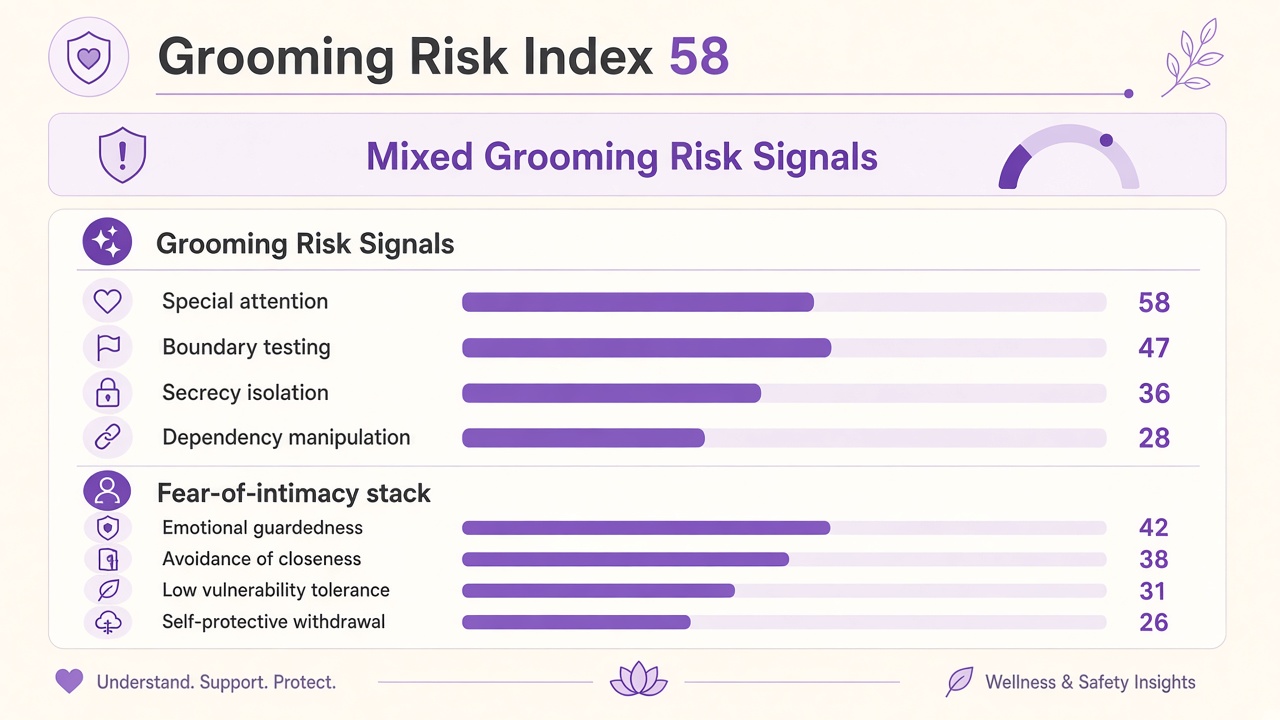
Your grooming risk index is the normalized total across all 22 items on a 0 to 100 scale. Higher scores mean more frequent endorsement of special attention, boundary testing, secrecy isolation, or dependency manipulation items on this screener. Domain bars show endorsement rates so you can see whether favors and flattery, limit pushes, secret contact, or guilt about space drives your result most. The fear-of-intimacy stack chart shows parallel layers for vulnerability pull-back, trust hesitation, self-disclosure limits, and closeness anxiety when grooming cues include guarded closeness.
| Band | Index range | Typical reading |
|---|---|---|
| Lower Grooming Risk Signals | 0 to 35 | Fewer grooming pattern signals; ordinary social tension may still appear |
| Mixed Grooming Risk Signals | 36 to 65 | Blend of ordinary awkwardness and grooming cues; worth tracking if persistent |
| Higher Grooming Risk Signals | 66 to 100 | Frequent special attention, secrecy, or boundary pressure; advocate or therapist support may help |
What your grooming risk report looks like
After all 22 items, you get a grooming risk index from 0 to 100, a band label, four grooming domain bars, and a fear-of-intimacy stack chart. Percentages reflect contact patterns you notice, not a criminal verdict about someone else's character.
What this quiz can and cannot tell you
Can tell you
- How often grooming pattern signals showed up for you in this connection
- A grooming risk index and four domain bars for attention, boundaries, secrecy, and dependency patterns
- A fear-of-intimacy stack showing which closeness-guarding layer feels strongest
- A starting point for therapy, advocacy, or retaking after a boundary change
Cannot tell you
- Whether someone is grooming you, exploiting you, or guilty of a crime
- Whether you should stay, leave, or confront them without a safety plan
- Whether age-gap dating or mentorship is harmful without context and consent
- What legal or clinical action you need without a licensed professional or advocate
Grooming tactics, trust-building, and boundary erosion
Researcher Ian Elliott and child-protection agencies describe grooming as a process where someone builds trust and special status to lower boundaries before harm. The U.S. Department of Justice notes that online and in-person grooming can include secrecy, flattery, favors, and gradual sexual or emotional boundary pushes. Psychologist Judith Herman's work on trauma also describes how dependency and shame can make limits harder to name even when something feels wrong. In everyday language, grooming often maps to singled-out attention, secret channels, repeated limit tests, and guilt when you want slower pace.
The Quiz Hub built this am I being groomed quiz as an original self-report screener inspired by those themes, not a reproduction of any single published clinical instrument. Readers often compare it to sibling tools on this site. Our love-bombed quiz screens early intensity pace and future faking rather than gradual secrecy and favor-based trust building. The gaslighting quiz measures reality distortion during conflict. The fear of intimacy quiz maps closeness-limiting habits without grooming-specific secrecy items.
| The Quiz Hub test | What it adds |
|---|---|
| Love-bombed quiz | Early intensity pace and isolation pressure, not gradual favor-based boundary erosion |
| Gaslighting quiz | Reality distortion and blame reversal during conflict, not secrecy and special-favor grooming |
| Trauma bond quiz | Bond-after-harm relief cycles and reunion craving, not pre-harm trust building tactics |
| Narcissist quiz | Partner grandiosity and empathy gap patterns, not your response to secrecy requests |
| Fear of intimacy quiz | Four-domain intimacy avoidance index without grooming-specific secrecy items |
| This grooming quiz | Grooming risk index plus fear-of-intimacy stack for attention, boundaries, secrecy, and dependency patterns |
Sample item types include frequency ratings such as whether you get asked to keep contact secret from people you trust, or whether conversations shift toward explicit topics before you feel ready. High boundary testing with high secrecy isolation often lands in Mixed or Higher Grooming Risk Signals. Mentor admiration, consensual age-gap dating, or online fan contact can spike some scores temporarily. Read how we review quizzes in our editorial policy or browse more tools on our relationships and dating hub.
Am I being groomed quiz FAQ
What is grooming in a relationship?
Grooming describes a pattern where someone builds trust, special attention, or secrecy to lower your boundaries over time. Researchers such as Ian Elliott and child-protection agencies note that grooming often includes flattery, favors, private contact, and gradual boundary pushes rather than one sudden event. This am I being groomed quiz measures how often special attention, boundary testing, secrecy isolation, and dependency manipulation patterns show up in your experience. It is not proof of grooming and it is not a criminal or clinical diagnosis.
What does this grooming quiz measure?
Twenty-two original frequency items ask how often you notice singled-out praise, generous favors, secret contact, boundary pushes, or guilt when you want space. Scores map to four grooming risk domains plus a parallel fear-of-intimacy stack with vulnerability pull-back, trust hesitation, self-disclosure limits, and closeness anxiety layers. You receive a grooming risk index from 0 to 100 where higher scores mean more grooming pattern signals, plus a band from Lower through Higher Grooming Risk Signals.
What is the fear-of-intimacy stack on this quiz?
The fear-of-intimacy stack is a second results chart inspired by FOIS-style intimacy avoidance themes, adapted to grooming risk framing. Each of the 22 items also maps to one of four stack layers: vulnerability pull-back, trust hesitation, self-disclosure limits, and closeness anxiety. The stack index summarizes how often you hide contact details, doubt your read on favors, minimize harm to yourself, or panic about upsetting them alongside grooming pattern items.
How is this different from the love-bombing quiz?
The am I being love-bombed quiz screens early relationship intensity pace, isolation pressure, future faking, and boundary erosion during the honeymoon phase. This grooming quiz focuses on gradual trust-building tactics: special favors, secrecy requests, repeated boundary tests, and dependency guilt. It adds a fear-of-intimacy stack chart that the love-bombing quiz does not include.
Can this quiz prove someone is grooming me?
No. The grooming risk index describes self-reported pattern signals on this abbreviated screener. Mentor admiration, age-gap dating with clear consent, or awkward flirting that stops when you say no can raise some scores without grooming. Only you plus honest dialogue, safety planning, and professional evaluation can define whether contact is safe. Higher bands include crisis resources for support.
Who reviewed this content?
Dr. Elena Vasquez, PhD, reviewed the test framing and result explanations. See our editorial policy for review standards.
Reviewed by