What this attachment style test measures
This attachment style test estimates how you balance closeness and independence in romantic or close relationships. Twenty-four self-report items split evenly between attachment anxiety (fear of rejection and need for reassurance) and attachment avoidance (discomfort with dependence and emotional intimacy). Your scores map to one of four classic attachment styles used in relationship research.
Attachment anxiety
Worry about being unloved, jealousy, reassurance seeking, and fear that partners will leave or stop caring.
Attachment avoidance
Preference for emotional self-reliance, discomfort with deep talks, distancing when things feel too close.
Four-style mapping
Secure (low anxiety, low avoidance), anxious, avoidant, and fearful-avoidant quadrants from your two dimension scores.
ECR-inspired core items
Selected items mirror Experiences in Close Relationships themes with plain-language frequency wording for online use.
How it works
Three steps from first question to your attachment style result. Click Start Quiz to open the interactive test in a full-screen modal.
Answer 24 frequency items
Rate each statement from Never to Very often about romantic or close relationships. No timer and no auto-advance.
Scores split into two dimensions
Your answers build attachment anxiety and avoidance percentages, each with a low or high pole at the 50 percent midpoint.
View your style and dimension bars
Results show secure, anxious, avoidant, or fearful-avoidant style with growth tips and ECR equivalent references.
Take the attachment style test
Rate 24 relationship statements on a five-point frequency scale. Your answers produce attachment anxiety and avoidance dimension bars, a four-style result, and ECR-inspired equivalent averages with plain-language growth tips.
Opens in a focused modal. No account required. Results stay on screen.
What your attachment style result means
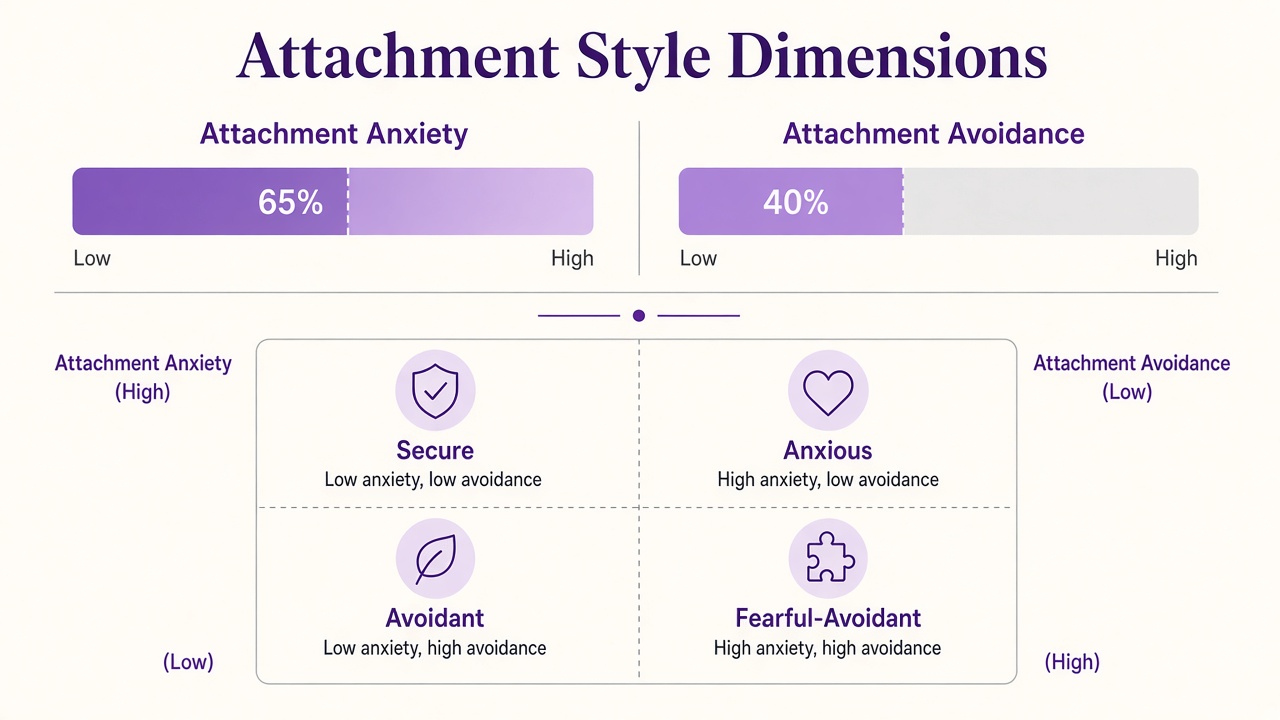
Each dimension score is the sum of twelve item responses normalized to 0 through 100 percent. A score at or above 50 percent counts as a high pole on that dimension. Your style comes from combining anxiety and avoidance poles into one of four quadrants below. Dimension bars show how strongly each pole contributed even when one dimension sits near the cutoff.
| Attachment style | Anxiety pole | Avoidance pole | Typical pattern |
|---|---|---|---|
| Secure | Low | Low | Comfort with closeness and reasonable independence |
| Anxious (preoccupied) | High | Low | Reassurance seeking, fear of loss, pursuit of closeness |
| Avoidant (dismissive) | Low | High | Emotional self-reliance, distancing, discomfort with dependence |
| Fearful-avoidant | High | High | Push-pull cycles: craving intimacy while pulling away |
Core ECR-inspired items also produce anxiety and avoidance equivalent averages on a 1 to 7 scale for readers familiar with published ECR reports. These equivalents are illustrative only and not comparable to official ECR norms.
Attachment style dimensions diagram
The diagram below shows how anxiety and avoidance bars feed the four-style quadrant. A result near 48 percent on anxiety with 52 percent on avoidance still maps to avoidant because the cutoff is 50 percent on each axis.
What this quiz can and cannot tell you
Can tell you
- Whether your self-reported pattern leans secure, anxious, avoidant, or fearful-avoidant on this screener
- Attachment anxiety and avoidance dimension percentages with low or high pole labels
- ECR-inspired equivalent averages on core items for rough comparison to research language
- A conversation starter for couples therapy or individual attachment work
Cannot tell you
- Whether you have an attachment disorder or any clinical diagnosis
- Official ECR scores comparable to Brennan, Clark, and Shaver (1998) research norms
- Your partner's attachment style or whether a relationship will succeed
- Whether symptoms are better explained by trauma, grief, or situational stress alone
ECR attachment styles in practice
In 1998, Kim Bartholomew and Leonard Horowitz published four-category attachment models, building on the Experiences in Close Relationships (ECR) scale by Brennan, Clark, and Shaver. The ECR measures two continuous dimensions: attachment anxiety and attachment avoidance. Researchers plot scores on a two-axis chart to describe secure, preoccupied, dismissive-avoidant, and fearful-avoidant patterns in adults. Only clinical assessment can link scores to specific diagnoses or treatment plans.
The Quiz Hub built this attachment style test as a shortened, plain-language version for couples and solo reflection. It alternates twelve anxiety and twelve avoidance items on a five-point frequency scale instead of the published seven-point agreement format. That trade-off favors readable dimension bars and a clear four-style label while naming the Brennan et al. (1998) source honestly. The APA notes that attachment patterns can shift with therapy, new relationships, and major life stressors.
| The Quiz Hub test | What it adds |
|---|---|
| Love language test | Five Chapman-inspired preference domains for how you give and receive care, not anxiety-avoidance axes |
| Abandonment issues quiz | Three-band attachment distress screener with fear, clinginess, and trust withdrawal domains |
| Compatibility test | Values and communication overlap items for couples, not dimensional attachment typing |
| Am I ready for a relationship quiz | Broader readiness domains including healing, time, and clarity before dating |
| This attachment style test | ECR-inspired anxiety and avoidance dimensions mapped to four classic attachment styles |
Sample item: rating Often on worrying your partner cares less raises your attachment anxiety score. Rating Very often on preferring to handle emotions alone raises avoidance. Past betrayal can raise both dimension scores without meeting any clinical threshold. Browse more quizzes on our relationships and dating hub or read how we review tests in our editorial policy.
Attachment style test FAQ
What does this attachment style test measure?
This attachment style test measures self-reported attachment anxiety and attachment avoidance in romantic or close relationships. Twenty-four items alternate anxiety and avoidance themes inspired by the Experiences in Close Relationships (ECR) framework. Results place you in one of four styles (secure, anxious, avoidant, or fearful-avoidant) with dimension bars and ECR-style equivalent averages. It is not a clinical diagnosis.
What are the four attachment styles on this test?
Secure attachment means lower anxiety and lower avoidance. Anxious (preoccupied) means higher anxiety with lower avoidance. Avoidant (dismissive) means lower anxiety with higher avoidance. Fearful-avoidant means both dimensions score high. The quiz uses a 50 percent pole threshold on each dimension, a simplified version of ECR quadrant logic.
How is this different from the abandonment issues quiz?
The abandonment issues quiz on The Quiz Hub focuses on fear of being left, clinginess, and trust withdrawal with three distress bands. This attachment style test maps anxiety and avoidance onto four classic attachment styles with two dimension bars. Both draw on ECR-inspired items but serve different questions: distress screening versus style typing.
Can this test diagnose an attachment disorder?
No. This quiz cannot diagnose attachment disorders, personality conditions, or any clinical diagnosis. It estimates self-reported tendencies on an abbreviated online screener. Only a licensed clinician can evaluate attachment-related conditions through structured interviews and history.
How does ECR scoring work on this quiz?
The ECR uses attachment anxiety and avoidance scales on a 1 to 7 agreement format. Our test uses twelve anxiety and twelve avoidance items on a five-point frequency scale, with core ECR-inspired items converted to 1 to 7 equivalents for reference. Official ECR norms do not apply to this shortened version.
Who reviewed this content?
Dr. Priya Sharma, PhD, reviewed the test framing and result explanations. See our editorial policy for review standards.
Reviewed by