What this narcissist quiz measures
This am I dealing with a narcissist quiz estimates how often narcissistic pattern signals show up in someone close to you. Twenty-four original frequency items group into four domains drawn from narcissism trait research and trauma-informed relationship education: gaslighting, entitlement, empathy gaps, and control tactics. Your narcissistic pattern index averages these signals into a 0 to 100 score with plain-language bands. It reflects behavior you notice, not a clinical label for your partner.
Gaslighting
Reality distortion, memory denial, and being told you are too sensitive when you raise concerns.
Entitlement
Special treatment demands, double standards, and outrage when preferences are not met.
Empathy gaps
Dismissing your feelings, one-sided support, and little remorse after hurtful behavior.
Control tactics
Monitoring without consent, punishment for limits, and restricting money, time, or social contact.
How it works
Three steps from first question to your narcissistic pattern report. Click Start Quiz to open the interactive quiz in a full-screen modal.
Answer 24 frequency items
Rate how often each pattern shows up when you think about this person in your relationship, from Never to Almost always. You click Next after each answer; nothing auto-advances.
Items map to four pattern domains
Your answers accumulate percentages for gaslighting, entitlement, empathy gaps, and control tactics, plus an overall narcissistic pattern index.
View band and domain bars
Results show Lower, Mixed, or Higher Narcissistic Pattern Concern with domain bars and reflection prompts. Higher bands include crisis resources.
Take the am I dealing with a narcissist quiz
Rate 24 statements about partner behavior patterns you notice in your relationship. Your answers produce a narcissistic pattern index from 0 to 100, four domain scores, and a band label for reflection or therapy conversation.
Opens in a focused modal. No account required. Results stay on screen.
What your result means
Your narcissistic pattern index is the normalized total across all 24 items on a 0 to 100 scale, with reverse scoring on respect and empathy items so higher scores mean more pattern signals overall. Domain bars show endorsement rates so you can see whether gaslighting, entitlement, empathy gaps, or control tactics drives your result most.
| Band | Index range | Typical reading |
|---|---|---|
| Lower Narcissistic Pattern Concern | 0 to 35 | Fewer pattern signals on this screener; normal conflict during stress may still appear |
| Mixed Narcissistic Pattern Signals | 36 to 65 | Blend of respectful moments and pattern signals; worth tracking if persistent |
| Higher Narcissistic Pattern Concern | 66 to 100 | Frequent gaslighting, entitlement, empathy gaps, or control; professional support may help |
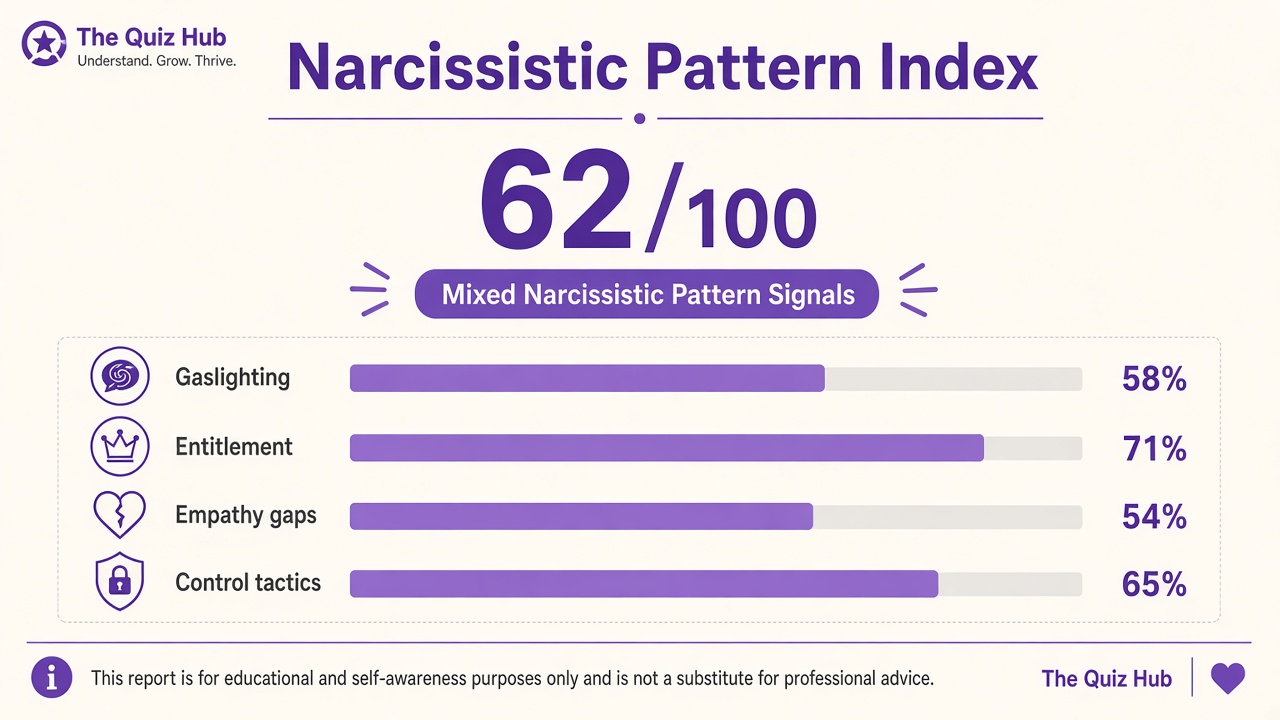
What your narcissist quiz report looks like
After all 24 items, you get a narcissistic pattern index from 0 to 100, a band label, and four domain bars for gaslighting, entitlement, empathy gaps, and control tactics. Percentages reflect pattern signals you notice, not a clinical verdict about narcissistic personality disorder.
What this quiz can and cannot tell you
Can tell you
- How often narcissistic pattern signals showed up for you in this relationship
- A narcissistic pattern index and four domain bars for gaslighting, entitlement, empathy gaps, and control
- Which domain pattern feels strongest in your current relationship
- A starting point for therapy conversation, advocacy, or retaking after a calmer month
Cannot tell you
- Whether your partner has narcissistic personality disorder or any clinical diagnosis
- Whether your partner is abusive without your own judgment and professional support
- Whether you should stay or leave without honest dialogue and safety planning
- What treatment or legal action you need without licensed professional guidance
Narcissism traits, gaslighting, and empathy gaps
Psychologists Robert R. Raskin and Calvin S. Hall published the Narcissistic Personality Inventory in 1979, measuring grandiosity, entitlement, and exhibitionism as personality traits rather than clinical labels. Later work by W. Keith Campbell and Joshua D. Miller (2011) summarized how entitlement and low empathy show up in close relationships through one-sided support and reality distortion. Clinical psychologist Ramani Durvasula and the American Psychological Association describe how gaslighting and control tactics can overlap with coercive control in intimate partnerships, even when love or good days still exist.
The Quiz Hub built this am I dealing with a narcissist quiz as an original self-report screener inspired by those themes, not a reproduction of the NPI or any single published instrument. Readers often compare it to sibling tools on this site. Our narcissistic abuse quiz screens gaslighting, isolation, blame-shifting, and control with a trauma-informed IPV frame. The love-bombing quiz measures early intensity and boundary erosion, not ongoing entitlement. The fear of intimacy quiz maps your own vulnerability avoidance rather than partner behavior frequency.
| The Quiz Hub test | What it adds |
|---|---|
| Narcissistic abuse quiz | Coercion index with isolation and blame-shift domains, not entitlement frequency alone |
| Love-bombing quiz | Early intensity and future faking, not ongoing gaslighting or empathy gap items |
| Fear of intimacy quiz | Your closeness avoidance habits, not partner entitlement or control tactics |
| Am I the problem quiz | Your accountability and repair habits during conflict, not partner pattern frequency |
| Trust issues quiz | Your hypervigilance and repair doubt, not partner gaslighting or entitlement |
| This narcissist quiz | Four-domain narcissistic pattern index for gaslighting, entitlement, empathy gaps, and control |
Sample item types include frequency ratings such as whether someone rewrites past events until you doubt your memory, or whether they expect comfort from you while offering little when you struggle. High gaslighting with high entitlement often lands in Mixed or Higher Narcissistic Pattern Concern. Stress, grief, and power imbalances can also raise scores without narcissistic personality disorder. Read how we review quizzes in our editorial policy or browse more tools on our relationships and dating hub.
Am I dealing with a narcissist quiz FAQ
What are narcissistic patterns in relationships?
Narcissistic patterns in everyday language often refer to recurring behaviors such as reality distortion, entitlement, empathy gaps, and control tactics that leave you doubting yourself or walking on eggshells. Clinical narcissistic personality disorder requires a formal evaluation and is not the same as a difficult partner during stress. This am I dealing with a narcissist quiz measures how often those pattern signals show up in someone close to you. It is not proof of narcissistic personality disorder or abuse.
What does this narcissist quiz measure?
Twenty-four original frequency items ask how often you notice gaslighting, entitlement, empathy gaps, and control tactics when you think about this person in your relationship. Scores map to four domains inspired by narcissism trait research and trauma-informed relationship education. You receive a narcissistic pattern index from 0 to 100 and a band from Lower through Higher Narcissistic Pattern Concern.
How is this different from the narcissistic abuse quiz?
The narcissistic abuse quiz screens coercion tactics across gaslighting, isolation, blame-shifting, and control with a trauma-informed IPV frame. This am I dealing with a narcissist quiz focuses on entitlement, empathy gaps, and partner behavior frequency rather than isolation and blame-shift domains alone. It uses a close-relationship frequency frame about pattern signals, not a clinical NPD checklist.
Can this quiz diagnose narcissistic personality disorder?
No. The narcissistic pattern index describes self-reported behavior signals on this abbreviated screener. Stress, cultural norms, and attachment wounds can raise scores without narcissistic personality disorder. Only a licensed clinician can evaluate personality disorders through structured interviews. Online quizzes cannot confirm or deny a diagnosis or label someone a narcissist.
What should I do if I get a higher narcissistic pattern band?
Consider contacting the National Domestic Violence Hotline at 1-800-799-7233 or thehotline.org for confidential support and safety planning. A licensed therapist or advocate who understands coercive control can help you interpret patterns. If you feel unsafe or in crisis, call or text 988 (US) or your local crisis line.
Who reviewed this content?
Dr. Elena Vasquez, PhD, reviewed the test framing and result explanations. See our editorial policy for review standards.
Reviewed by