What this narcissistic abuse quiz measures
This narcissistic abuse quiz estimates how often coercive control patterns showed up when you think about your partner or relationship. Twenty-four original frequency items group into four domains drawn from intimate partner violence and trauma-informed research: gaslighting, isolation, blame-shifting, and control. Your abuse pattern index averages these signals into a 0 to 100 score with plain-language bands. It reflects your self-report, not a verdict about your partner's personality or hidden motives.
Gaslighting
Reality distortion, memory denial, and being told you are too sensitive when you raise concerns.
Isolation
Discouraging support networks, monitoring without consent, and criticizing people close to you.
Blame-shift
Absorbing blame for partner anger, apologizing to keep peace, and feeling responsible for their moods.
Control
Restricted choices about money, schedule, or social life, plus threats or walking on eggshells.
How it works
Three steps from first question to your abuse pattern report. Click Start Quiz to open the interactive quiz in a full-screen modal.
Answer 24 frequency items
Rate how often each coercion pattern showed up when you think about your partner, from Never to Almost always. You click Next after each answer; nothing auto-advances.
Items map to four coercion domains
Your answers accumulate percentages for gaslighting, isolation, blame-shift, and control, plus an overall abuse pattern index.
View band and domain bars
Results show Lower, Mixed, or Higher Abuse Pattern Concern with domain bars and reflection prompts. Higher bands include NDVH and 988 crisis resources.
Take the narcissistic abuse quiz
Rate 24 statements about partner dynamics when you think about your relationship. Your answers produce an abuse pattern index from 0 to 100, four domain scores, and a band label for reflection or advocate conversation.
Opens in a focused modal. No account required. Results stay on screen.
What your result means
Your abuse pattern index is the normalized total across all 24 items on a 0 to 100 scale, with reverse scoring on respect-response items so higher scores mean more coercion pattern signals overall. Domain bars show raw endorsement rates so you can see whether gaslighting, isolation, blame-shifting, or control drives your result most.
| Band | Index range | Typical reading |
|---|---|---|
| Lower Abuse Pattern Concern | 0 to 35 | Fewer coercion signals on this screener; normal conflict may still appear during stress |
| Mixed Abuse Pattern Signals | 36 to 65 | Blend of respectful moments and more frequent control patterns; worth tracking if persistent |
| Higher Abuse Pattern Concern | 66 to 100 | Frequent gaslighting, isolation, blame-shift, or control; advocate or therapist support may help |
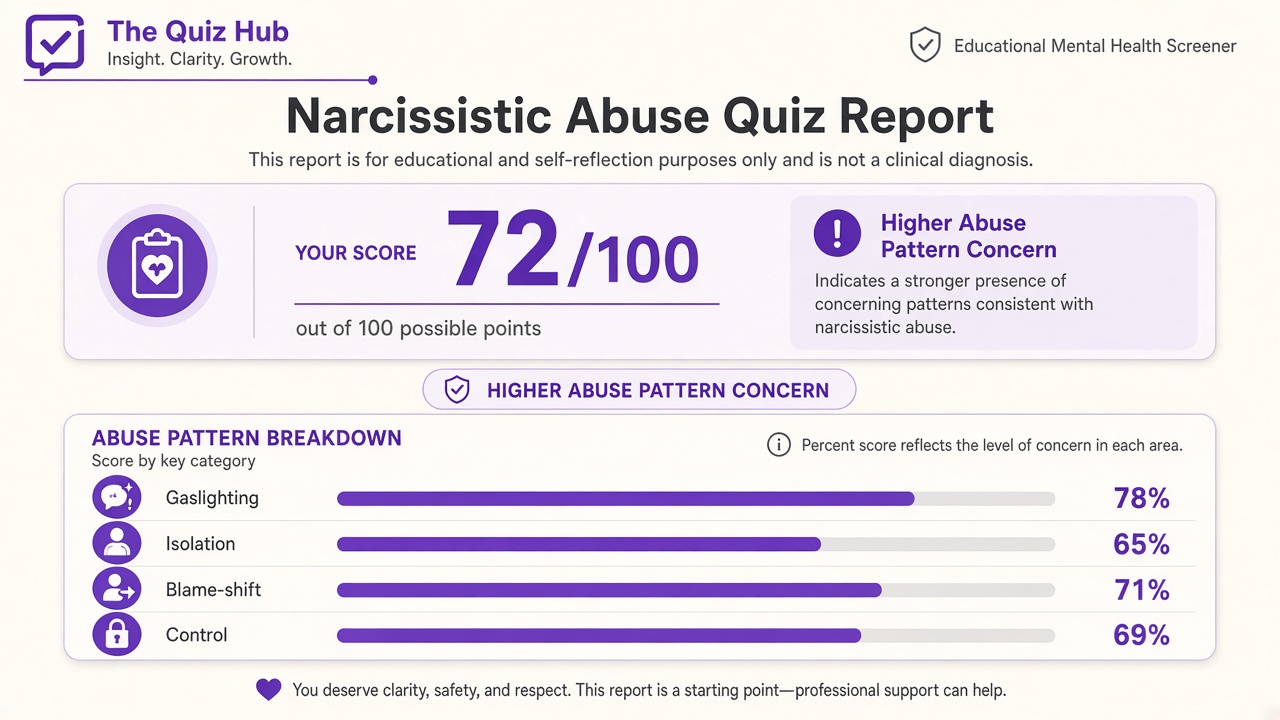
What your narcissistic abuse report looks like
After all 24 items, you get an abuse pattern index from 0 to 100, a band label, and four domain bars for gaslighting, isolation, blame-shift, and control. Percentages reflect dynamics you experience, not a clinical verdict about narcissistic personality disorder.
What this quiz can and cannot tell you
Can tell you
- How often coercion pattern signals showed up when you think about your partner
- An abuse pattern index and four domain bars for gaslighting, isolation, blame-shift, and control
- Which domain pattern feels strongest in your current relationship
- A starting point for advocate, therapist, or safety planning conversation
Cannot tell you
- Whether your partner has narcissistic personality disorder or is abusive
- Whether you should stay or leave without your own safety judgment and support
- Whether conflict is situational stress or a long-term coercion pattern without context
- What legal or clinical steps you need without professional evaluation
Coercive control, gaslighting, and trauma-informed screening
Psychologists and domestic violence researchers describe coercive control as a pattern of tactics that restrict autonomy: monitoring, isolation, financial gatekeeping, and reality distortion. The American Psychological Association publishes resources on intimate partner violence that emphasize safety planning over quick labels. Gaslighting entered popular language from Patrick Hamilton's 1938 play, but clinicians today map it to denial of events, minimization of harm, and making victims doubt their own perception. The National Domestic Violence Hotline (2024) lists isolation and monitoring among common power-and-control tactics on its power and control wheel.
The Quiz Hub built this narcissistic abuse quiz as an original self-report screener inspired by trauma-informed IPV frameworks, not a reproduction of any published clinical instrument. Readers often compare it to sibling tools on this site. Our am I narcissistic quiz screens self-reported narcissistic trait patterns in your own behavior. The am I toxic quiz measures criticism, jealousy, control, and negativity you may bring to relationships. The attachment style test screens anxiety and avoidance in closeness rather than partner coercion frequency.
| The Quiz Hub test | What it adds |
|---|---|
| Am I narcissistic quiz | Self-reported narcissistic trait patterns in your behavior, not partner coercion you experience |
| Am I toxic quiz | Your criticism, jealousy, control, and negativity habits, not partner gaslighting or isolation |
| Attachment style test | Anxiety and avoidance dimensions across closeness, not four-domain coercion frequency |
| This narcissistic abuse quiz | Four-domain abuse pattern index for gaslighting, isolation, blame-shift, and control signals |
Sample item types include frequency ratings such as whether your partner rewrote past conversations so you doubted your memory, or whether you felt free to maintain friendships without guilt. High gaslighting with high isolation often lands in Mixed or Higher Abuse Pattern Concern. Financial stress, new parenthood, or cultural family pressure can spike conflict without proving abuse. Leaving can be the most dangerous time in coercive relationships, so safety planning matters more than confronting patterns alone. Read how we review quizzes in our editorial policy or browse more tools on our relationships and dating hub.
Narcissistic abuse quiz FAQ
What is narcissistic abuse?
Narcissistic abuse is a popular term for patterns of coercive control in close relationships: gaslighting, isolation from support, blame-shifting, and restrictive control over money, time, or social life. It overlaps with intimate partner violence frameworks used by the American Psychological Association and domestic violence advocates. This narcissistic abuse quiz measures how often those patterns showed up for you in your current relationship. It is not a clinical diagnosis of narcissistic personality disorder or proof of abuse.
What does this narcissistic abuse quiz measure?
Twenty-four original frequency items ask how often you experienced gaslighting, isolation, blame-shifting, and control when you think about your partner or relationship. Scores map to four domains drawn from trauma-informed intimate partner violence research. You receive an abuse pattern index from 0 to 100 and a band from Lower through Higher Abuse Pattern Concern.
How is this different from the am I narcissistic quiz?
The am I narcissistic quiz screens self-reported narcissistic trait patterns in your own behavior. This narcissistic abuse quiz focuses on partner dynamics you experience: reality distortion, cutting off support, blame reversal, and control tactics. It uses relationship frequency items rather than agree-disagree trait statements about yourself.
Can this quiz prove my partner is abusive or has NPD?
No. The abuse pattern index describes self-reported coercion signals on this abbreviated screener. Only a licensed clinician can evaluate personality disorders, and only you plus trusted professionals can assess safety in your relationship. Online quizzes cannot confirm or deny abuse or diagnose narcissistic personality disorder.
What should I do if I get a higher abuse pattern band?
Consider contacting the National Domestic Violence Hotline at 1-800-799-7233 or thehotline.org for confidential support and safety planning. A licensed therapist or advocate who understands coercive control can help you interpret patterns. If you feel unsafe or in crisis, call or text 988 (US) or your local crisis line.
Who reviewed this content?
Dr. Elena Vasquez, PhD, reviewed the test framing and result explanations. See our editorial policy for review standards.
Reviewed by