What this love-bombing quiz measures
This am I being love-bombed quiz estimates how often early relationship behaviors that can signal manipulation show up in your experience. Twenty-two original frequency items group into four domains drawn from intimate partner coercion research: intensity and pace, isolation pressure, future faking, and boundary erosion. Your love-bombing risk index averages these patterns into a 0 to 100 score with plain-language bands. It reflects what you notice about their behavior early on, not a verdict about their character or your judgment.
Intensity & pace
Fast declarations, constant contact, grand gestures, and upset reactions when you need space.
Isolation pressure
Criticizing your circle, steering you away from independent plans, and monitoring your time.
Future faking
Premature marriage talk, named milestones, and bonding through a fantasy future before trust builds.
Boundary erosion
Testing limits, guilt when you say no, and charm cycles after you set boundaries.
How it works
Three steps from first question to your love-bombing risk report. Click Start Quiz to open the interactive quiz in a full-screen modal.
Answer 22 frequency items
Rate how often each early relationship pattern shows up, from Never to Almost always. You click Next after each answer; nothing auto-advances.
Items map to four risk domains
Your answers accumulate percentages for intensity and pace, isolation pressure, future faking, and boundary erosion, plus an overall love-bombing risk index.
View band and domain bars
Results show Lower, Mixed, or Higher Love-Bombing Risk with domain bars and reflection prompts. Higher bands include crisis and advocacy resources.
Take the love-bombing quiz
Rate 22 statements about how this person treats you early in the relationship. Your answers produce a love-bombing risk index from 0 to 100, four domain scores, and a band label for reflection or support conversations.
Opens in a focused modal. No account required. Results stay on screen.
What your result means
Your love-bombing risk index is the normalized total across all 22 items on a 0 to 100 scale. Higher scores mean more frequent endorsement of intensity, isolation pressure, future faking, and boundary erosion items on this screener. Domain bars show endorsement rates so you can see whether fast affection, cutting off support, premature future talk, or limit-testing drives your result most.
| Band | Index range | Typical reading |
|---|---|---|
| Lower Love-Bombing Risk | 0 to 35 | Fewer early intensity or control pattern signals; enthusiastic romance can still feel exciting without pressure tactics |
| Mixed Love-Bombing Signals | 36 to 65 | Blend of chemistry and more frequent intensity or boundary-testing signals; worth tracking and naming |
| Higher Love-Bombing Risk | 66 to 100 | Frequent fast-track affection, isolation pressure, future faking, or boundary erosion; professional or advocacy support may help |
What your love-bombing report looks like
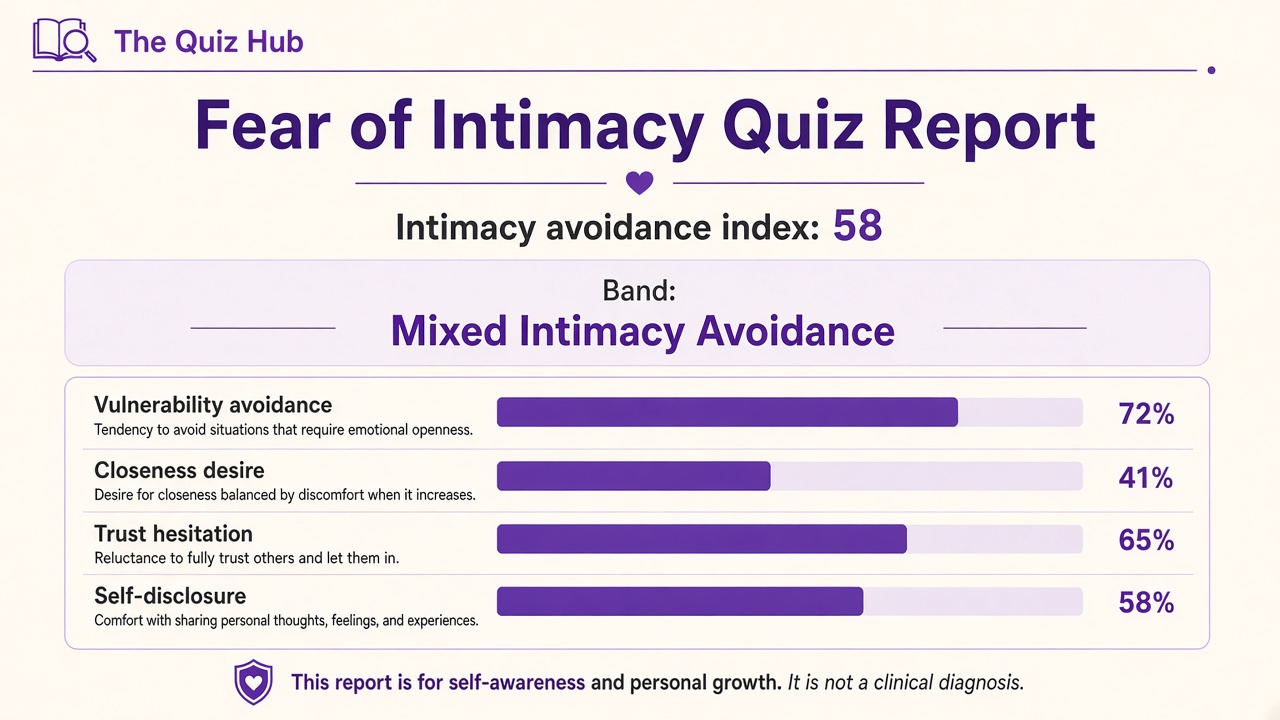
After all 22 items, you get a love-bombing risk index from 0 to 100, a band label, and four domain bars for intensity and pace, isolation pressure, future faking, and boundary erosion. Percentages reflect early behaviors you notice, not proof that someone is manipulating you.
What this quiz can and cannot tell you
Can tell you
- How often love-bombing pattern signals showed up for you early in this relationship
- A love-bombing risk index and four domain bars for intensity, isolation, future talk, and boundaries
- Which domain pattern feels strongest in your current experience
- A starting point for therapy, advocacy, or retaking after a pace change
Cannot tell you
- Whether your partner is manipulative, narcissistic, or abusive without your own judgment and support
- Whether fast romance is healthy excitement or coercion in your specific culture and context
- Whether you should stay or leave without honest dialogue and safety planning
- What treatment or legal action you need without licensed professional guidance
Love bombing, future faking, and early red flags
Clinical psychologist Ramani Durvasula and domestic violence researchers describe love bombing as a surge of affection, praise, and access that can create fast emotional dependency before compatibility is tested. The term appears widely in media about narcissistic abuse, but the underlying pattern overlaps with coercive control frameworks documented by the American Psychological Association: overwhelming attention, isolation from support, premature commitment talk, and erosion of limits. Future faking, a related label, refers to bonding through named milestones (marriage, kids, shared plans) before everyday trust is established.
The Quiz Hub built this am I being love-bombed quiz as an original self-report screener inspired by those themes, not a reproduction of any single published instrument. Readers often compare it to sibling tools on this site. Our narcissistic abuse quiz screens gaslighting, isolation, blame-shifting, and control across an ongoing relationship. The fear of intimacy quiz measures your own vulnerability avoidance and trust hesitation, not partner intensity. The attachment style test maps anxiety and avoidance dimensions rather than early manipulation tactics.
| The Quiz Hub test | What it adds |
|---|---|
| Narcissistic abuse quiz | Gaslighting, blame-shift, and control across time, not early intensity alone |
| Fear of intimacy quiz | Your closeness avoidance habits, not partner behavior frequency |
| Relationship anxiety quiz | Reassurance seeking and jealousy scan worry, not fast affection tactics |
| Anxiety or intuition quiz | Body alarm versus gut clarity, not love-bombing domain scores |
| Orange peel test | Small-favor responsiveness, not isolation pressure or future faking |
| This love-bombing quiz | Four-domain early relationship risk index for intensity, isolation, future talk, and boundaries |
Sample item types include frequency ratings such as whether you hear soulmate language within the first few weeks, or whether saying no leads to guilt trips or charm offensives. High intensity with high isolation pressure often lands in Mixed or Higher Love-Bombing Risk. Cultural norms, long-distance pacing, and genuine excitement can also raise scores without abuse. Read how we review quizzes in our editorial policy or browse more tools on our relationships and dating hub.
Love-bombing quiz FAQ
What is love bombing?
Love bombing is a pattern of overwhelming affection, praise, gifts, and future promises early in a relationship, often used to create fast emotional dependency before boundaries are tested. Psychologists who study intimate partner coercion describe it as a tactic that can appear in abusive dynamics, though enthusiastic new romance can look similar without manipulation. This am I being love-bombed quiz measures how often intensity, isolation pressure, future faking, and boundary erosion signals showed up for you early in the relationship. It is not proof of abuse or a clinical diagnosis.
What does this love-bombing quiz measure?
Twenty-two original frequency items ask how often you notice fast-track affection, isolation pressure, premature future talk, and boundary testing when you think about how this person treats you early in the relationship. Scores map to four domains drawn from trauma-informed relationship red-flag research. You receive a love-bombing risk index from 0 to 100 and a band from Lower through Higher Love-Bombing Risk.
How is this different from the narcissistic abuse quiz?
The narcissistic abuse quiz screens gaslighting, isolation, blame-shifting, and control across an established relationship. This love-bombing quiz focuses on early-stage intensity: constant contact, soulmate language, future promises before trust builds, and pressure when you set limits. It uses a frequency frame about new relationship behavior rather than long-term coercion items alone.
Can this quiz prove my partner is love bombing or abusive?
No. The love-bombing risk index describes self-reported pattern signals on this abbreviated screener. Cultural differences, attachment styles, and genuine excitement can raise scores without manipulation. Only you plus trusted professionals can assess safety. Online quizzes cannot confirm or deny abuse or diagnose personality disorders.
What should I do if I get a higher love-bombing risk band?
Consider contacting the National Domestic Violence Hotline at 1-800-799-7233 or thehotline.org for confidential support and safety planning. A licensed therapist or advocate who understands coercive control can help you interpret patterns. If you feel unsafe or in crisis, call or text 988 (US) or your local crisis line.
Who reviewed this content?
Dr. Elena Vasquez, PhD, reviewed the test framing and result explanations. See our editorial policy for review standards.
Reviewed by