What this gaslighting quiz measures
This am I being gaslighted quiz estimates how often reality erosion behaviors that can signal manipulation show up in your experience during conflict. Twenty-two original frequency items group into four domains drawn from intimate partner coercion research: reality distortion, blame reversal, memory doubt, and isolation tactics. Your gaslighting exposure index averages these patterns into a 0 to 100 score with plain-language bands. It reflects what you notice about their behavior during disagreements, not a verdict about their character or your judgment.
Reality distortion
Shifting facts, denying events, minimizing harm, and reframing your feelings as overreactions.
Blame reversal
Making you apologize, accusing you of manipulation, and turning your boundaries into proof you do not care.
Memory doubt
Challenging your recollection, sensitivity labels, and hesitation to bring up past incidents.
Isolation tactics
Discouraging outside support, questioning allies, and framing advice-seeking as betrayal.
How it works
Three steps from first question to your gaslighting exposure report. Click Start Quiz to open the interactive quiz in a full-screen modal.
Answer 22 frequency items
Rate how often each conflict pattern shows up, from Never to Almost always. You click Next after each answer; nothing auto-advances.
Items map to four exposure domains
Your answers accumulate percentages for reality distortion, blame reversal, memory doubt, and isolation tactics, plus an overall gaslighting exposure index.
View band and domain bars
Results show Lower, Mixed, or Higher Gaslighting Exposure with domain bars and reflection prompts. Higher bands include crisis and advocacy resources.
Take the gaslighting quiz
Rate 22 statements about how this person responds during disagreements or tense moments. Your answers produce a gaslighting exposure index from 0 to 100, four domain scores, and a band label for reflection or support conversations.
Opens in a focused modal. No account required. Results stay on screen.
What your result means
Your gaslighting exposure index is the normalized total across all 22 items on a 0 to 100 scale. Higher scores mean more frequent endorsement of reality distortion, blame reversal, memory doubt, and isolation tactic items on this screener. Domain bars show endorsement rates so you can see whether fact-shifting, blame reversal, memory erosion, or support cutoff drives your result most.
| Band | Index range | Typical reading |
|---|---|---|
| Lower Gaslighting Exposure | 0 to 35 | Fewer reality erosion or blame-reversal pattern signals; normal conflict can still feel heated without systematic doubt |
| Mixed Gaslighting Signals | 36 to 65 | Blend of communication friction and more frequent reality-shifting or blame-reversal signals; worth tracking and naming |
| Higher Gaslighting Exposure | 66 to 100 | Frequent fact-shifting, blame reversal, memory doubt, or isolation tactics; professional or advocacy support may help |
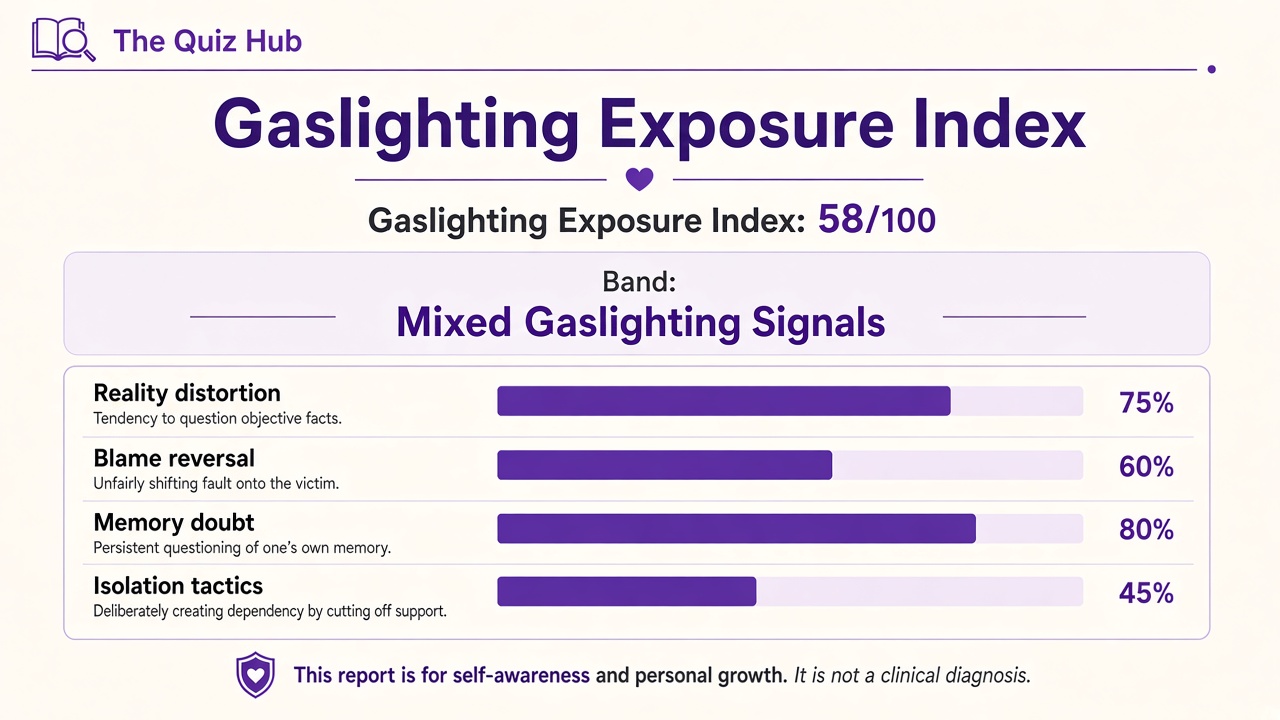
What your gaslighting report looks like
After all 22 items, you get a gaslighting exposure index from 0 to 100, a band label, and four domain bars for reality distortion, blame reversal, memory doubt, and isolation tactics. Percentages reflect conflict behaviors you notice, not proof that someone is manipulating you.
What this quiz can and cannot tell you
Can tell you
- How often gaslighting pattern signals showed up for you during disagreements
- A gaslighting exposure index and four domain bars for reality distortion, blame reversal, memory doubt, and isolation
- Which domain pattern feels strongest in your current experience
- A starting point for therapy, advocacy, or retaking after a major conflict
Cannot tell you
- Whether your partner is manipulative, narcissistic, or abusive without your own judgment and support
- Whether defensive arguing is poor communication or intentional coercion in your specific context
- Whether you should stay or leave without honest dialogue and safety planning
- What treatment or legal action you need without licensed professional guidance
Gaslighting, reality erosion, and conflict red flags
Psychologist Robin Stern coined the term gaslighting in her 2007 book to describe how someone can make you doubt your own perception through denial, minimization, and blame reversal. The pattern appears widely in media about narcissistic abuse, but the underlying mechanics overlap with coercive control frameworks documented by the American Psychological Association: shifting facts, undermining memory, reversing accountability, and cutting off outside perspective. The 1944 film Gaslight gave the behavior its popular name, though clinical writers now treat it as one tactic within broader intimate partner violence research.
The Quiz Hub built this am I being gaslighted quiz as an original self-report screener inspired by those themes, not a reproduction of any single published instrument. Readers often compare it to sibling tools on this site. Our narcissistic abuse quiz screens gaslighting alongside isolation, blame-shifting, and control across an ongoing relationship. The fear of intimacy quiz measures your own vulnerability avoidance and trust hesitation, not partner conflict tactics. The do I have trust issues quiz maps hypervigilance and repair doubt rather than reality distortion during arguments.
| The Quiz Hub test | What it adds |
|---|---|
| Narcissistic abuse quiz | Broader coercion index across gaslighting, isolation, blame-shift, and control over time |
| Am I being love-bombed quiz | Early intensity pace, future faking, and boundary erosion, not conflict reality erosion |
| Fear of intimacy quiz | Your closeness avoidance habits, not partner behavior frequency |
| Am I dealing with a narcissist quiz | Entitlement and empathy gap items alongside gaslighting, not memory doubt focus alone |
| Anxiety or intuition quiz | Body alarm versus gut clarity, not gaslighting domain scores |
| This gaslighting quiz | Four-domain conflict exposure index for reality distortion, blame reversal, memory doubt, and isolation tactics |
Sample item types include frequency ratings such as whether you leave conversations unsure what happened because their version keeps changing, or whether you hear labels like too sensitive when you recall what was said. High reality distortion with high blame reversal often lands in Mixed or Higher Gaslighting Exposure. Defensive arguing, trauma history, and cultural communication norms can also raise scores without abuse. Read how we review quizzes in our editorial policy or browse more tools on our relationships and dating hub.
Gaslighting quiz FAQ
What is gaslighting?
Gaslighting is a pattern where someone denies events, shifts blame, or undermines your memory so you doubt your own perception. Psychologist Robin Stern and domestic violence researchers describe it as a tactic that can appear in coercive control, though poor communication during stress can look similar without intent to manipulate. This am I being gaslighted quiz measures how often reality distortion, blame reversal, memory doubt, and isolation tactic signals showed up for you during disagreements. It is not proof of abuse or a clinical diagnosis.
What does this gaslighting quiz measure?
Twenty-two original frequency items ask how often you notice shifting facts, reversed blame, memory challenges, and isolation from support when you think about how this person responds during tense moments. Scores map to four domains drawn from trauma-informed relationship red-flag research. You receive a gaslighting exposure index from 0 to 100 and a band from Lower through Higher Gaslighting Exposure.
How is this different from the narcissistic abuse quiz?
The narcissistic abuse quiz screens gaslighting alongside isolation, blame-shifting, and control across an established relationship with broader coercion items. This gaslighting quiz focuses on reality erosion during conflict: fact-shifting, blame reversal, memory doubt, and cutting off outside perspective. It uses a frequency frame about disagreement dynamics rather than the full abuse pattern inventory alone.
Can this quiz prove my partner is gaslighting or abusive?
No. The gaslighting exposure index describes self-reported pattern signals on this abbreviated screener. Defensive arguing, trauma history, and cultural communication norms can raise scores without manipulation. Only you plus trusted professionals can assess safety. Online quizzes cannot confirm or deny abuse or diagnose personality disorders.
What should I do if I get a higher gaslighting exposure band?
Consider contacting the National Domestic Violence Hotline at 1-800-799-7233 or thehotline.org for confidential support and safety planning. A licensed therapist or advocate who understands coercive control can help you interpret patterns. If you feel unsafe or in crisis, call or text 988 (US) or your local crisis line.
Who reviewed this content?
Dr. Elena Vasquez, PhD, reviewed the test framing and result explanations. See our editorial policy for review standards.
Reviewed by