What this waiter test relationship quiz measures
This waiter test relationship quiz turns a viral dining-room observation into structured self-report. You rate what you have seen when your partner interacts with waitstaff, host teams, delivery drivers, and other service workers. Twenty-three original items group into five domains that everyday ethics researchers often treat as distinct: politeness under delay, empathy when mistakes happen, tipping and fairness values, behavior when someone feels superior as the customer, and whether courtesy matches in public versus private.
Politeness and patience
Please-and-thank-you habits, calm waiting when a restaurant is slammed, and equal tone toward all front-of-house staff.
Empathy after mistakes
Calm correction without humiliation, benefit of the doubt for overwhelmed kitchens, and moving on after a fair fix.
Tip and fairness attitudes
Fair tipping when service was merely adequate, views on worker pay, and not punishing servers for kitchen delays.
Power-difference behavior
Avoiding entitlement, review threats, status pressure, and accepting polite limits without escalation.
Public vs private consistency
Similar courtesy when you are alone versus performing for friends, across restaurants and other service settings.
How it works
Three steps from first question to your observation report. Click Start Quiz to open the interactive quiz in a full-screen modal.
Answer 23 observation items
Rate each statement from strongly disagree to strongly agree based on what you have observed with your partner. There is no timer and no auto-advance between items.
Items map to five domains
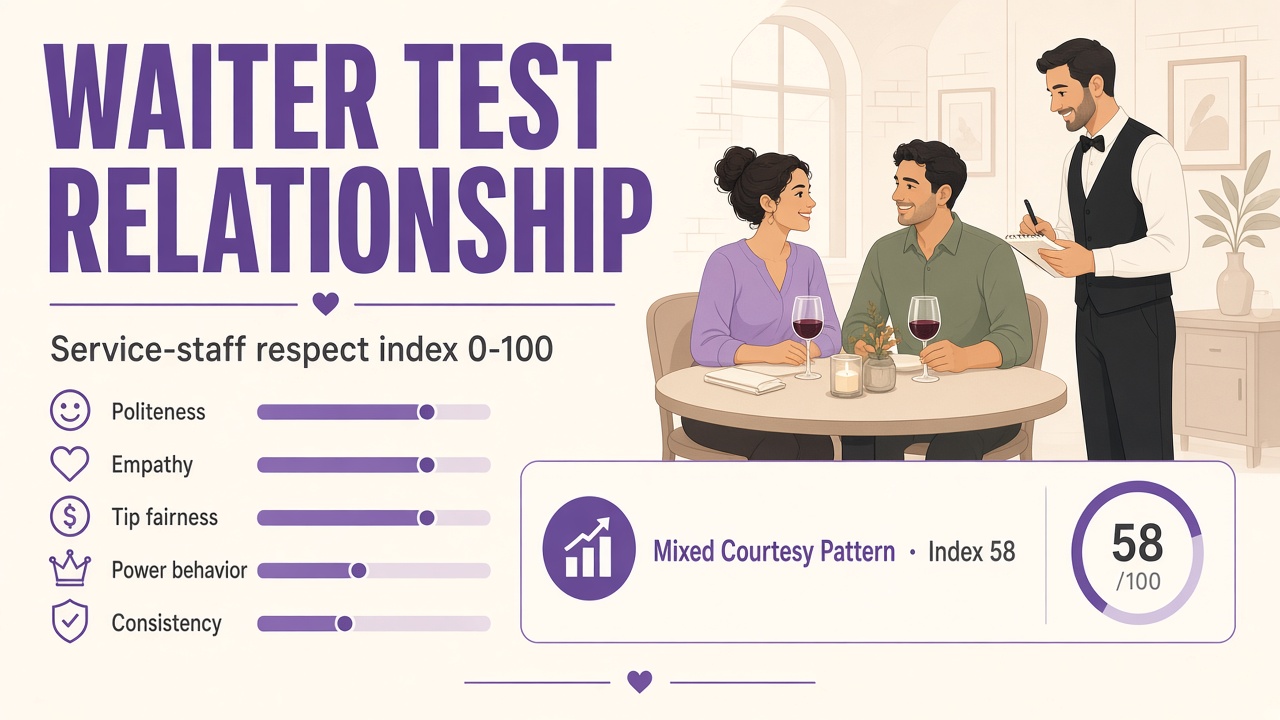
Your answers accumulate percentages for politeness, mistake empathy, tip fairness, power behavior, and public-private consistency, plus an overall service-staff respect index.
View band and next steps
Results show Lower Respect Signals, Mixed Courtesy Pattern, or Higher Respect Signals with domain bars and honest limits on judging your partner.
Take the waiter test relationship quiz
Rate 23 partner observation statements on a five-point agree-disagree scale. Your answers produce a service-staff respect index from 0 to 100, five domain scores, and a courtesy band with plain-language next steps.
Opens in a focused modal. No account required. Results stay on screen.
What your result means
Your service-staff respect index is the normalized average across all 23 items on a 0 to 100 scale. The band groups that index into plain-language observation signals. Domain bars show whether patience, empathy, tipping values, power behavior, or consistency drives your result most.
| Courtesy band | Score range | Typical reading |
|---|---|---|
| Lower Respect Signals | 0 to 35 | Several observed patterns where courtesy toward service workers may be inconsistent or strained |
| Mixed Courtesy Pattern | 36 to 65 | Blend of respectful habits and uneven moments when your partner deals with staff |
| Higher Respect Signals | 66 to 100 | Consistent patience, empathy, fairness, and similar courtesy in public and private |
What your waiter test report looks like
After all 23 items, you get a service-staff respect index from 0 to 100, a courtesy band, and five domain bars for politeness, mistake empathy, tip fairness, power behavior, and public-private consistency. Percentages reflect how strongly you endorsed observation items, not proof of your partner's full character.
What this quiz can and cannot tell you
Can tell you
- Whether your observed partner behavior toward staff leans lower, mixed, or higher on this screener
- A service-staff respect index and five domain scores for courtesy patterns you report
- Which domain (patience, empathy, tipping, power, or consistency) drives your result most
- A starting point for direct conversations about fairness and respect, like our am I toxic quiz limits on labeling others
Cannot tell you
- Whether your partner is abusive, narcissistic, or unsafe based on restaurant behavior alone
- Whether you should stay, leave, or confront them without your own context and safety plan
- How they treat you in private conflict, intimacy, or family settings not covered here
- Absolute truth when cultural tipping norms, class background, or one bad night skew observation
The viral waiter test, everyday ethics, and character observation
Social media revived an older dinner-table idea: watch how a date treats the waiter. The premise is simple. When someone holds temporary power as the paying customer, their patience, empathy, and tone toward staff may reveal habits that also show up elsewhere. Philosophers who study everyday ethics, including Eric Schwitzgebel and Joshua Rust in their work on moral behavior in daily life, argue that small courteous acts and rude slips in ordinary settings can be meaningful data, though never complete proof of character.
Relationship advice creators paired the waiter test with sibling memes such as the orange peel test and bird test relationship quizzes, which also ask what you observe when a partner performs small caring acts or reacts to animals. The Quiz Hub built this waiter test relationship quiz to answer that search intent with 23 original items, five domain bars, and explicit limits like our compatibility test and am I toxic quiz. Courtesy toward workers correlates with some prosocial habits in survey research, yet class bias, regional tipping rules, language barriers, and service mistakes can distort any single meal.
| The Quiz Hub test | What it adds |
|---|---|
| Orange peel test | Observation of small caring gestures such as peeling fruit, not service-worker courtesy |
| Bird test relationship quiz | Partner reactions to birds or animals as another viral observation lens |
| Compatibility test | Your own values, communication, repair, and lifestyle fit on 30 self-reflection items |
| Relationship test | Six-domain partnership health inside your current bond, not dining-room behavior alone |
| This waiter test relationship quiz | Five-domain service-staff respect index from partner observation items |
Sample item: agreeing that your partner waits calmly when a restaurant is busy raises your politeness and patience score. Agreeing that they threaten bad reviews over minor issues raises concern on power-difference items. A partner who grew up in a no-tipping culture may look harsh on tip items until you talk about norms. That is why we label results as signals, not sentences. For broader fit questions, pair this quiz with our compatibility test. For overall bond health, try the relationship test. Browse more tools on our relationships and dating hub or read how we review quizzes in our editorial policy.
Waiter test relationship FAQ
What is the viral waiter test in relationships?
The waiter test is a social observation idea: watch how someone treats waitstaff, retail workers, or others with less visible power when they think no one important is watching. Supporters treat it as an everyday ethics snapshot. Critics note class bias, cultural tipping norms, and bad nights out. This quiz turns that idea into 23 structured observation items with clear limits, not a breakup command.
What does this waiter test relationship quiz measure?
Twenty-three agree-disagree items ask what you have observed about your partner with servers and service workers. Five domains score politeness and patience, empathy after mistakes, tip and fairness attitudes, power-difference behavior, and public versus private consistency. Results show a service-staff respect index from 0 to 100 plus five domain bars.
Can this quiz prove my partner is a good or bad person?
No. The index reflects your self-report about observed behavior in service settings. It is one data point, not a moral verdict, abuse screening tool, or compatibility prediction. Kindness to waitstaff can correlate with everyday courtesy in some research, but it cannot prove how someone treats you in private conflict or intimacy.
How is this different from the compatibility test?
The compatibility test maps your own values overlap, communication habits, conflict repair, and lifestyle fit on 30 self-reflection items. This waiter test relationship quiz focuses on partner behavior toward service workers you have observed. Compatibility is about fit patterns. The waiter test is about courtesy under status difference.
Should I break up if my partner scores low?
Not based on this quiz alone. Lower respect signals can reflect stress, unfamiliar dining settings, different tipping cultures, or one embarrassing night. Use results to start a direct conversation about courtesy and fairness, not as a silent verdict. Safety concerns always deserve professional support beyond any online quiz.
Who reviewed this content?
Dr. Priya Sharma, PhD, reviewed the test framing and result explanations. See our editorial policy for review standards.
Reviewed by