What this relationship test measures
This relationship test maps six domains that shape how a partnership feels when you are already inside it. Twenty-six original agree-disagree items ask about communication habits, trust, emotional closeness, repair after conflict, shared direction, and respect for autonomy. The result is your self-report snapshot today. It does not score chemistry with a new match or predict whether you should stay or leave.
Communication
Expressing needs, listening with curiosity, check-ins, and naming appreciation before resentment builds.
Trust
Reliability, emotional safety, good-faith assumptions, and freedom from chronic surveillance habits.
Emotional intimacy
Feeling seen, sharing inner life, responding to bids for connection, and warmth in daily moments.
Conflict repair
Returning after cooling down, apologizing, avoiding scorekeeping, and disagreeing without catastrophe fears.
Shared goals
A shared direction on future plans, money, family, and teamwork in major decisions.
Respect and autonomy
Honoring boundaries, supporting individual growth, and balancing togetherness with personal freedom.
How it works
Three steps from first question to your relationship health profile. Click Start Test to open the interactive quiz in a full-screen modal.
Answer 26 statements
Rate how much you agree with each item about your current relationship on a five-point scale. You click Next after each answer; nothing auto-advances.
Items map to six domains
Your answers accumulate scores across communication, trust, emotional intimacy, conflict repair, shared goals, and respect with autonomy.
View index, band, and domain bars
Results show a relationship health index from 0 to 100, a band label, six domain percentages, and conversation prompts.
Take the relationship test
Rate 26 partnership statements on a five-point agree-disagree scale. Your answers produce a relationship health index, band label, and six domain bars for reflection or couple conversation.
Opens in a focused modal. No account required. Results stay on screen.
What your result means
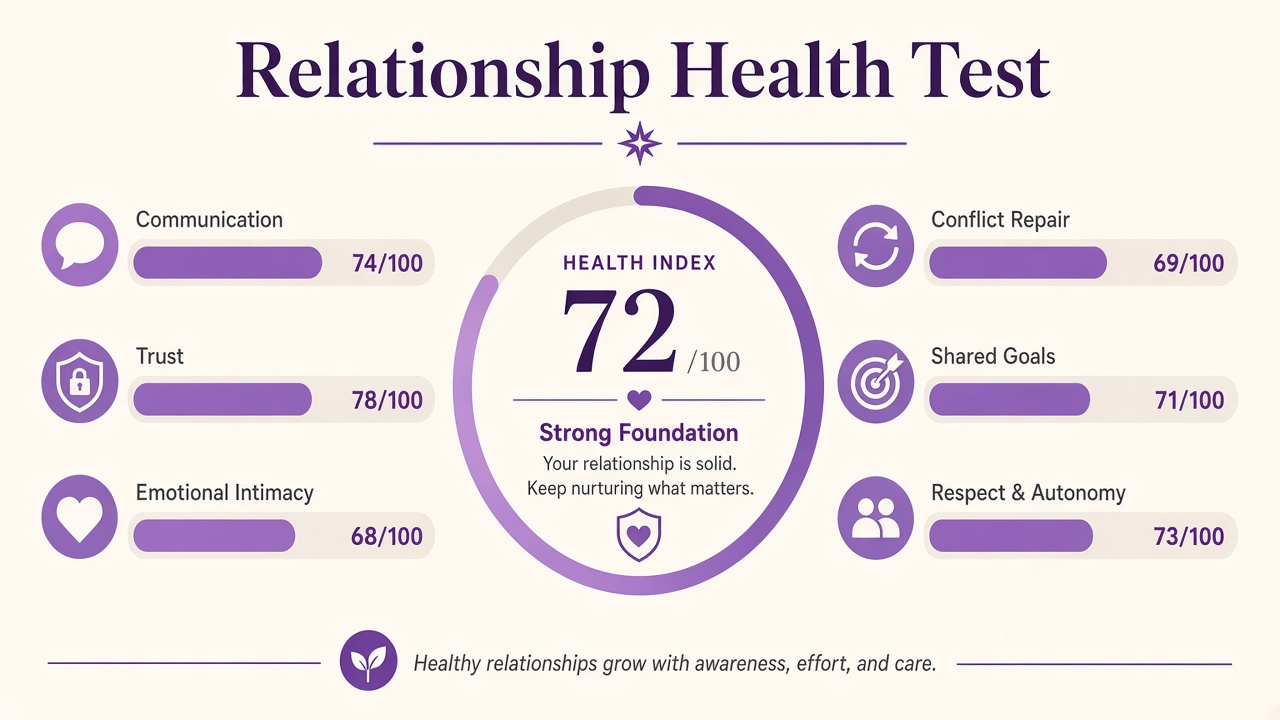
Your relationship health index is the normalized average across all 26 items on a 0 to 100 scale. Higher scores mean stronger self-reported patterns in communication, trust, intimacy, repair, goals, and respect. Domain bars show which area feels strongest and which may need the most attention or conversation.
| Band | Index range | Typical reading |
|---|---|---|
| Needs Attention | 0 to 35 | Several domains may feel strained or unclear; use bars to pick one topic for support or dialogue |
| Mixed Health | 36 to 65 | Real strengths alongside uneven domains; compare bars with your partner separately |
| Strong Foundation | 66 to 100 | Consistent self-reported habits that support partnership health; still not proof problems will never appear |
Six relationship health domains
The diagram below shows how domain bars and the central relationship health index appear in your results. High trust with moderate shared goals, for example, can still land you in Mixed Health if your overall average sits between bands.
What this test can and cannot tell you
Can tell you
- Your self-reported emphasis across six partnership health domains
- A relationship health index from 0 to 100 with Needs Attention, Mixed Health, or Strong Foundation band
- Which domain bar is strongest and which may benefit from conversation or support
- A starting point for honest talks about trust, intimacy, repair, goals, or respect
Cannot tell you
- Whether you should stay in or leave your relationship
- Whether your partner loves you, is faithful, or will change without their input
- Clinical relationship pathology, abuse patterns, or attachment disorder diagnoses
- Compatibility with a new partner or a fixed score that never shifts with growth or therapy
Partnership health research and everyday reflection
Relationship researchers such as John Gottman emphasize that long-term satisfaction depends less on avoiding conflict and more on how partners repair after ruptures, respond to emotional bids, and maintain trust over time. Work on dyadic coping shows that couples who face stress as a team often report higher intimacy even when life circumstances are hard. The Quiz Hub built this relationship test as a plain-language health snapshot across six domains inspired by that research tradition without reproducing any published clinical instrument.
Readers often compare relationship health quizzes to narrower tools on this site. Our compatibility test maps values overlap and lifestyle fit patterns that shape how two profiles might align. The loyalty test maps honesty, reliability, boundaries, and commitment habits. Our am I a good boyfriend quiz focuses on supportive partner habits such as emotional support, romantic effort, and accountable repair. The attachment style test maps anxiety and avoidance in closeness. Our love language test names how you prefer to give and receive care. Our am I ready for a relationship quiz screens personal bandwidth before dating. Our when will I get married quiz maps marriage-readiness focus without predicting wedding dates. This relationship test sits apart: it asks how your current partnership feels across trust, intimacy, repair, goals, and respect.
| The Quiz Hub test | What it adds |
|---|---|
| Compatibility test | Values alignment and lifestyle fit bars, not day-to-day trust or intimacy inside the bond |
| Loyalty test | Honesty, boundaries, and commitment habits, not broader partnership health across intimacy and goals |
| Am I a good boyfriend quiz | Supportive boyfriend habits such as communication, support, romance, and accountability, not bond-wide health |
| Attachment style test | Closeness anxiety and avoidance patterns, not shared goals or respect for autonomy |
| Love language test | Preference language for affection, not conflict repair or partnership direction |
| When will I get married quiz | Marriage-readiness bands for singles, not health inside an existing partnership |
| Am I ready for a relationship quiz | Personal readiness before dating, not health inside an existing partnership |
| This relationship test | Six-domain health index with communication, trust, intimacy, repair, goals, and respect bars |
Sample item: agreeing strongly that you feel emotionally seen by your partner raises your emotional intimacy bar. Agreeing that you often scan messages for reassurance lowers your trust score through a reverse-scored item. Couples who answer separately often discover that one domain feels strong while another wobbles. That gap is useful data for a calm conversation, not proof that the relationship should end. Read how we review quizzes in our editorial policy or browse more tools on our relationships and dating hub.
Relationship test FAQ
What does this relationship test measure?
This relationship test measures self-reported partnership health across six domains: communication, trust, emotional intimacy, conflict repair, shared goals, and respect with autonomy. Twenty-six agree-disagree items ask how your current relationship feels day to day. Results show a relationship health index from 0 to 100, a band label, and six domain bars. It reflects your experience inside a relationship, not compatibility with a hypothetical partner.
Who should take this relationship health quiz?
This quiz is designed for people who are already in a relationship and want an honest snapshot of how it feels right now. It is not a dating readiness screener or a partner mind-reading tool. If you are single or unsure about starting dating, try our am I ready for a relationship quiz instead.
How is the relationship health index calculated?
Each item scores from 1 to 5 on a five-point agree-disagree scale, with some reverse-scored items to reduce acquiescence bias. Domain percentages normalize item totals within communication, trust, emotional intimacy, conflict repair, shared goals, and respect with autonomy. The overall relationship health index is the normalized average across all 26 items, mapped to bands: Needs Attention (0 to 35), Mixed Health (36 to 65), and Strong Foundation (66 to 100).
How is this different from the compatibility test?
The compatibility test focuses on values overlap, lifestyle fit, and habits that shape how two profiles might align. This relationship test asks how your current partnership feels across trust, intimacy, repair, goals, and respect. Compatibility is about fit patterns. Relationship health is about the quality you experience inside the bond today.
Can this quiz tell me whether to stay or leave?
No. The relationship health index is a self-reflection snapshot, not a stay-or-go verdict. Low scores can reflect stress, unspoken needs, or a season that needs support rather than an automatic exit. Use results to name topics for conversation, therapy, or personal reflection. Safety concerns always deserve professional help beyond any online quiz.
Who reviewed this content?
Dr. Priya Sharma, PhD, reviewed the test framing and result explanations. See our editorial policy for review standards.
Reviewed by