What this relationship compatibility test measures
This compatibility test maps four domains that shape how partnerships feel day to day. Thirty original agree-disagree items ask about values, how you communicate needs, how you repair after conflict, and whether your lifestyle rhythm fits. The result is your profile only. It does not score chemistry with a named partner.
Values alignment
Honesty, commitment, money, family time, and long-term priorities you want to share.
Communication
Expressing needs, listening, checking in, and naming small hurts before they grow.
Conflict repair
Apologizing, de-escalating, compromising, and reconnecting after disagreements.
Lifestyle fit
Time together, affection, social energy, chores, intimacy expectations, and daily pace.
How it works
Three steps from first question to your compatibility profile. Click Start Test to open the interactive quiz in a full-screen modal.
Answer 30 statements
Rate how much you agree with each relationship item on a five-point scale. You click Next after each answer; nothing auto-advances.
Items map to four domains
Your answers accumulate scores across values alignment, communication, conflict repair, and lifestyle fit.
View index, band, and domain bars
Results show a compatibility index from 0 to 100, a band label, four domain percentages, and conversation prompts.
Take the compatibility test
Rate 30 relationship statements on a five-point agree-disagree scale. Your answers produce a compatibility index, band label, and four domain bars for reflection or couple conversation.
Opens in a focused modal. No account required. Results stay on screen.
What your result means
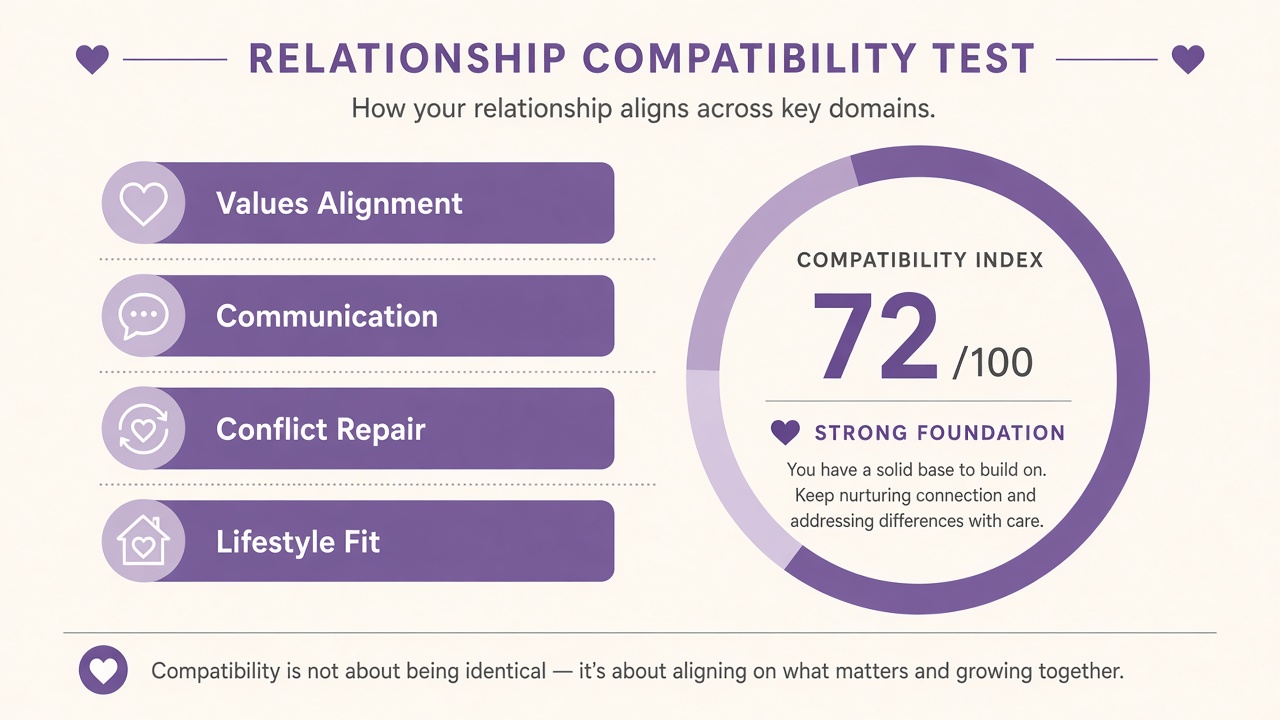
Your compatibility index is the normalized average across all 30 items on a 0 to 100 scale. Higher scores mean stronger self-reported patterns in values, communication, repair, and lifestyle fit. Domain bars show which area scores highest and which may need the most conversation.
| Band | Index range | Typical reading |
|---|---|---|
| Growing Edges | 0 to 35 | Several domains may need clarity before deep partnership talks; use bars to pick one topic |
| Mixed Strengths | 36 to 65 | Balanced profile with uneven domains; compare bars with a partner separately |
| Strong Foundation | 66 to 100 | Consistent self-reported habits that support compatibility dialogue; still not a fate prediction |
Four compatibility domains
The diagram below shows how domain bars and the central compatibility index appear in your results. High communication with moderate lifestyle fit, for example, can still land you in Mixed Strengths if your overall average sits between bands.
What this test can and cannot tell you
Can tell you
- Your self-reported emphasis across four relationship compatibility domains
- A compatibility index from 0 to 100 with Growing Edges, Mixed Strengths, or Strong Foundation band
- Which domain bar is strongest and which may benefit from conversation
- A starting point for honest talks about values, repair skills, or daily-life fit
Cannot tell you
- Whether you and a specific partner are soulmates or destined to stay together
- Compatibility with another person without their separate self-report answers
- Clinical relationship pathology or attachment disorder diagnoses
- A fixed score that never shifts with growth, therapy, or life stage
Relationship compatibility research and everyday fit
John Gottman and Robert Levenson studied what predicts relationship stability in long-term couples, emphasizing repair attempts, emotional bids, and how partners manage conflict rather than initial chemistry alone. Later work on value congruence shows that shared priorities about money, family, and commitment matter more for satisfaction than identical hobbies. The Quiz Hub built this compatibility test as a plain-language profile across four domains inspired by that research tradition without reproducing any published clinical instrument.
Readers often compare compatibility quizzes to narrower tools. Our my type of man quiz names which partner archetypes you find appealing before you assess fit with a specific person. Our love language test names how you prefer to give and receive care. The attachment style test maps anxiety and avoidance in closeness. Our am I ready for a relationship quiz screens whether you have bandwidth and clarity before dating. The relationship test measures partnership health across trust, intimacy, repair, goals, and respect for people already in a bond. For nostalgic name games, the love calculator paper runs the schoolyard letter cross-out trick with disclosed math. This compatibility test sits between them: wide enough to cover values and lifestyle, focused enough to produce four domain bars and one index score.
| The Quiz Hub test | What it adds |
|---|---|
| Love language test | Preference language for affection and appreciation, not full values or lifestyle fit |
| Attachment style test | Closeness anxiety and avoidance patterns, not conflict repair or daily routines |
| Am I ready for a relationship quiz | Personal readiness for dating: healing, time, communication, and clarity domains |
| Relationship test | Six-domain partnership health index for people already in a relationship |
| This compatibility test | Four-domain index with values, communication, conflict repair, and lifestyle fit bars |
Sample item: agreeing strongly that you apologize when you hurt your partner raises your conflict repair bar. Agreeing that you want similar expectations about intimacy raises lifestyle fit. Couples who answer separately often discover that one domain diverges while others align. That gap is useful data for a calm conversation, not proof that the relationship should end. Read how we review quizzes in our editorial policy or browse more tools on our relationships and dating hub.
Compatibility test FAQ
What does this relationship compatibility test measure?
This compatibility test measures self-reported patterns across four domains: values alignment, communication, conflict repair, and lifestyle fit. Thirty agree-disagree items cover honesty priorities, expressing needs, apologizing after fights, and expectations about time, intimacy, and daily routines. Results show a compatibility index from 0 to 100, a band label, and four domain bars. It reflects your profile, not a score with a specific partner.
Can this quiz predict whether my relationship will work?
No. The compatibility index is a self-reflection snapshot based on your answers alone. It cannot predict relationship success, failure, or soulmate fit. Real compatibility depends on how two people communicate, repair conflict, and adapt over time. Use results as conversation starters, not verdicts.
How is the compatibility index calculated?
Each item scores from 1 to 5 on a five-point agree-disagree scale, with some reverse-scored items to reduce acquiescence bias. Domain percentages normalize item totals within values alignment, communication, conflict repair, and lifestyle fit. The overall compatibility index is the normalized average across all 30 items, mapped to bands: Growing Edges (0 to 35), Mixed Strengths (36 to 65), and Strong Foundation (66 to 100).
Should couples take this compatibility test together?
Many couples answer separately and compare domain bars afterward. That approach reduces pressure to match answers and opens specific talks about values, repair skills, or lifestyle rhythm. Do not use the quiz to grade each other or settle arguments about who is more compatible.
How is this different from a love language or attachment style test?
Love language quizzes focus on how you prefer to give and receive affection. Attachment style tests map anxiety and avoidance in closeness. This compatibility test spans broader partnership domains including money values, conflict repair, and daily-life fit. All three work best as complementary reflection tools.
Who reviewed this content?
Dr. Priya Sharma, PhD, reviewed the test framing and result explanations. See our editorial policy for review standards.
Reviewed by