What this am I evil quiz measures
This good and evil quiz maps how you say you would act across thirty moral scenarios. Instead of a single yes-or-no evil label, scoring tracks three leans: good (care and repair), neutral (pragmatic tradeoffs), and dark (self-protection and sharper retaliation). The framing is moral psychology for self-reflection, not a courtroom or clinical verdict.
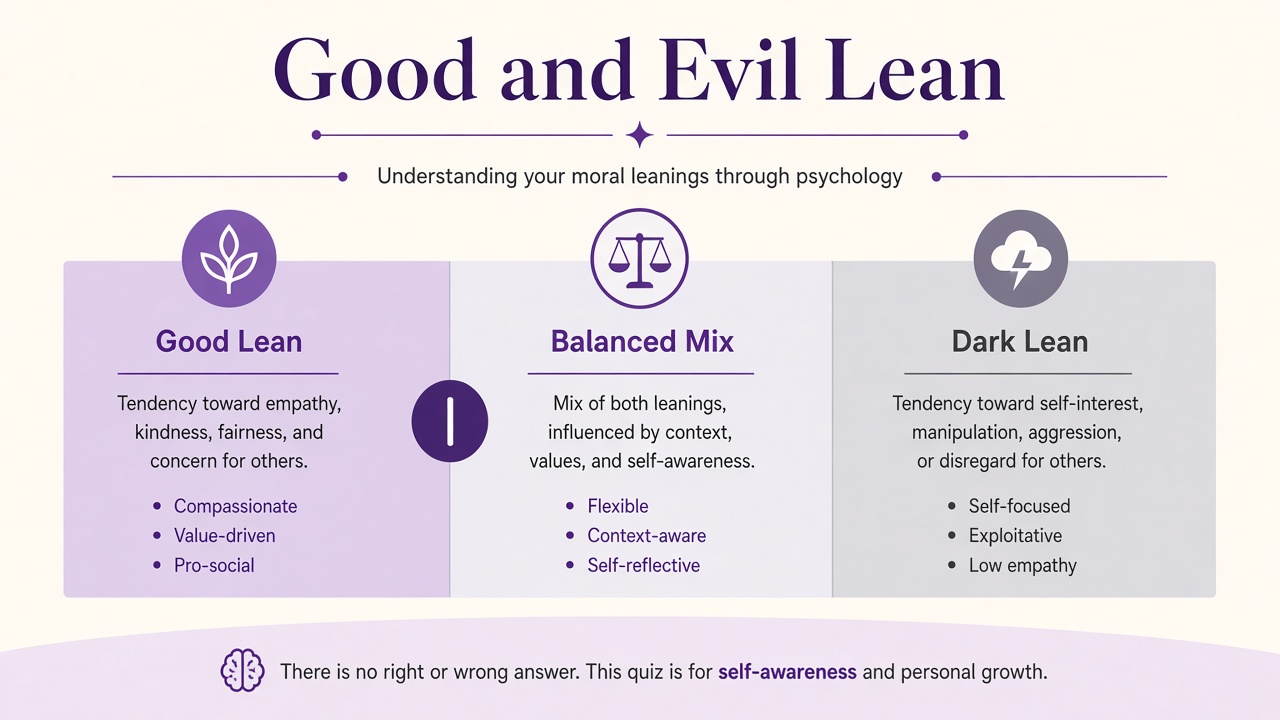
Good lean
Compassion, honesty, forgiveness, and standing up for others when harm is visible.
Neutral lean
Practical judgment, white lies, loyalty tradeoffs, and choosing peace over every fight.
Dark lean
Revenge, hidden advantage, mockery, and cold self-gain when trust feels unsafe.
How it works
Three steps from first scenario to your moral lean profile. Click Start Test to open the interactive quiz in a full-screen modal.
Picture thirty scenarios
Rate how much each hypothetical action matches what you would actually do on a five-point scale.
Items map to three leans
Your answers accumulate scores across good, neutral, and dark scenario groups with ten items each.
View lean bands and bars
Results show a Good-Hearted Lean, Balanced Moral Mix, or Darker Lean band plus lean bars and honest limits.
Take the am I evil quiz
Rate thirty moral scenarios about money, loyalty, conflict, and revenge. Your lean scores map to reflection bands, not a clinical evil diagnosis.
Opens in a focused modal. No account required. Results stay on screen.
What your result means
Each lean group has ten scenarios scored on a 10-to-50 raw scale, shown as a percentage. Your headline band compares good lean against dark lean with a twelve-point margin. Read all three bars when the label feels too broad.
| Pattern | Band | Typical reading |
|---|---|---|
| Good lean leads by 12+ points | Good-Hearted Lean | More care, repair, and integrity-driven scenario agreement |
| Leans stay close or neutral leads | Balanced Moral Mix | Contextual ethics and pragmatic tradeoffs across scenarios |
| Dark lean leads by 12+ points | Darker Lean | More self-protection, strategy, and sharp-edge scenario agreement |
Good, neutral, and dark lean on one spectrum
Moral reflection is rarely binary. This diagram shows the three lean groups used on The Quiz Hub plus the bands behind your headline result. Compare with our moral alignment test for values archetypes, the Mach IV test for tactical cynicism, or the maturity test for responsibility patterns.
What this test can and cannot tell you
Can tell you
- Which moral lean your scenario answers emphasize today
- How good, neutral, and dark agreement compare on this quiz
- A plain-language band for reflection after searching am I evil
- A starting point before deeper alignment or interpersonal quizzes
Cannot tell you
- Whether you are evil, a bad person, or morally irredeemable
- Psychopathy, narcissism, or personality disorder status
- Hiring fit, legal guilt, or relationship verdicts
- Scores from any validated clinical morality instrument
Why people search am I evil
People type am I evil quiz after a fight, a secret thought, or a pattern they dislike in themselves. Moral psychology research treats everyday ethics as situational: the same person can return lost money and still enjoy a rival's stumble. The Quiz Hub version turns that nuance into thirty original scenarios with separate good, neutral, and dark lean scores instead of a single harsh label.
The quiz differs from alignment charts that sort you into lawful good or chaotic neutral. Those tests emphasize values identity. This one emphasizes behavior you admit in hypotheticals. When our moral alignment test ships, use it for archetype language and this quiz for lean percentages. For cynical strategy without moral framing, try the Mach IV test. For broader temperament, start with the Big Five personality test. Philosophers from Immanuel Kant to contemporary virtue ethicists debate whether motives or outcomes matter most; this quiz stays descriptive and leaves that debate to you.
Sample scenario: "Forgive someone who apologized sincerely even when I still feel hurt." High agreement raises your good lean. Low agreement does not prove malice; it may reflect boundaries after repeated harm. Social desirability bias can inflate good lean on public quizzes, so answer privately and read warnings if you straight-line every item. Browse more on our personality psychology hub.
Am I evil quiz FAQ
What does the am I evil quiz measure?
This quiz measures self-reported moral lean from thirty everyday scenarios: compassionate and repair-oriented choices (good lean), pragmatic tradeoffs (neutral lean), and self-protective or sharper choices (dark lean). It is a moral reflection tool, not a clinical evilness test or diagnosis.
Does a darker lean mean I am evil?
No. A darker lean means you agreed more with revenge, secrecy, or self-gain scenarios in this quiz. That describes hypothetical self-report patterns, not a moral verdict. Many people score darker on stress weeks and lighter after repair. The result is for reflection, not labeling.
How is this different from a moral alignment test?
Moral alignment tests usually map values to archetypes like lawful good or chaotic neutral. This am I evil quiz uses scenario agreement to estimate good, neutral, and dark lean without D&D framing. Pair both when you want values labels plus everyday behavior patterns.
How long does the good and evil quiz take?
Most people finish in about six minutes. There are thirty scenario items on a five-point agree scale. You can pause and return in the same browser session thanks to autosave.
Is this quiz clinical or diagnostic?
No. It does not screen for psychopathy, narcissism, or personality disorder. It does not tell you whether you are a bad person. It is educational self-reflection only, with clear limits on every results screen.
Who reviewed this content?
Dr. James Whitfield, PhD, reviewed the test framing and result explanations. See our editorial policy for review standards.
Reviewed by