What this personality complex test measures
This personality complex test maps six recurring self-protective patterns that pop psychology often labels complexes. Items describe everyday habits: comparing yourself to others, pushing back on rules, over-giving without asking, or smoothing conflict to keep approval. The goal is reflection, not diagnosis.
Inferiority
Self-comparison, fear of looking foolish, and holding back until you feel ready enough.
Superiority
Ranking others, correcting details, and protecting status when competence feels threatened.
Martyr
Over-carrying burdens, skipping rest, and resenting unnoticed sacrifice.
Rebel
Automatic pushback against authority, trends, and expectations that feel controlling.
Perfectionist
Delaying starts, harsh self-review, and difficulty calling work good enough.
People-Pleaser
Softening opinions, quick yes answers, and anxiety when boundaries might disappoint someone.
How it works
Three steps from first question to your top two complexes. Click Start Test to open the interactive quiz in a full-screen modal.
Answer 45 statements
Rate how much you agree with each everyday habit item on a five-point scale. You click Next between questions; answers do not auto-advance.
Items map to six complexes
Your responses accumulate within inferiority, superiority, martyr, rebel, perfectionist, and people-pleaser areas. Some items are reverse-scored to reduce agreement bias.
View top two complexes
Results show a primary complex profile, a secondary influence, a six-bar chart, strengths, growth edges, and clear limits on what the quiz cannot prove.
Take the personality complex test
Rate 45 statements about comparison, status, sacrifice, rebellion, standards, and approval habits. Your highest two complex scores become your primary and secondary reflection labels with plain-language interpretation.
Opens in a focused modal. No account required. Results stay on screen.
What your result means
Each complex score is the sum of its items as a percentage of the maximum possible within that complex. The two highest scores become your primary and secondary labels. Read the bar chart when both scores are close.
| Complex | What high scores suggest | Reflection focus |
|---|---|---|
| Inferiority | Frequent self-comparison and caution in new settings | Notice where you hold back despite adequate skill |
| Superiority | Status protection and impatience with perceived incompetence | Ask whether winning the point costs connection |
| Martyr | Over-giving with unspoken expectations of recognition | Name limits before resentment builds |
| Rebel | Identity tied to resisting rules and mainstream paths | Choose pushback when structure is harmful, not merely annoying |
| Perfectionist | Fear of visible mistakes and delayed starts | Ship imperfect drafts as practice, not failure |
| People-Pleaser | Conflict avoidance and mood responsibility for others | Pause before automatic yes answers |
Six complexes at a glance
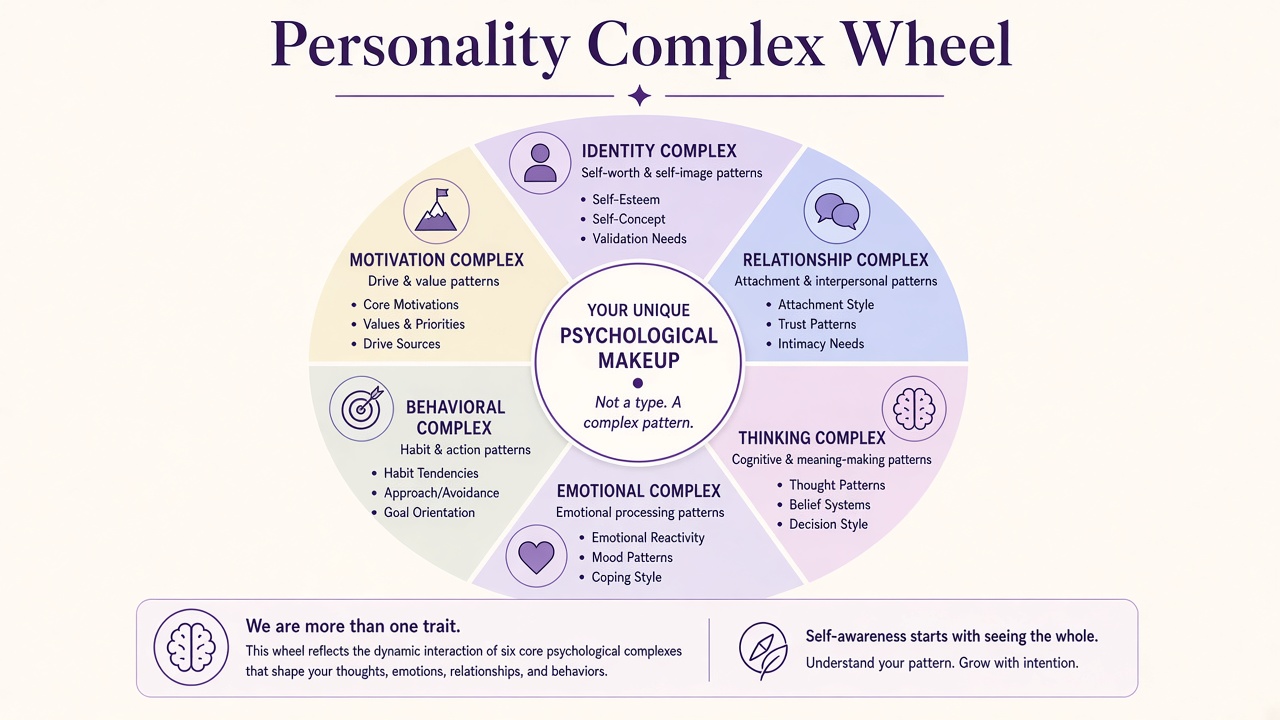
Pop-psych writers often place these patterns on a reflection wheel because they overlap in real life. A perfectionist streak can hide inferiority fear. A rebel stance can mask people-pleasing burnout. The diagram below is illustrative. Your bar chart shows which patterns dominate for you right now.
What this test can and cannot tell you
Can tell you
- Which of six pop-psych complex patterns score highest for you today
- A secondary complex that may color your primary pattern
- Plain-language strengths and growth edges for reflection
- A starting point to compare with type and trait quizzes on The Quiz Hub
Cannot tell you
- Whether you have a personality disorder or clinical condition
- Trauma history, attachment style, or therapy needs
- Fixed identity labels you must keep forever
- Hiring fit, relationship compatibility, or treatment plans
Where personality complex language comes from
Alfred Adler, an early psychoanalyst, wrote about inferiority feelings and compensation strategies that could tilt toward superiority striving. Later pop-psych authors stretched the word complex to describe martyrdom, rebellion, perfectionism, and chronic approval-seeking. Those labels can spark useful reflection, but they are not the same as constructs in the Journal of Personality and Social Psychology or formal diagnostic manuals.
Sample item on this quiz: "I hint at how tired I am instead of asking directly for help." High agreement nudges your martyr score. That does not mean you are manipulative; it may mean you learned that direct requests felt unsafe. Context always matters more than a single label. If you want research-backed trait scores, start with our Big Five personality test. For motivation types, try the Enneagram test. For interpersonal dark patterns, bookmark our planned difficult person test when it goes live.
Comparison table for The Quiz Hub readers: the Big Five measures continuous traits with decades of factor-analytic support. The Enneagram names a core type plus wing. This personality complex test ranks six defense-style patterns and returns your top two. None of these online quizzes replace a therapist who can hear your full story. Browse more options on our personality psychology hub.
Personality complex test FAQ
What is a personality complex in pop psychology?
Pop psychology uses complex to describe a recurring emotional pattern that shapes how you react under stress. Alfred Adler wrote about inferiority and superiority complexes. Online quizzes extend that language to martyrdom, rebellion, perfectionism, and people-pleasing. These are reflection labels, not clinical diagnoses.
How is this personality complex test scored?
Forty-five agree-disagree items map to six complexes. Your answers sum within each complex, convert to a percentage of the maximum, and rank from highest to lowest. Results name your primary complex and a secondary influence, plus a bar chart for all six scores.
How long does the personality complex test take?
Most people finish in about 7 minutes. There are 45 statements on a five-point scale. You can pause and return in the same browser session because progress autosaves.
Is a personality complex the same as a mental health diagnosis?
No. This quiz is for casual self-reflection only. It does not assess personality disorders, trauma responses, or conditions that require licensed evaluation. High scores on one complex are patterns to notice, not proof of pathology.
Which complexes does this test measure?
The inventory covers inferiority, superiority, martyr, rebel, perfectionist, and people-pleaser patterns. Each complex has seven or eight items with some reverse-scored statements to reduce agreement bias.
How does this compare to the Enneagram or Big Five tests?
The Enneagram maps nine motivation types with wing detection. The Big Five scores five continuous trait domains backed by research. This personality complex test uses Adler-inspired pop-psych language about recurring defense patterns rather than trait percentiles or type numbers.
Who reviewed this content?
Dr. James Whitfield, PhD, reviewed the test framing and result explanations. See our editorial policy for review standards.
Reviewed by