What this moral alignment test measures
This moral alignment test uses the Dungeons and Dragons nine-cell grid: lawful, neutral, and chaotic on one axis; good, neutral, and evil on the other. Thirty-six scenario prompts ask what you would do when rules, kindness, freedom, and self-interest collide. The goal is playful self-reflection for tabletop fans and curious readers, not moral judgment from a therapist or judge.
Lawful
Preference for rules, promises, documented process, and institutions that keep power predictable.
Chaotic
Comfort improvising, questioning stale tradition, and acting before committees finish debating.
Good
Reducing harm, returning what is not yours, and speaking up for vulnerable people even when it costs you.
Evil
Exploiting weakness, letting rivals take blame, and choosing personal gain when strangers pay the price.
How it works
Three steps from the first scenario to your alignment code. Click Start Test to open the interactive quiz in a full-screen modal.
Answer 36 scenarios
Rate how much you agree with each "In this situation, I would..." prompt on a five-point scale. You click Next between questions; answers do not auto-advance.
Items map to four poles
Nine items each lean toward law, chaos, good, or evil. Some reverse-scored statements reduce agreement bias. Scores combine into two axis totals.
View your nine-cell result
Results show your alignment code (LG through CE), axis percentages, a highlighted grid, profile copy, fandom comparisons, and clear recreational limits.
Take the moral alignment test
Rate 36 scenarios about rules, rebellion, kindness, and self-interest. Your law/chaos and good/evil axis scores place you on the classic Dungeons and Dragons alignment grid with plain-language interpretation.
Opens in a focused modal. No account required. Results stay on screen.
What your result means
Each axis compares two poles after summing nine items per side. If law beats chaos by enough points, you land lawful; if chaos wins, chaotic; otherwise neutral on order. The same logic applies to good versus evil. The intersection picks your primary alignment from the table below.
| Code | Alignment | Typical pattern |
|---|---|---|
| LG | Lawful Good | Kind outcomes through fair rules and duty |
| NG | Neutral Good | Helps people first; treats rules as tools |
| CG | Chaotic Good | Protects others by challenging bad authority |
| LN | Lawful Neutral | Order, contracts, and code over sentiment |
| TN | True Neutral | Balance, pragmatism, or deliberate restraint |
| CN | Chaotic Neutral | Personal freedom over group plans or crusades |
| LE | Lawful Evil | Power through systems and weaponized procedure |
| NE | Neutral Evil | Self-interest with flexible morals |
| CE | Chaotic Evil | Selfish impulse plus contempt for norms |
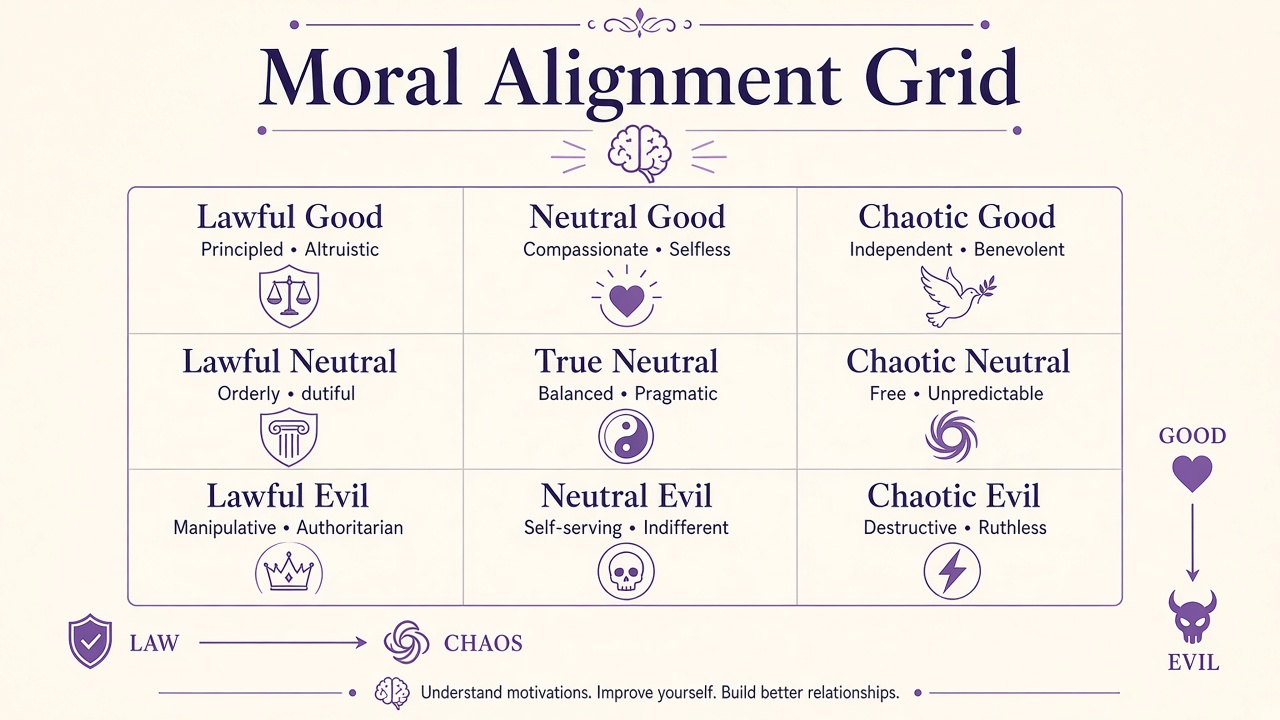
Nine alignments at a glance
Gary Gygax and Dave Arneson popularized this grid in early Dungeons and Dragons manuals as a quick roleplay shorthand. Modern tables still debate whether alignments describe actions or ideals. This diagram shows the nine cells. Your quiz result highlights the cell that matches your current axis scores.
What this test can and cannot tell you
Can tell you
- Which D&D-style alignment label fits your scenario answers today
- Law versus chaos and good versus evil axis percentages
- Plain-language strengths, growth edges, and fandom comparison notes
- A starting point to compare with other The Quiz Hub personality pages
Cannot tell you
- Whether you are a good or bad person in absolute terms
- Official Dungeons and Dragons character sheet data
- Clinical personality traits or diagnostic categories
- Hiring fit, relationship verdicts, or religious moral authority
Where the alignment grid comes from
The nine-alignment system grew out of early fantasy wargaming and solidified in 1970s Dungeons and Dragons rulebooks. Players tagged characters as Lawful Good paladins, Chaotic Neutral rogues, or Lawful Evil tyrants to speed up roleplay debates at the table. The official D&D site still treats alignment as a story tool rather than a real-world moral scorecard.
Sample item on this quiz: "In this situation, I would question a rule that exists mostly because that is how we always do it." High agreement nudges your chaos score. Another item asks whether you would return a lost wallet when inconvenient; that nudges good. Real ethics are messier than nine boxes, which is why we show axis bars and a secondary lean when you sit near neutral.
Comparison table for The Quiz Hub readers: the character personality test scores fiction archetypes like mentor and trickster. The Mach IV test measures cynical interpersonal style from social psychology. This moral alignment test uses the D&D grid for fans who want LG-through-CE language. For trait research, start with our Big Five personality test. Browse more options on our personality psychology hub.
Moral alignment test FAQ
What is a moral alignment in Dungeons and Dragons?
Dungeons and Dragons uses a nine-cell grid that crosses order (lawful, neutral, chaotic) with morality (good, neutral, evil). Characters and players use labels like Lawful Good or Chaotic Neutral to describe how someone balances rules, freedom, kindness, and self-interest. It is a tabletop roleplay shorthand, not a clinical personality model.
How is this moral alignment test scored?
Thirty-six scenario items split across law, chaos, good, and evil poles. Your answers sum on each pole, then convert to law versus chaos and good versus evil axis scores. A neutral band sits in the middle of each axis. The intersection names your primary alignment from the nine D&D codes (LG through CE).
How long does the moral alignment test take?
Most people finish in about 6 minutes. There are 36 agree-disagree scenario prompts on a five-point scale. Progress autosaves in the same browser session if you pause mid-quiz.
Is this the same as the official D&D alignment quiz?
No. Wizards of the Coast publishes roleplay guidance, not a single validated online moral alignment test. The Quiz Hub wrote original scenario items inspired by the classic grid for casual reflection. Results are fan-facing entertainment, not official game content.
What alignments does this test return?
Results map to all nine codes: Lawful Good, Neutral Good, Chaotic Good, Lawful Neutral, True Neutral, Chaotic Neutral, Lawful Evil, Neutral Evil, and Chaotic Evil. You also see axis percentages and a secondary lean when scores sit near the neutral band.
How does this compare to the character personality test on The Quiz Hub?
The character personality test scores story archetypes like mentor, trickster, and guardian from fiction habits. This moral alignment test uses the D&D law/chaos and good/evil axes. Both are recreational quizzes with limits sections, not research instruments.
Who reviewed this content?
Dr. James Whitfield, PhD, reviewed the test framing and result explanations. See our editorial policy for review standards.
Reviewed by