What this beta male test measures
This beta male test maps self-reported habits tied to the internet beta archetype: aligning with groups, noticing approval cues, supporting teams, and reading social rank. It is descriptive language from pop culture, not a formal personality model.
Group alignment
Following shared plans, group norms, and consensus over solo detours.
Validation seeking
Approval sensitivity, reputation awareness, and feedback from people you respect.
Cooperative support
Helper roles, harmony over dominance, and credit shared with the team.
Hierarchy awareness
Pecking-order reading, polite deference, and status cue tracking.
How it works
Three steps from first question to your beta profile band. Click Start Test to open the interactive quiz in a full-screen modal.
Answer 40 statements
Rate how much you agree with each group and hierarchy habit item on a five-point scale.
Items map to four dimensions
Your answers accumulate scores across alignment, validation, cooperation, and hierarchy awareness areas.
View band and dimension chart
Results show an alignment percentage, profile band, dimension bars, highlights, and honest limits.
Take the beta male test
Rate 40 statements about group plans, approval cues, supportive roles, and status dynamics. Your overall percentage maps to a profile band from Strong Beta Profile through Independence-Oriented Lean.
Opens in a focused modal. No account required. Results stay on screen.
What your result means
Your alignment percentage sums all four dimensions. The band label groups that total into plain-language ranges. Read dimension bars when the headline band feels too broad.
| Alignment range | Profile band | Typical reading |
|---|---|---|
| 75% to 100% | Strong Beta Profile | Clear group-aligned and support-oriented pattern across items |
| 60% to 74% | Beta-Leaning Collaborator | Strong in two or more areas with some independent habits |
| 40% to 59% | Mixed Social Style | Blend of cooperation and self-direction by context |
| Below 40% | Independence-Oriented Lean | More self-directed than group-aligned on this quiz |
Beta vs alpha in pop-culture framing
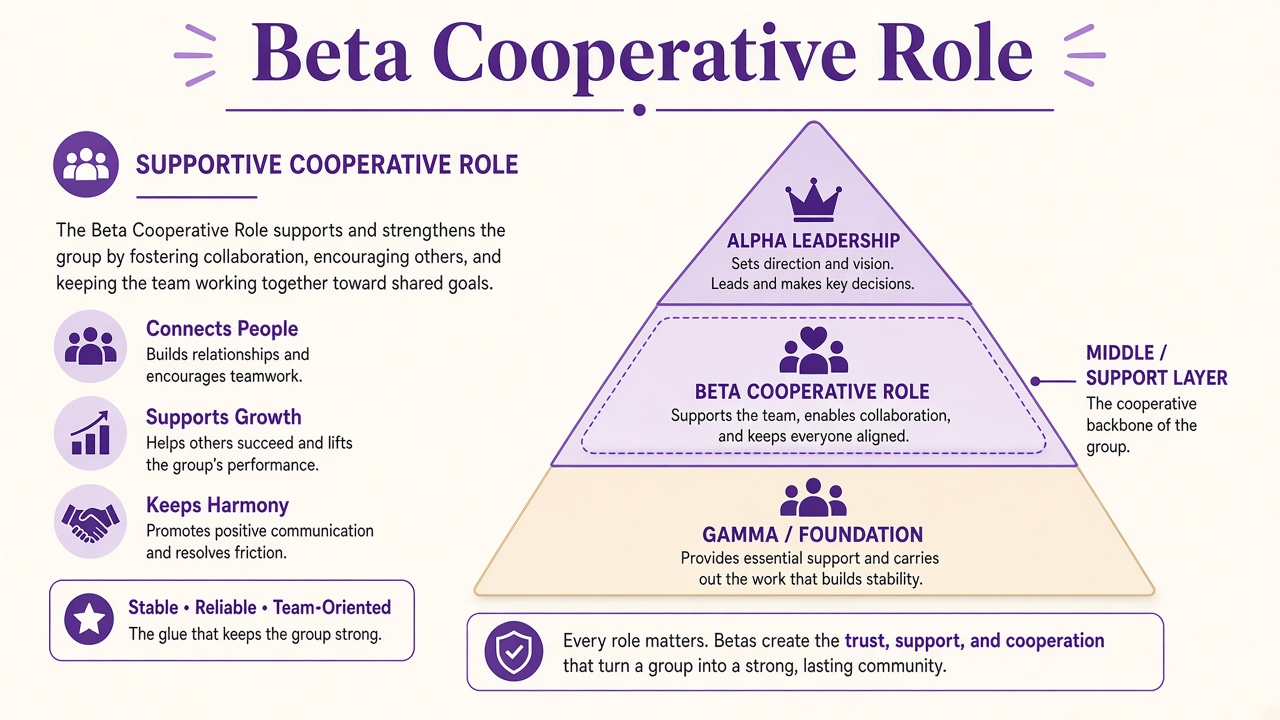
Meme culture often places alpha types at the visible top of a social pyramid and beta types as cooperative members inside the structure. Sigma types sit outside the circle. This diagram is illustrative, not a research model. Compare your beta score with our alpha male test and sigma personality test for the full hierarchy vocabulary.
What this test can and cannot tell you
Can tell you
- How strongly your self-report matches beta archetype items
- Which of four dimensions score highest for you
- A plain-language band for casual discussion or reflection
- A starting point to compare with our alpha and sigma hierarchy quizzes
Cannot tell you
- Whether you are a "real" beta, alpha, or sigma male
- Clinical personality traits or mental health status
- Dating worth, masculinity score, or relationship outcomes
- Job fit, leadership potential, or hiring suitability
Where the beta male label comes from
The beta male idea spread through pickup forums and self-help threads as the counterpart to alpha leadership and, later, sigma independence. Unlike research on agreeableness or social sensitivity, the Greek-letter nicknames simplify complex behavior into meme-friendly roles. Outlets such as Vox and Psychology Today have noted how wolf-pack metaphors were stretched far beyond what animal behavior studies actually support.
Researchers who study affiliation and status, such as work published in the Journal of Personality and Social Psychology, use validated scales rather than internet nicknames. This quiz uses pop-culture items, not those research instruments. If you want trait scores backed by studies, start with our Big Five personality test. For motivation patterns, try the Enneagram test. For the dominance-forward side of the same vocabulary, take the alpha male test. For the lone-wolf side, try the sigma male test on The Quiz Hub.
Sample item: "I volunteer for helper roles when a team project needs glue work." High agreement nudges your cooperative support score. Low agreement does not mean you are selfish; it may mean you lead instead of assist or work solo by preference. Context always matters more than a single label. Browse more quizzes on our personality psychology hub.
Beta male test FAQ
What is a beta male in pop culture?
Online communities use beta male to describe someone who aligns with group norms, reads social rank, seeks fair approval, and often plays supportive roles rather than chasing top status. The label comes from wolf-pack metaphors and meme culture, not peer-reviewed personality psychology.
How is this beta male test different from the alpha and sigma tests?
This quiz scores group alignment, validation seeking, cooperative support, and hierarchy awareness. Our alpha male test focuses on leadership and dominance. Our sigma personality test and sigma male test focus on independence outside hierarchy rather than followership inside it.
How long does the beta male test take?
Most people finish in about 6 minutes. There are 40 agree-disagree statements across four scored areas. You can pause and return in the same browser session.
Is the beta male archetype scientifically validated?
No. Alpha, beta, and sigma labels are pop-culture shorthand. They are not formal constructs in personality psychology like the Big Five or validated type inventories. Treat results as casual self-reflection.
What do the four dimension scores mean?
Group alignment covers following shared plans and group norms. Validation seeking measures approval sensitivity and reputation awareness. Cooperative support scores helper roles and harmony over dominance. Hierarchy awareness tracks pecking-order reading and polite deference.
Can women take this beta male test?
Yes. Items describe behaviors anyone might report. The name reflects search language for the archetype quiz, not a gate on who can answer.
Who reviewed this content?
Dr. James Whitfield, PhD, reviewed the test framing and result explanations. See our editorial policy for review standards.
Reviewed by