What this stay-or-leave quiz measures
This should I stay with my boyfriend after he cheated quiz estimates how often post-affair tension patterns show up while you weigh forgiveness against self-respect. Twenty original frequency items group into four stay-or-leave domains inspired by affair recovery research from Shirley Glass, Janis Spring, and Gottman Institute betrayal work: betrayal impact, trust erosion, partner accountability, and repair readiness. Each item also maps to a fear-of-intimacy stack layer so you can see whether vulnerability pull-back, trust hesitation, self-disclosure limits, or closeness anxiety drives confusion most. Your stay-or-leave clarity index averages these signals into a 0 to 100 score where higher numbers mean more tension endorsement on this screener.
Betrayal impact
Replay loops, body tension, hidden grief, and wondering whether love can feel safe again.
Trust erosion
Phone checks, assuming lies, edited sharing, panic when he is unreachable, and emotional pull-back.
Partner accountability
Blame-shifting and minimizing versus full ownership, transparency, and honest answers.
Repair readiness
Imagining relief if you left, fear-based staying, hope for therapy, forgiveness, and intimacy retry.
How it works
Three steps from first question to your stay-or-leave report with fear-of-intimacy stack. Click Start Quiz to open the interactive quiz in a full-screen modal.
Answer 20 frequency items
Rate how often each post-affair pattern shows up since you learned about the cheating, from Never to Almost always. You click Next after each answer; nothing auto-advances.
Items map to stay-or-leave domains and intimacy stack
Your answers accumulate percentages for betrayal impact, trust erosion, partner accountability, and repair readiness, plus four fear-of-intimacy stack layers.
View band, domain bars, and stack chart
Results show Clearer Stay Path, Mixed Stay-or-Leave Signals, or Stronger Leave-Leaning Clarity with domain bars, stack layers, and reflection prompts.
Take the should I stay after he cheated quiz
Rate 20 statements about life after the affair. Your answers produce a stay-or-leave clarity index from 0 to 100, four domain scores, a fear-of-intimacy stack chart, and a band label for reflection or repair talks.
Opens in a focused modal. No account required. Results stay on screen.
What your stay-or-leave clarity result means
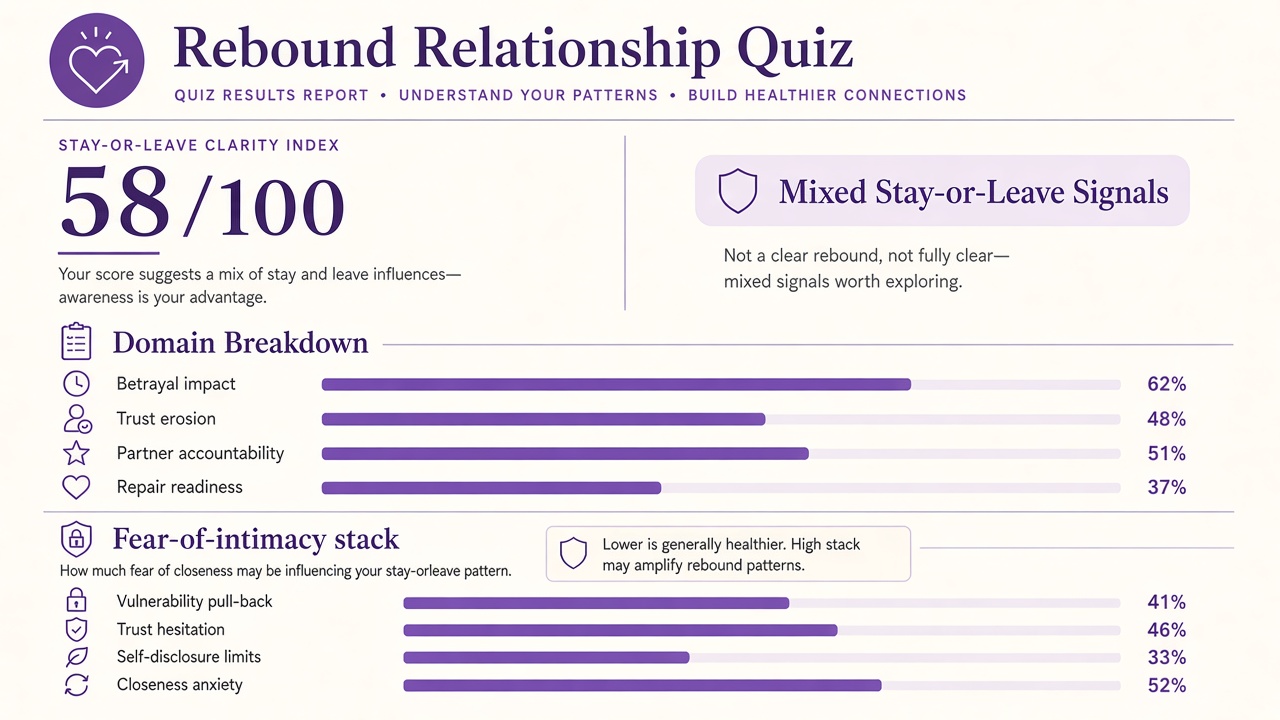
Your stay-or-leave clarity index is the normalized total across all 20 items on a 0 to 100 scale. Higher scores mean more frequent endorsement of betrayal impact, trust erosion, low accountability, and leave-leaning repair items on this screener. Domain bars show endorsement rates so you can see whether grief replay, hypervigilance, blame-shifting, or weak repair hope drives your result most. The fear-of-intimacy stack chart shows parallel layers for vulnerability pull-back, trust hesitation, self-disclosure limits, and closeness anxiety while you decide what comes next.
| Band | Index range | Typical reading |
|---|---|---|
| Clearer Stay Path | 0 to 35 | Fewer tension signals; accountability and repair may feel more workable on this screener |
| Mixed Stay-or-Leave Signals | 36 to 65 | Blend of love and unfinished betrayal work; worth naming triggers and repair needs |
| Stronger Leave-Leaning Clarity | 66 to 100 | Frequent betrayal impact, trust erosion, or low accountability; slow reconciliation pressure and seek support |
What your stay-or-leave report looks like
After all 20 items, you get a stay-or-leave clarity index from 0 to 100, a band label, four domain bars for betrayal impact, trust erosion, partner accountability, and repair readiness, plus a fear-of-intimacy stack chart with vulnerability, trust, disclosure, and closeness anxiety layers.
What this quiz can and cannot tell you
Can tell you
- How often stay-or-leave tension signals showed up in your self-report on this screener
- A stay-or-leave clarity index and four domain bars for betrayal, trust, accountability, and repair
- A fear-of-intimacy stack showing which closeness-avoidance layer feels strongest after the affair
- A starting point for therapy, disclosure talks, or boundary trials before a big decision
Cannot tell you
- Whether you should stay or leave without your own judgment, dialogue, and safety planning
- Whether he will cheat again or whether forgiveness is morally required
- Whether your relationship is doomed or worth saving in your specific context
- What legal, financial, or custody steps you need without licensed professional guidance
Betrayal impact, accountability, and repair readiness
Infidelity shatters the story partners tell about trust, safety, and who they are together. Psychologist Shirley Glass described how affairs create walls between partners and outside windows where needs get met elsewhere, while Janis Spring outlined how forgiveness can coexist with accountability when disclosure stays honest over time. The Gottman Institute frames betrayal recovery as rebuilding trust through small consistent actions, not one dramatic apology. Those frameworks help explain why staying sometimes works and sometimes does not: the question is rarely only whether you still love him, but whether accountability, transparency, and grief processing feel real enough to try again.
The Quiz Hub built this should I stay with my boyfriend after he cheated quiz as an original self-report screener inspired by those themes plus FOIS-style intimacy avoidance layers, not a reproduction of any single published instrument. Readers often compare it to sibling tools on this site. Our am I emotionally cheating quiz screens outside emotional bonds in your own behavior. The do I have trust issues quiz measures general trust hesitation across relationships, not post-affair repair with a specific partner. The trauma bond quiz screens cycle intensity and loyalty isolation in high-conflict bonds rather than one-time infidelity disclosure.
| The Quiz Hub test | What it adds |
|---|---|
| Am I emotionally cheating quiz | Outside emotional bond risk in your behavior, not post-affair stay-or-leave tension |
| Do I have trust issues quiz | General trust hesitation across partners, not accountability after he cheated |
| Trauma bond quiz | Cycle intensity and hope pendulum in high-conflict bonds, not affair repair readiness |
| Compatibility test | Values and lifestyle fit, not betrayal replay or partner accountability |
| Fear of intimacy quiz | General vulnerability avoidance, not post-affair stay-or-leave domains |
| This stay-or-leave quiz | Stay-or-leave clarity index plus fear-of-intimacy stack for betrayal, trust, accountability, and repair |
Sample item types include frequency ratings such as whether you check his phone because you do not believe his answers, or whether you feel genuine hope that couples therapy could rebuild trust. High betrayal impact with low partner accountability often lands in Mixed or Stronger Leave-Leaning Clarity. Consistent transparency, honest disclosure, and slowing reconciliation pressure can score in Clearer Stay Path even when grief still hurts. Read how we review quizzes in our editorial policy or browse more tools on our relationships and dating hub.
Should I stay after he cheated FAQ
Should I stay with my boyfriend after he cheated?
No online quiz can answer that for you. Shirley Glass and Janis Spring wrote influential guides on affair recovery showing that staying can work when accountability, transparency, and grief processing stay consistent over time, while leaving may fit when blame-shifting, repeated deception, or safety risks persist. This should I stay after he cheated quiz measures how often betrayal impact, trust erosion, low accountability, and weak repair readiness show up in your self-report. It is a reflection tool, not a command to stay or leave.
What does this stay-or-leave quiz measure?
Twenty original frequency items ask how often you notice betrayal replay, trust erosion, partner accountability gaps, and repair readiness signals since learning about the cheating. Scores map to four stay-or-leave domains plus a parallel fear-of-intimacy stack with vulnerability pull-back, trust hesitation, self-disclosure limits, and closeness anxiety layers. You receive a stay-or-leave clarity index from 0 to 100 where higher scores mean more tension signals on this screener, plus a band from Clearer Stay Path through Stronger Leave-Leaning Clarity.
What is the fear-of-intimacy stack on this quiz?
The fear-of-intimacy stack is a second results chart inspired by FOIS-style intimacy avoidance themes, adapted to post-affair decision-making. Each of the 20 items also maps to one of four stack layers: vulnerability pull-back, trust hesitation, self-disclosure limits, and closeness anxiety. The stack index summarizes how often you dodge affair talks, assume honesty will backfire, hide grief from others, or tense up during closeness while you weigh staying or leaving.
How is this different from the am I emotionally cheating quiz?
The am I emotionally cheating quiz screens secrecy and outside emotional bonds in your own behavior within a committed relationship. This stay-or-leave quiz focuses on your experience after your boyfriend cheated: betrayal impact, trust repair, his accountability, and your repair readiness. It uses a post-disclosure frequency frame rather than screening your outside confidants.
Can this quiz tell me to break up?
No. The stay-or-leave clarity index describes self-reported tension signals on this abbreviated screener. Love, finances, children, faith, or slow accountability repair can raise or lower scores without a single right answer. Only you plus honest reflection, dialogue, and professional support can define your next step. Online quizzes cannot confirm whether reconciliation will succeed.
Who reviewed this content?
Dr. Priya Sharma, PhD, reviewed the test framing and result explanations. See our editorial policy for review standards.
Reviewed by