What this am I emotionally cheating quiz measures
This am I emotionally cheating quiz estimates how often emotional affair pattern signals show up in your committed relationship. Twenty-two original frequency items group into four domains drawn from affair-recovery research: secrecy, emotional intimacy outside the relationship, comparison with your partner, and boundary crossing. Your emotional affair risk index averages these patterns into a 0 to 100 score with plain-language bands. It reflects your self-report about outside bonds, not your partner's hidden behavior.
Secrecy
Hiding messages, lying about contact, and relief when a friendship stays unmentioned.
Emotional intimacy outside
Sharing core feelings, seeking comfort, and turning to someone else before your partner.
Comparison
Ranking someone else above your partner, imagining alternate lives, and spark at outside attention.
Boundary crossing
Flirtation, fantasies about real people, crossing agreed limits, and loyalty pull.
How it works
Three steps from first question to your emotional affair risk report. Click Start Quiz to open the interactive quiz in a full-screen modal.
Answer 22 frequency items
Rate how often each outside-bond pattern shows up in your committed relationship, from Never to Almost always. You click Next after each answer; nothing auto-advances.
Items map to four affair-risk domains
Your answers accumulate percentages for secrecy, outside emotional intimacy, comparison, and boundary crossing, plus an overall emotional affair risk index.
View band and domain bars
Results show Lower, Mixed, or Higher Emotional Affair Risk with domain bars and reflection prompts. Higher bands include crisis resources.
Take the am I emotionally cheating quiz
Rate 22 statements about secrecy, outside emotional intimacy, comparison, and boundary crossing in your committed relationship. Your answers produce an emotional affair risk index from 0 to 100, four domain scores, and a band label for reflection or therapy conversation.
Opens in a focused modal. No account required. Results stay on screen.
What your result means
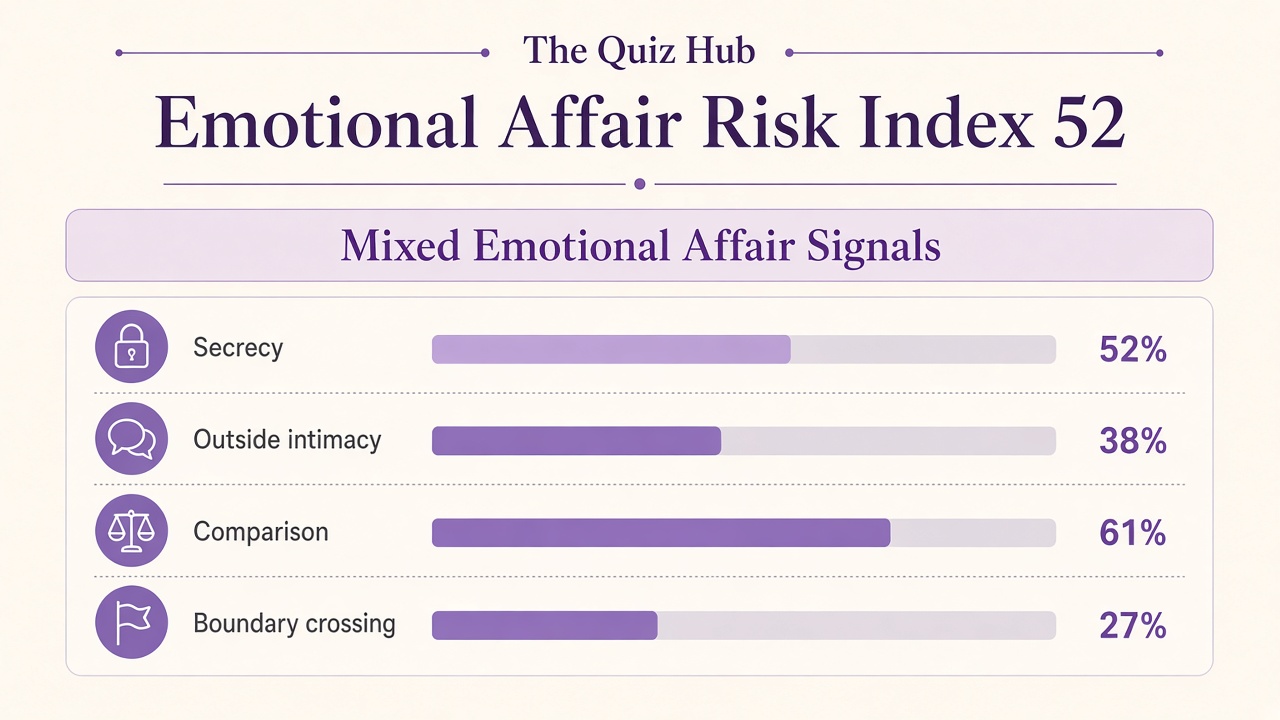
Your emotional affair risk index is the normalized total across all 22 items on a 0 to 100 scale, with reverse scoring on transparency and boundary-maintenance items so higher scores mean more risk overall. Domain bars show endorsement rates so you can see whether secrecy, outside intimacy, comparison, or boundary crossing drives your result most.
| Band | Index range | Typical reading |
|---|---|---|
| Lower Emotional Affair Risk | 0 to 35 | Fewer outside-bond pattern signals on this screener; close friendships can still exist without affair territory |
| Mixed Emotional Affair Signals | 36 to 65 | Blend of loyalty and outside connection; worth naming if a friendship deepens or stress pulls you away |
| Higher Emotional Affair Risk | 66 to 100 | Frequent secrecy, outside intimacy, comparison, or boundary crossing; couples therapy may help |
What your emotionally cheating report looks like
After all 22 items, you get an emotional affair risk index from 0 to 100, a band label, and four domain bars for secrecy, outside emotional intimacy, comparison, and boundary crossing. Percentages reflect how you handle outside bonds in a committed relationship, not proof that you have cheated.
What this quiz can and cannot tell you
Can tell you
- How often emotional affair pattern signals showed up for you in a committed relationship
- An emotional affair risk index and four domain bars for secrecy, outside intimacy, comparison, and boundaries
- Which domain pattern feels strongest in your current outside-bond habits
- A starting point for honest conversation, couples therapy, or retaking after a trust repair
Cannot tell you
- Whether you have emotionally cheated or whether your partner has cheated
- Whether your relationship should end without your own judgment and support
- Whether a close friendship is harmless or harmful without context only you know
- What treatment or next step you need without a licensed clinician's evaluation
Glass research, secrecy, and outside emotional bonds
Psychologist Shirley Glass published influential work on emotional affairs, including her book Not Just Friends (2003), describing how secrecy and outside confiding can rival physical infidelity in eroding trust. The Gottman Institute later framed betrayal as a wall between partners and an outside window where emotional needs get met elsewhere. Emotional cheating in everyday language often maps to those patterns: hiding contact, turning to someone else for core comfort, comparing your partner unfavorably, and letting flirtation or fantasies blur agreed limits.
The Quiz Hub built this am I emotionally cheating quiz as an original self-report screener inspired by those themes, not a reproduction of any single published instrument. Readers often compare it to sibling tools on this site. Our fear of intimacy quiz screens your own vulnerability avoidance and closeness pull-back habits. The do I have trust issues quiz measures hypervigilance and repair doubt rather than outside emotional bonds. The relationship test screens six partnership health domains from both sides rather than secrecy with someone outside the bond.
| The Quiz Hub test | What it adds |
|---|---|
| Fear of intimacy quiz | Your closeness avoidance habits, not outside emotional bonds or secrecy with someone else |
| Do I have trust issues quiz | Hypervigilance and reassurance seeking about partner honesty, not outside confiding frequency |
| Am I emotionally unavailable quiz | Hot-and-cold presence and intimacy caps with your partner, not bonds with someone outside |
| Relationship anxiety quiz | Reassurance seeking and jealousy scan worry, not secrecy or comparison with an outside friend |
| Compatibility test | Values and lifestyle fit bars, not affair-risk secrecy or boundary crossing |
| This emotionally cheating quiz | Four-domain emotional affair risk index for secrecy, outside intimacy, comparison, and boundaries |
Sample item types include frequency ratings such as whether you delete messages with someone you feel drawn to, or whether you seek emotional comfort from someone else after fights with your partner. High secrecy with high outside intimacy often lands in Mixed or Higher Emotional Affair Risk. Work friendships, grief seasons, and long-distance stress can spike scores temporarily without an affair. Read how we review quizzes in our editorial policy or browse more tools on our relationships and dating hub.
Am I emotionally cheating quiz FAQ
What is emotional cheating?
Emotional cheating refers to forming a close bond outside your committed relationship that rivals or replaces the emotional intimacy you share with your partner. Psychologist Shirley Glass described how secrecy, outside confiding, comparison, and blurred boundaries can erode trust before any physical affair occurs. This am I emotionally cheating quiz measures how often those pattern signals show up in your current relationship. It is not proof of cheating or a clinical diagnosis.
What does this emotionally cheating quiz measure?
Twenty-two original frequency items ask how often you experience secrecy, emotional intimacy outside the relationship, comparison with your partner, and boundary crossing when you think about your committed bond. Scores map to four domains drawn from affair-recovery research. You receive an emotional affair risk index from 0 to 100 and a band from Lower through Higher Emotional Affair Risk.
How is this different from the fear of intimacy quiz?
The fear of intimacy quiz screens your own vulnerability avoidance and closeness pull-back habits. This am I emotionally cheating quiz focuses on outside emotional bonds: hiding contact, confiding in someone else, comparing your partner, and crossing agreed limits. It uses a committed-relationship frequency frame rather than intimacy avoidance items alone.
Can this quiz prove I am emotionally cheating?
No. The emotional affair risk index describes self-reported pattern signals on this abbreviated screener. Close friendships, work stress, and cultural privacy norms can raise scores without an affair. Only you plus honest dialogue with your partner or a licensed therapist can interpret what your behavior means. Online quizzes cannot confirm or deny cheating.
What should I do if I get a higher emotional affair risk band?
Consider scheduling a session with a licensed couples therapist or individual counselor who treats affair recovery and trust repair. Bring your result summary and describe which domain feels hardest. If you feel unsafe, controlled, or in crisis, call or text 988 (US) or your local crisis line.
Who reviewed this content?
Dr. Priya Sharma, PhD, reviewed the test framing and result explanations. See our editorial policy for review standards.
Reviewed by