What this overthinking test measures
This overthinking test estimates how often repetitive thought patterns showed up over the past two weeks. Twenty-four original frequency items group into four domains drawn from rumination research: replaying past events, looping worries, decision paralysis, and social replay. Your rumination index averages these patterns into a 0 to 100 score with plain-language bands. It reflects your self-report, not a clinician's judgment.
Rumination replay
Replaying past events, rehashing mistakes, and struggling to let go of what already happened.
Worry loops
Repeating what-if chains, returning to unresolved worries, and mental loops that resist closure.
Decision paralysis
Over-researching choices, second-guessing after deciding, and freezing when options feel equally risky.
Social replay
Analyzing what you said after conversations, scanning others' reactions, and replaying awkward moments.
How it works
Three steps from first question to your overthinking report. Click Start Quiz to open the interactive test in a full-screen modal.
Answer 24 frequency items
Rate how often each thought pattern showed up in the past two weeks, from Never to Very often. You click Next after each answer; nothing auto-advances.
Items map to four thought domains
Your answers accumulate percentages for rumination replay, worry loops, decision paralysis, and social replay, plus an overall rumination index.
View band and domain bars
Results show Lower, Mixed, or Higher Overthinking with domain bars and reflection prompts. Higher bands include crisis resources.
Take the overthinking test
Rate 24 statements about repetitive thought patterns over the past two weeks. Your answers produce a rumination index from 0 to 100, four domain scores, and a band label for reflection or therapy conversation.
Opens in a focused modal. No account required. Results stay on screen.
What your result means
Your rumination index is the normalized total across all 24 items on a 0 to 100 scale, with reverse scoring on problem-solving items so higher scores mean more overthinking overall. Domain bars show raw endorsement rates so you can see whether replay, worry loops, decision paralysis, or social replay drives your result most.
| Band | Index range | Typical reading |
|---|---|---|
| Lower Overthinking | 0 to 35 | Fewer repetitive loops on this screener; brief second-guessing during stress may still appear |
| Mixed Overthinking | 36 to 65 | Blend of focused thinking and more frequent rumination; worth tracking if persistent |
| Higher Overthinking | 66 to 100 | Frequent replay, worry loops, or decision paralysis; professional support may help |
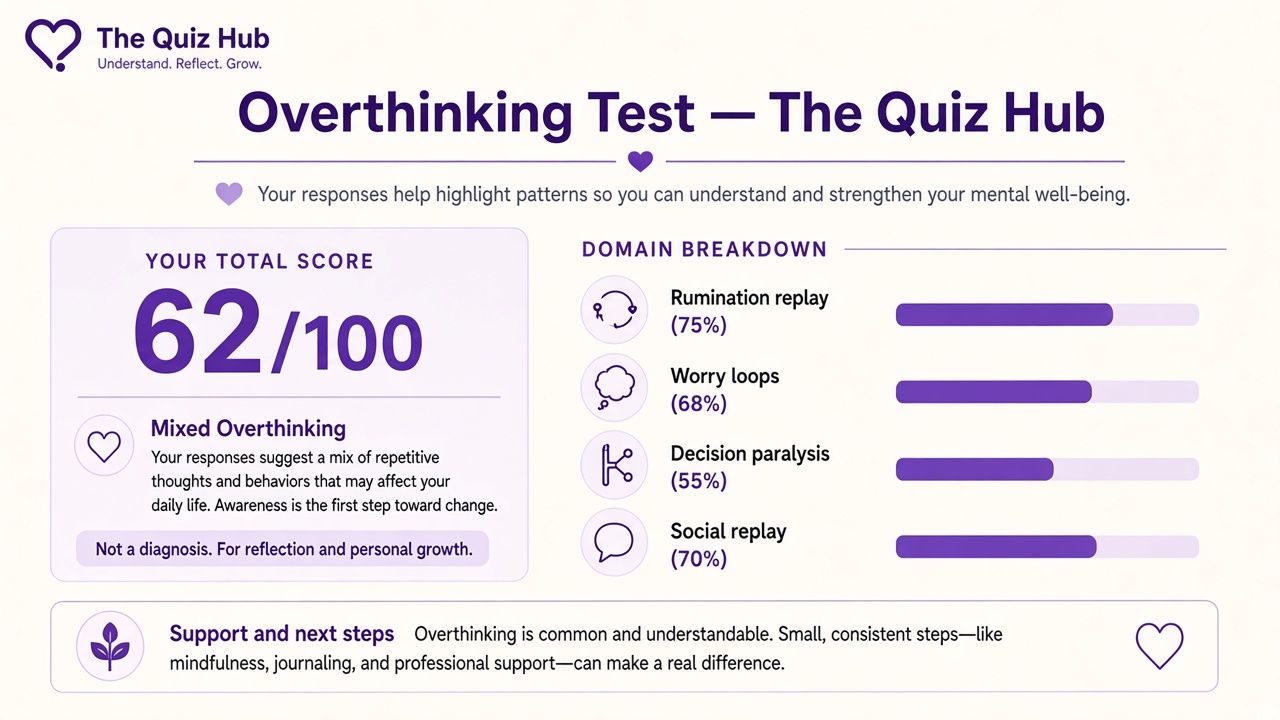
What your overthinking report looks like
After all 24 items, you get a rumination index from 0 to 100, a band label, and four domain bars for rumination replay, worry loops, decision paralysis, and social replay. Percentages reflect how you experience thought patterns, not a clinical verdict about your mind.
What this quiz can and cannot tell you
Can tell you
- How often repetitive thought patterns showed up for you in the past two weeks
- A rumination index and four domain bars for replay, worry loops, decision paralysis, and social replay
- Which domain pattern feels strongest in your current routine
- A starting point for therapy conversation or retaking after a calmer month
Cannot tell you
- Whether you have rumination disorder, GAD, depression, or any clinical diagnosis
- Whether your thinking style is permanently fixed or will never improve
- Whether you need medication without a licensed clinician's evaluation
- What treatment you need without structured professional assessment
Rumination, worry loops, and when thinking stops helping
Psychologist Susan Nolen-Hoeksema published foundational work on rumination in 1991, distinguishing repetitive focus on distress from active problem solving. Rumination tends to prolong low mood and reduce effective action because the mind revisits the same material without new conclusions. Overthinking in everyday language often maps to those patterns: replaying conversations, looping what-if scenarios, freezing on decisions, and scanning social cues long after an interaction ends.
The Quiz Hub built this overthinking test as an original self-report screener inspired by Nolen-Hoeksema's rumination framework, not a reproduction of any published clinical instrument. Readers often compare it to sibling tools on this site. Our anxiety test screens generalized worry and tension across life domains using GAD-style items. The am I anxious or normal quiz offers a broader anxiety snapshot with norm-reference framing. The depression test maps mood and anhedonia over two weeks rather than thought-loop frequency alone.
| The Quiz Hub test | What it adds |
|---|---|
| Anxiety test | Generalized worry and tension across life domains, not replay-specific loops |
| Am I anxious or normal quiz | Broader anxiety snapshot with norm-reference bands, not four rumination domains |
| Depression test | Mood and anhedonia frequency, not decision paralysis or social replay |
| Mental health test | Cross-domain wellbeing screener, not rumination-specific measurement |
| Relationship anxiety quiz | Partner-focused worry patterns, not general mental replay |
| This overthinking test | Four-domain rumination index for replay, worry loops, decision paralysis, and social replay |
Sample item types include frequency ratings such as whether you returned to the same worry after trying to distract yourself, or whether you made a reasonable decision without excessive back-and-forth. High rumination replay with high worry loops often lands in Mixed or Higher Overthinking. Sleep loss, deadlines, and social stress can spike scores temporarily. PHQ and GAD screeners measure mood and anxiety symptom clusters; this test targets repetitive cognition specifically. Read how we review quizzes in our editorial policy or browse more tools on our mental health and clinical hub.
Overthinking test FAQ
What is overthinking?
Overthinking usually means repetitive thought patterns that do not move you toward action: replaying past events, looping worries, second-guessing decisions, or analyzing social interactions long after they end. Psychologists often call persistent replay rumination. This overthinking test measures how often those patterns showed up for you in the past two weeks. It is not a clinical diagnosis.
What does this overthinking test measure?
Twenty-four original frequency items ask how often you experienced rumination replay, worry loops, decision paralysis, and social replay over the past two weeks. Scores map to four domains inspired by Susan Nolen-Hoeksema's rumination research (1991). You receive a rumination index from 0 to 100 and a band from Lower through Higher Overthinking.
How is this different from the anxiety test?
The anxiety test screens generalized worry, tension, and restlessness across life domains using GAD-style items. This overthinking test focuses on repetitive thought loops: mental replay, decision paralysis, and post-conversation analysis. Both use a two-week frequency frame but measure different symptom patterns.
Can this quiz diagnose rumination disorder or GAD?
No. The rumination index describes self-reported thought patterns on this abbreviated screener. Only a licensed clinician can evaluate rumination, generalized anxiety, depression, or related conditions through structured interviews. Online quizzes cannot confirm or deny a diagnosis.
What should I do if I get a higher overthinking band?
Consider scheduling an evaluation with a licensed therapist who treats anxiety or mood concerns. Bring your result summary and describe which domain feels hardest. If you feel unsafe or in crisis, call or text 988 (US) or your local crisis line.
Who reviewed this content?
Dr. Elena Vasquez, PhD, reviewed the test framing and result explanations. See our editorial policy for review standards.
Reviewed by