What this Waterman Ginsberg test measures
This Waterman Ginsberg test estimates ego identity status from two processes James Marcia paired in 1966: exploration (questioning and sampling alternatives) and commitment (settled, self-chosen priorities). Thirty-two original items group into four life domains without using the published EIPQ or EOM-EIS wording.
Career and study direction
Whether you compare paths, defend current goals, or feel unsure about professional direction.
Values and beliefs
How much you test moral or political views versus holding firm, chosen principles.
Relationships and social roles
Exploration of partner and friend roles alongside commitment to relationship style.
Self-definition and integration
Discovery of personal identity versus a coherent sense of self across settings.
How it works
Three steps from first question to your identity status band. Click Start Test to open the interactive quiz in a full-screen modal.
Answer 32 identity items
Rate each statement on a five-point agree-disagree scale. There is no timer and no auto-advance between items.
Items map to exploration and commitment
Sixteen items score exploration and sixteen score commitment across four life domains.
View status and matrix
Results show Achievement, Moratorium, Foreclosure, or Diffusion, a two-by-two matrix marker, and per-domain bars.
Take the Waterman Ginsberg test
Rate 32 identity status statements on a five-point scale. Your answers produce exploration and commitment percentages and one of four Marcia-inspired status labels with a domain breakdown chart.
Opens in a focused modal. No account required. Results stay on screen.
What your result means
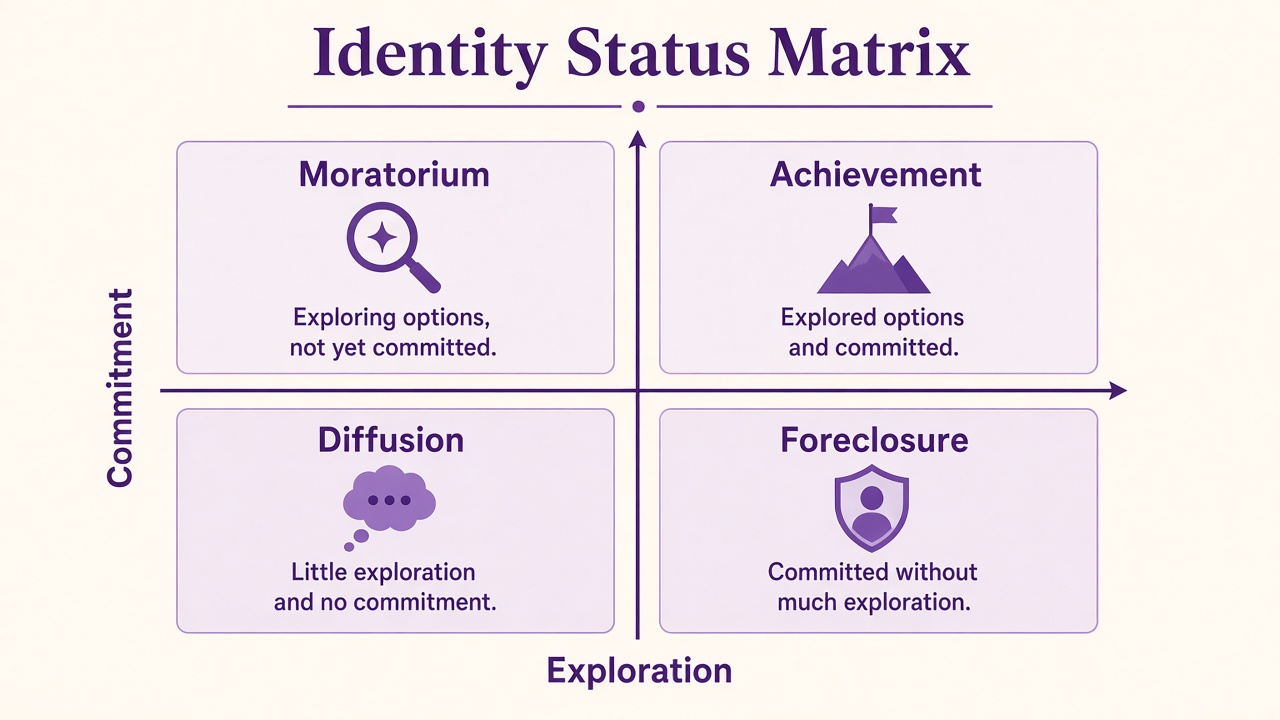
Exploration and commitment scores are each normalized to 0 through 100 percent from sixteen items. Your primary status comes from whether each score sits above or below the 50 percent midpoint on Marcia's classic matrix. Domain bars show which life area drives your overall pattern.
| Identity status | Exploration | Commitment | Typical reading |
|---|---|---|---|
| Achievement | High (50%+) | High (50%+) | Explored alternatives and settled on self-chosen priorities |
| Moratorium | High (50%+) | Low (below 50%) | Active questioning without firm commitments yet |
| Foreclosure | Low (below 50%) | High (50%+) | Strong commitments with limited personal exploration |
| Diffusion | Low (below 50%) | Low (below 50%) | Low exploration and low commitment across domains |
Exploration and commitment matrix
The diagram below shows how Marcia's four statuses map onto exploration and commitment axes. A high values score with low career commitment might still land you in Moratorium if overall exploration exceeds commitment.
What this test can and cannot tell you
Can tell you
- Whether your self-report pattern leans toward Achievement, Moratorium, Foreclosure, or Diffusion
- Separate exploration and commitment percentages for reflection
- Which of four life domains score highest toward questioning or settled priorities
- A starting point for conversations about identity development with a counselor or mentor
Cannot tell you
- Official EIPQ or Ginsberg EOM-EIS scores comparable to published research norms
- Whether you have a personality disorder or need psychiatric treatment
- Whether you should be hired, admitted, or cleared for any high-stakes decision
- A fixed identity label that never shifts with age, culture, or life events
Marcia, Waterman, and Ginsberg identity research
In 1966, James Marcia extended Erik Erikson's identity stage theory with four ego identity statuses defined by exploration and commitment: Achievement, Moratorium, Foreclosure, and Diffusion. Marcia's identity status interview became a foundation for adolescent and young-adult research on how people choose values, careers, and roles.
Alan S. Waterman and colleagues later developed the Ego Identity Process Questionnaire (EIPQ) to measure exploration and commitment as continuous processes rather than interview categories. Ruthie Weinstein-Ginsberg contributed to extended objective measures of ego identity status (EOM-EIS) that operationalized Marcia's statuses in self-report form. Full validation requires those published instruments and norms, not a shortened web quiz.
The Quiz Hub built this Waterman Ginsberg test as an abbreviated, plain-language screener inspired by those exploration-commitment themes. It uses 32 original items and a two-by-two status matrix rather than the full EIPQ item bank. That trade-off favors readability for casual users while naming Marcia (1966), Waterman, and Ginsberg sources honestly.
| The Quiz Hub test | What it adds |
|---|---|
| Enneagram motivation test | Nine core motivations and stress patterns, not exploration-commitment status |
| Emotional maturity self-assessment | Regulation and responsibility bands, not Marcia status categories |
| Chronotype test (MEQ) | Morning-evening rhythm, not identity development processes |
| This Waterman Ginsberg test | Exploration and commitment scores with four Marcia-inspired status labels |
Sample item: agreeing that you actively read viewpoints that challenge your beliefs raises your values exploration score. Agreeing that you follow family values without personal reflection lowers commitment and can push results toward Foreclosure. Identity develops across years, so retake after major life transitions if your status feels outdated. Browse more options on our personality psychology hub or read how we review quizzes in our editorial policy.
Waterman Ginsberg test FAQ
What is the Waterman Ginsberg test?
The Waterman Ginsberg test on The Quiz Hub is a 32-item self-report screener inspired by ego identity status research from James Marcia, Alan S. Waterman, and Ruthie Weinstein-Ginsberg. It estimates whether your current pattern looks like Achievement, Moratorium, Foreclosure, or Diffusion based on exploration and commitment scores.
What are the four ego identity statuses?
Marcia defined four statuses from two dimensions: exploration (questioning alternatives) and commitment (settled self-chosen priorities). Achievement combines high exploration with high commitment. Moratorium is high exploration with low commitment. Foreclosure is low exploration with high commitment. Diffusion is low on both.
How is this related to Waterman and Ginsberg research?
Alan S. Waterman developed the Ego Identity Process Questionnaire (EIPQ) to measure exploration and commitment processes. Ruthie Weinstein-Ginsberg contributed to extended objective measures of ego identity status. Our online version uses original plain-language items inspired by those themes. It is not the published EIPQ or EOM-EIS and is not validated for research or clinical use.
Can my identity status change over time?
Yes. Identity status describes a process snapshot, not a permanent label. Moratorium often precedes Achievement in late adolescence and early adulthood. Foreclosure can shift after deliberate re-examination. Diffusion may reflect a season of stress rather than a fixed trait.
Is this Waterman Ginsberg test a clinical assessment?
No. Results are educational self-report only. They cannot diagnose personality disorders, guide treatment, or replace counseling with a licensed mental health professional. See a clinician if identity confusion blocks daily functioning or safety.
How long does the Waterman Ginsberg test take?
Most people finish in about 7 minutes. There are 32 items on a five-point agree-disagree scale. You can pause and return in the same browser session.
Who reviewed this content?
Dr. James Whitfield, PhD, reviewed the test framing and result explanations. See our editorial policy for review standards.
Reviewed by