What this love calculator paper page offers
This love calculator paper page combines an interactive name tool with an educational walkthrough of the schoolyard folded-paper trick. You supply two first names; the calculator normalizes letters, crosses out shared pairs, counts what remains, and maps the count to a novelty percentage with every step shown on screen. It does not measure real chemistry or long-term fit.
Interactive calculator
Enter two first names in a focused modal and get an instant paper love percentage with a copyable results summary.
Disclosed letter math
Cross-out counts, remaining letters, digit reduction, and alphabet-position tie-break are listed so the score is never mysterious.
Manual paper guide
Step-by-step instructions below teach the handwritten version you may remember from notebooks or playground games.
Honest novelty limits
Playful Spark, Steady Match, and Strong Bond bands label the percentage without pretending to predict romance.
How the paper love calculator works
Three steps from names to percentage. Click Open Calculator to launch the interactive tool, or follow the handwritten method in the next section.
Enter two first names
Type first names only. The tool strips spaces and punctuation, then keeps a-z letters so Alex and A.L.E.X. behave the same.
Cross out shared letters
Each letter that appears in both names is removed once from each side, matching the classic pairwise cross-out on folded paper.
Count, reduce, and read the band
Remaining letters are totaled, digit-summed while above 99, adjusted by a fixed alphabet-position tie-break, then mapped to Playful Spark, Steady Match, or Strong Bond.
Try the love calculator paper tool
Enter two first names to run the folded-paper letter trick digitally. Your percentage is deterministic: the same names always produce the same result on The Quiz Hub.
Opens in a focused modal. No account required. Novelty only.
How to do the love calculator paper trick by hand
Before phone apps, students folded notebook paper and ran this name game during lunch breaks. The steps below mirror what our digital tool automates.
Write both first names
Stack the names vertically on lined paper. Many versions use first names only because nicknames change the letter count.
Cross out matching letters
For each letter in the top name, find the same letter in the bottom name and cross out one pair. Each match consumes one instance on each side.
Count uncrossed letters
Add the remaining letters from both names. If the total exceeds 99, add the digits together repeatedly until you reach a two-digit number.
Read the love percentage
Playground rules treated that final number as a love percentage. The Quiz Hub adds a small alphabet-position tie-break so tied counts still resolve consistently online.
For a written tutorial with the same steps, see our guide how to find love percentage on paper.
What your paper love percentage means
Bands translate the final number into plain language. They describe the novelty scale only, not whether a relationship should start, continue, or end.
| Band | Percentage range | Typical reading |
|---|---|---|
| Playful Spark | 1 to 39 | Lower letter overlap on paper; treat as light playground energy |
| Steady Match | 40 to 69 | Middle range after cross-outs; common among many name pairs |
| Strong Bond | 70 to 99 | Higher paper score from remaining letters; still not scientific proof |
Paper method at a glance
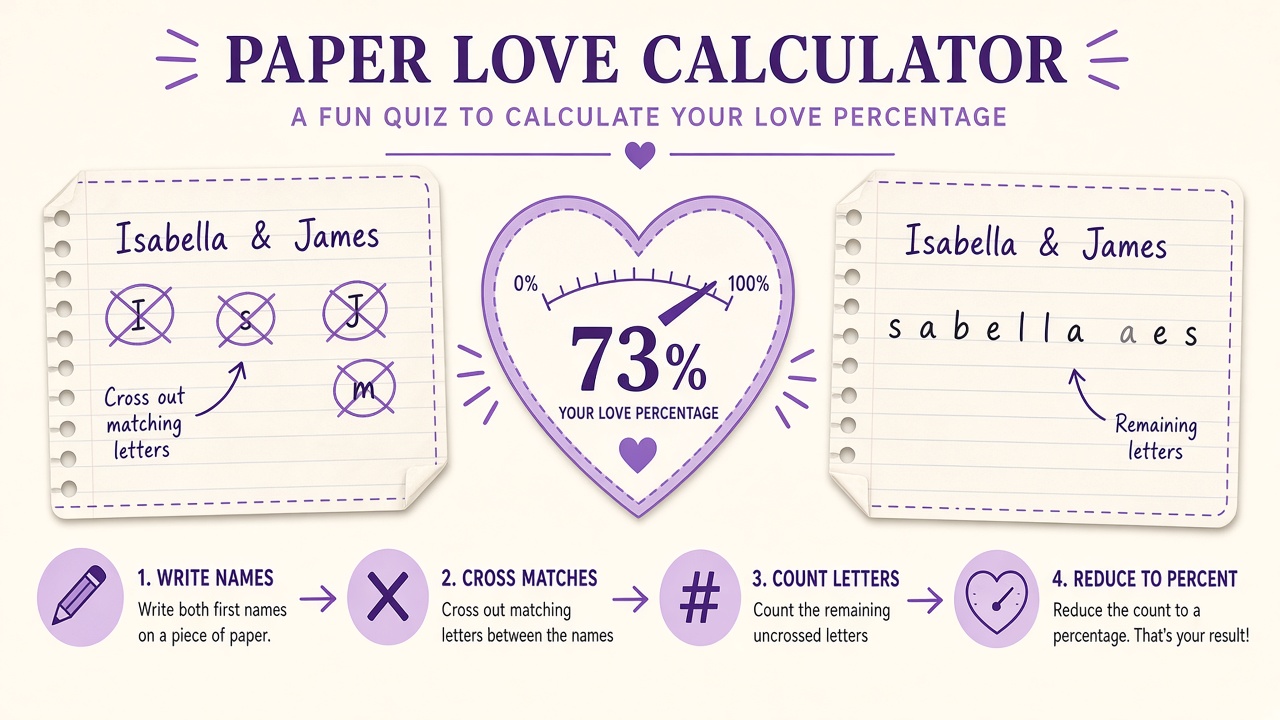
The diagram summarizes write, cross, count, and reduce. Your live result also lists the exact letters that remained after cross-outs.
What this love calculator can and cannot tell you
Can tell you
- A deterministic paper love percentage for two typed first names
- How many letters were crossed out and which letters remained
- The digit-reduction and alphabet-position steps used on The Quiz Hub
- A playful band label for sharing or nostalgia
Cannot tell you
- Real compatibility, attraction, or long-term relationship success
- Whether someone loves you or whether you should date them
- A scientifically validated match score or personality overlap
- Different results on purpose; randomness is not part of this method
Why paper love calculators became a playground staple
Folded-paper name games spread through schools long before smartphones because they need only a pencil and two willing participants. Sociologist Viviana Zelizer wrote about how children practice economic and emotional scripts through playful rituals; playground love percentages fit that pattern. They let friends test crushes safely, laugh at high scores, and dramatize uncertainty without asking anyone out loud. The math feels official even though every classroom used slightly different tie-break rules.
The Quiz Hub built this hybrid page so readers can learn the handwritten steps and run the same logic instantly. If you want reflection instead of novelty, start with our compatibility test, which scores values alignment, communication, conflict repair, and lifestyle fit across thirty items. When you are sorting butterflies from friendship, the crush quiz maps excitement, proximity desire, and nervous energy with clear bands. For a deeper written walkthrough of the manual version, bookmark how to find love percentage on paper (guide launching soon).
| The Quiz Hub tool | What it adds |
|---|---|
| Compatibility test | Four-domain self-report index for values, communication, repair, and lifestyle fit |
| Crush quiz | Twenty-item crush intensity screener with domain bars, not letter games |
| Love language test | Chapman-inspired care preference domains for how you give and receive affection |
| Soulmate initial quiz | Playful initial cluster from scenario items, not name letter counts |
| This love calculator paper | Deterministic paper letter cross-out percentage with disclosed steps |
Example: crossing Alex and Jordan removes a, j, and r pairs, leaving e, x, and o, d, n. Seven remaining letters digit-reduce to 7, then the alphabet-position tie-break adjusts the final percentage shown in the modal. Change a single letter in either name and the cross-out pattern shifts, which is why classmates retried the game endlessly. Read how we review relationship tools in our editorial policy or browse more quizzes on the relationships and dating hub.
Love calculator paper FAQ
How does the paper love calculator work?
You write two first names, cross out letters that appear in both names once each, count the remaining letters, reduce the count by adding digits when it exceeds 99, then apply a small alphabet-position tie-break. The Quiz Hub runs the same steps digitally so the percentage is deterministic for a given pair of names.
Is a paper love calculator accurate?
No. The paper method is a schoolyard novelty trick with arbitrary math. It cannot measure real compatibility, attraction, or relationship success. Treat the percentage as nostalgic fun or a conversation starter, not evidence about your bond.
Why do different websites show different love percentages?
Sites may use different tie-break rules, include spaces or surnames, or add randomness. The Quiz Hub discloses every step: letter normalization, pairwise cross-outs, digit reduction, and a fixed alphabet-position adjustment. Same two first names always produce the same result here.
Can I use full names instead of first names?
This tool is built for first names because that is how most folded-paper tricks spread in classrooms. Middle names or surnames change the letter count and therefore the percentage. For a research-informed compatibility snapshot, try our compatibility test instead.
How is this different from a crush quiz or compatibility test?
Crush quizzes measure your self-reported feelings with Likert items. Compatibility tests score values, communication, repair, and lifestyle domains. This love calculator paper page runs a letter-matching game only. It is faster and more playful, with explicit limits on every results screen.
Who reviewed this content?
Dr. Priya Sharma, PhD, reviewed the test framing and result explanations. See our editorial policy for review standards.
Reviewed by