
What this cognitive reflection test measures
This cognitive reflection test blends five logic-trap multiple-choice items with ten agree-disagree reflection statements. Trap items reward slowing down when the intuitive answer is wrong. Likert items screen impulse control, answer checking, and metacognition habits that support reflective thinking in daily quizzes and puzzles.
Reflective trap accuracy
Whether you resist intuitive wrong answers on price-split, proportional, doubling, race-position, and shared-resource traps.
Impulse control
Pausing before answering and resisting first-instinct picks on questions that feel easy.
Answer checking
Re-reading questions, verifying math, and working through logic when two options seem right.
Metacognition
Noticing rushed thinking and recognizing when a question is designed to trip fast guesses.
How it works
Three steps from first trap to your cognitive reflection band. Click Start Cognitive Reflection Test to open the interactive quiz in a full-screen modal.
Answer 5 logic traps
Five multiple-choice items use original wording inspired by viral bat-and-ball style brain teasers. Each has an intuitive wrong option and a reflective correct answer.
Rate 10 reflection habits
Ten agree-disagree statements cover impulse control, answer checking, and metacognition on a five-point scale. Some items are reverse-coded.
View accuracy and domain chart
Results show reflective trap accuracy, a reflection style index, a cognitive reflection index from 0 to 100, one of three bands, and four domain bars.
Take the cognitive reflection test
Solve five logic traps and rate ten reflection habits about how you answer puzzles and brain teasers. Your answers produce reflective trap accuracy, three style domain bars, and one of three cognitive reflection bands.
Opens in a focused modal. No account required. Results stay on screen.
What your result means
Your cognitive reflection index blends reflective trap accuracy (70 percent) with reflection-style habits (30 percent) on a 0 to 100 scale. Reflective trap accuracy is simply the share of five traps you answered correctly. The band label groups that blended score into plain-language stages for self-reflection.
| Reflection band | Index range | Typical reading |
|---|---|---|
| High Intuitive Responder | 0% to 35% | More intuitive wrong answers on traps; habits may still show checking strength |
| Mixed Reflective Pattern | 36% to 65% | Blend of trap hits and misses; domain chart shows which habit lags |
| Strong Cognitive Reflection | 66% to 100% | Most traps correct plus stronger reflection-habit agreement |
What your cognitive reflection report looks like
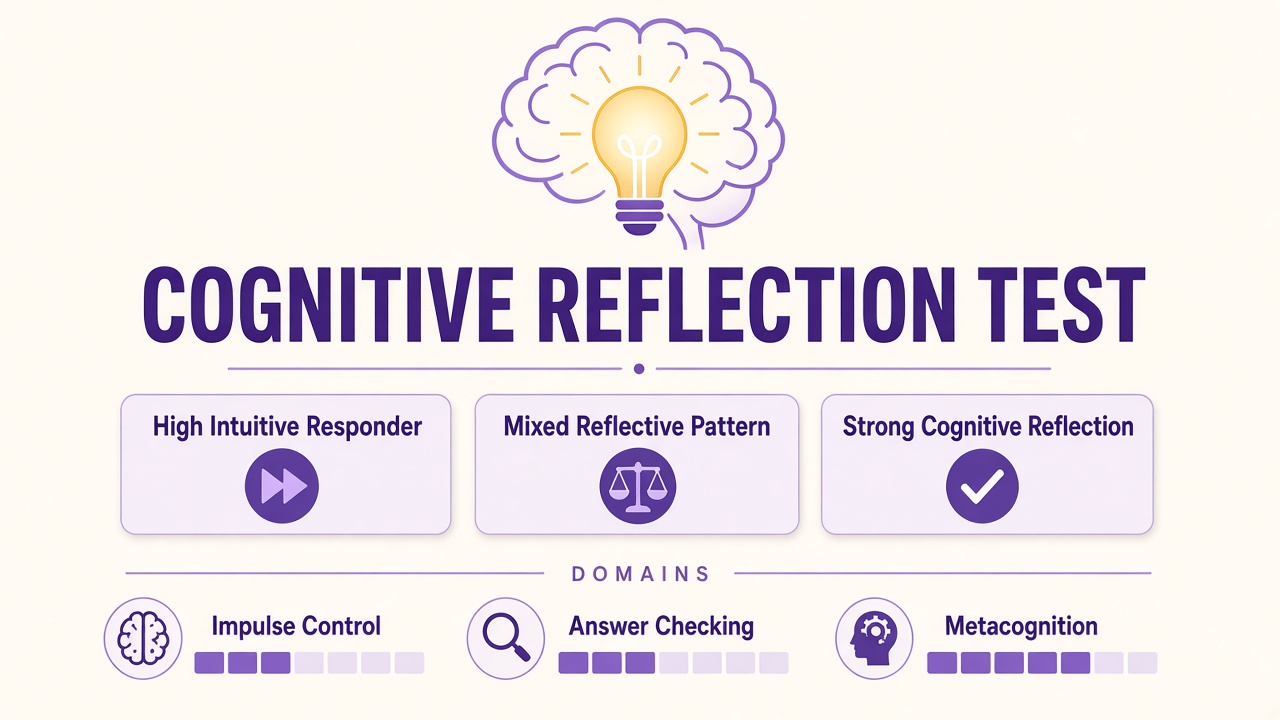
Your report opens with a band label such as Mixed Reflective Pattern, a cognitive reflection index percentage, reflective trap accuracy (for example 3 of 5 correct), and a reflection style index. Below that, four horizontal bars rank trap accuracy plus impulse control, answer checking, and metacognition from lowest to highest so you can spot whether habits or trap difficulty drove the result.
What this test can and cannot tell you
Can tell you
- How often you resist intuitive wrong answers on five original trap items
- Self-reported impulse control, checking, and metacognition habits today
- A band label and percentage for reflection practice
- Which reflection domain bar scores lowest on this snapshot
Cannot tell you
- Your official Frederick (2005) CRT score or MIT research result
- A real IQ score, percentile, or Mensa qualification
- Clinical reasoning ability or neuropsychological capacity
- Whether you will always think reflectively under stress or time pressure
Cognitive reflection, Frederick CRT, and viral brain teasers
Shane Frederick introduced the Cognitive Reflection Test in a 2005 paper studying how people answer questions where intuition conflicts with logic. The famous bat-and-ball problem is the best-known example: a bat and ball cost $1.10, the bat costs $1.00 more than the ball, and many adults say the ball costs $0.10 even though the correct answer is $0.05. TikTok repackaged similar traps for millions of views, which is why reflection quizzes surged in 2025 and 2026.
Our five trap items use original wording. Sample trap: a sketchbook and pencil cost $1.30 total, the sketchbook costs $1.00 more than the pencil, so the pencil is $0.15 (not $0.30). Sample habit item: agreeing that you re-read a question to check for tricks raises your answer-checking score. The cognitive reflection index weights trap accuracy at 70 percent and reflection habits at 30 percent.
For broader reasoning practice, take our live IQ test with twenty-eight logic puzzles. For daily engagement habits, take our live brain test. For attention warm-up, take our live focus test. For multi-domain aptitude practice, take our live aptitude test. Read how we review quizzes in our editorial policy.
Cognitive reflection test FAQ
What is a cognitive reflection test?
A cognitive reflection test measures whether you slow down on logic problems where the fast, intuitive answer is wrong. Shane Frederick published the original Cognitive Reflection Test (CRT) in 2005 with bat-and-ball style items. The Quiz Hub version uses five original trap questions plus ten reflection-habit statements. Results show reflective trap accuracy, three style domains, and a band such as High Intuitive Responder, Mixed Reflective Pattern, or Strong Cognitive Reflection. It is a practice screener, not MIT research or an IQ certificate.
Is this the official MIT CRT?
No. This is an original expanded practice quiz inspired by the viral bat-and-ball trend on TikTok and Frederick (2005) CRT research. We do not copy Frederick items verbatim and we do not issue official CRT scores. Use results for self-reflection and puzzle practice only.
How long does the cognitive reflection test take?
Most people finish in about six minutes. There are fifteen items: five multiple-choice logic traps and ten agree-disagree reflection statements. You can pause and return in the same browser session thanks to autosave.
What is reflective trap accuracy?
Reflective trap accuracy is the percentage of five logic-trap items you answered correctly. Each trap has an intuitive wrong option and a reflective correct option. Five correct equals 100 percent accuracy. That score blends with reflection-style habits (70 percent traps, 30 percent habits) into a cognitive reflection index from 0 to 100.
How is this different from an IQ test?
The IQ test on The Quiz Hub scores many logic and pattern puzzles for a practice index. This cognitive reflection test focuses on resisting intuitive wrong answers on classic-style traps plus self-reported checking habits. Neither replaces licensed psychometric testing.
Who reviewed this content?
Dr. James Whitfield, PhD, reviewed the test framing and result explanations. See our editorial policy for review standards.
Reviewed by
