What the shortest IQ test measures
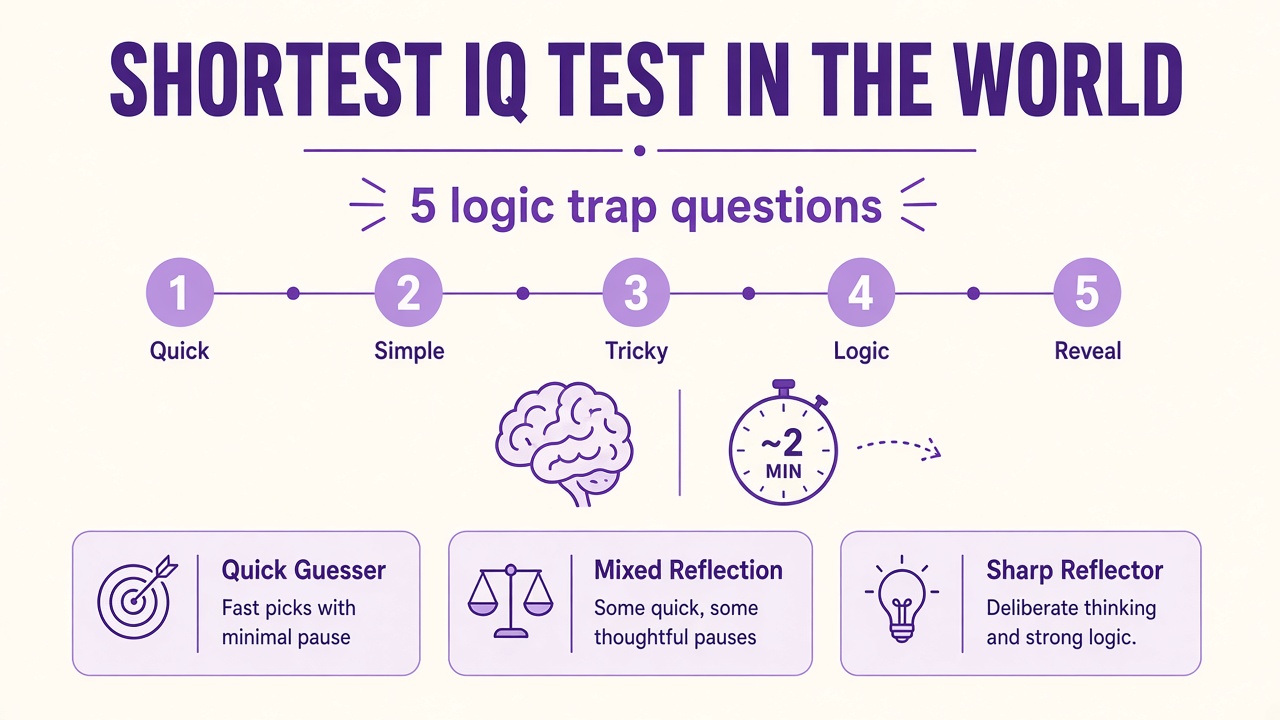
The shortest IQ test in the world measures whether you slow down on five logic problems where the fast, intuitive answer is wrong. Each trap uses original wording inspired by viral brain-teaser trends and Shane Frederick cognitive reflection research. Your trap score is simply how many of five traps you answered correctly, shown as a percentage and grouped into one of three reflection bands.
Price split traps
Whether you catch when one item costs more than the total difference suggests.
Proportional reasoning
Whether you scale workers and tasks correctly instead of matching numbers blindly.
Doubling traps
Whether you remember exponential growth halves one step before full coverage.
Race and resource traps
Whether you track position when passing someone and shared tools that do not multiply time.
How it works
Three steps from first trap to your shortest IQ test band. Click Start Shortest IQ Test to open the interactive quiz in a full-screen modal.
Answer 5 logic traps
Five multiple-choice items use original wording with four options each. Each has an intuitive wrong answer and a reflective correct answer.
Submit every question
Use Back and Next to move through traps. The quiz does not auto-advance when you pick an option.
View trap score and band
Results show trap score 0 to 100, correct count out of five, one of three bands, and a trap-by-trap breakdown chart.
Take the shortest IQ test in the world
Solve five original logic traps in about two minutes. Your answers produce a trap score from 0 to 100 and one of three reflection bands plus a per-trap chart.
Opens in a focused modal. No account required. Results stay on screen.
What your result means
Trap score equals traps correct divided by five, multiplied by 100. The band label groups that percentage into plain-language stages for self-reflection. Two correct traps equals 40 percent and lands at the top of Quick Guesser. Four correct equals 80 percent and opens Sharp Reflector.
| Reflection band | Trap score | Typical reading |
|---|---|---|
| Quick Guesser | 0% to 40% | More intuitive wrong answers on traps; common on first viral-hook pass |
| Mixed Reflection | 41% to 79% | Blend of trap hits and misses; chart shows which trap type tripped you |
| Sharp Reflector | 80% to 100% | Most traps correct after slowing down; still not a real IQ certificate |
What your shortest IQ test report looks like
Your report opens with a band label such as Mixed Reflection, a trap score percentage, and correct count out of five. Below that, five horizontal bars mark each trap as correct or missed so you can spot whether price-split, doubling, or race-position items drove the result.
What this test can and cannot tell you
Can tell you
- How often you resist intuitive wrong answers on five original trap items today
- A trap score percentage and band label for puzzle practice
- Which trap types you missed on this two-minute snapshot
- A curiosity baseline before trying the longer cognitive reflection test
Cannot tell you
- Your real IQ score, percentile, or Mensa qualification
- Official Frederick (2005) CRT results or MIT research scores
- Clinical reasoning ability or neuropsychological capacity
- Whether you will always think reflectively under stress or time pressure
Why viral shortest-IQ hooks use logic traps
Social feeds repackage classic cognitive reflection puzzles as shortest IQ tests because five traps fit a scroll-stopping hook. Shane Frederick published the Cognitive Reflection Test in 2005 showing that many adults endorse intuitive wrong answers on bat-and-ball style problems even when they can solve harder math elsewhere. The curiosity is not raw intelligence but whether you pause when a question feels too easy.
Our five traps use original wording. Sample trap: a novel and bookmark cost $1.40 total, the novel costs $1.20 more than the bookmark, so the bookmark is $0.10 (not $0.20). Trap score is traps correct divided by five. That formula differs from our cognitive reflection test, which adds ten reflection-habit items and blends trap accuracy with style domains.
For broader reasoning practice, take our live IQ test with twenty-eight logic puzzles. For daily engagement habits, take our live brain test. For multi-domain aptitude warm-up, take our live aptitude test. Read how we review quizzes in our editorial policy.
Shortest IQ test FAQ
What is the shortest IQ test in the world?
On The Quiz Hub, the shortest IQ test in the world is a five-question logic-trap quiz inspired by viral brain-teaser hooks and cognitive reflection research. Each item has an intuitive wrong answer and a reflective correct answer. Your trap score is the share of five traps you answered correctly, converted to a percentage from 0 to 100. It is a practice curiosity quiz, not a real IQ score or Mensa exam.
Is this a real IQ test?
No. This is a recreational five-item logic-trap screener for mental warm-up and self-reflection. It does not report a normed IQ score, percentile, or Mensa qualification. Formal IQ testing requires standardized instruments such as the WAIS with proctored administration.
How is the shortest IQ test scored?
Trap score equals traps correct divided by five, multiplied by 100. Five correct equals 100 percent. Bands group that score into Quick Guesser (0 to 40 percent), Mixed Reflection (41 to 79 percent), or Sharp Reflector (80 to 100 percent). Partial answers never show results.
How is this different from the cognitive reflection test?
The cognitive reflection test on The Quiz Hub has fifteen items: five logic traps plus ten reflection-habit statements with domain bars and a blended index. This shortest IQ test keeps only five original trap questions for a roughly two-minute curiosity hook. Take the cognitive reflection test when you want a longer reflective snapshot.
How long does the shortest IQ test take?
Most people finish in about two minutes. There are five multiple-choice logic traps with four options each. You can pause and return in the same browser session thanks to autosave.
Who reviewed this content?
Dr. James Whitfield, PhD, reviewed the test framing and result explanations. See our editorial policy for review standards.
Reviewed by